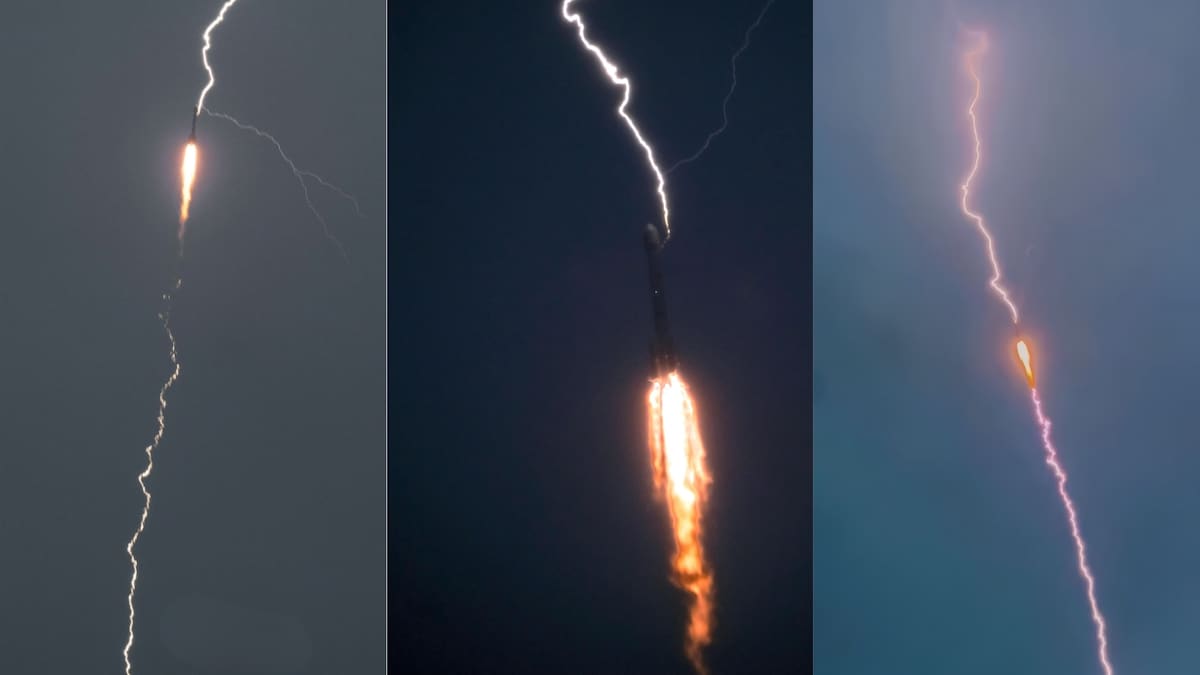
Despite the lightning strike, the launch went as scheduled, with the rocket successfully placing the Tianlian II-06 data relay satellite into its geostationary transfer orbit.
The event took place just after liftoff, as the rocket faced intense weather conditions during its ascent. Although lightning seemed to strike the vehicle, no technical difficulties were reported, and the mission was completed smoothly.
What the viral videos and images show
Videos and photos trending on social media depict the moment a bright lightning bolt appears to hit the climbing rocket. The electrical discharge is visible traveling along the body of the launch vehicle before following the rocket’s exhaust plume toward the ground, creating a captivating image.
The footage demonstrates the rocket continuing its ascent without any observable loss of control or flight disruption.
Xichang Space Launch Center in ????????
A mighty electrical discharge struck the Chinese Long March-3B rocket during its ascent. Reports from ???????? indicate that the lightning did not harm the spacecraft’s equipment, and the Tianlian-2-06 satellite launch was successful. pic.twitter.com/31laAgkNsJ
— Vijesti (@Vijesti11111) July 24, 2026
What is the Tianlian II-06 satellite?
On Thursday, China launched the Tianlian II-06 data relay satellite aboard a Long March 3B rocket from the Xichang Satellite Launch Centre in Sichuan Province.
The satellite is intended to provide data relay, telemetry, tracking, and command services for China’s crewed spacecraft, space station, and satellites in medium- and low-Earth orbit.
It will also facilitate upcoming spacecraft launches. This mission marked the 658th flight in China’s Long March rocket series.
Not the first rocket to be struck by lightning
This incident has drawn parallels to NASA’s Apollo 12 mission, which was hit by lightning twice shortly after its launch on November 14, 1969. Apollo 12 launched from Launch Complex 39A at Kennedy Space Center.
The Saturn V rocket carrying astronauts Charles “Pete” Conrad, Alan Bean, and Richard “Dick” Gordon was struck about 36.5 seconds after liftoff and again roughly 52 seconds into the flight.
“As a result, various temporary effects were observed in both the launch vehicle and spacecraft. Some permanent effects were noted in the spacecraft, including the loss of nine non-essential instrumentation sensors,” states a NASA document summarizing the event.
The mission was rescued after flight controller John Aaron advised the crew to switch the Signal Conditioning Electronics (SCE) system to its auxiliary mode. Apollo 12 ultimately completed its lunar mission successfully, landing on the Moon and returning safely to Earth.
China’s recent reusable rocket milestone
This successful launch follows shortly after China celebrated another achievement in its space program. Earlier this month, the country executed its first successful controlled recovery of a rocket during an orbital launch. During the inaugural flight of the Long March 10B, the rocket’s first stage was caught in a net-like recovery system operated by a vessel at sea.
(Edited by : Vivek Dubey)
First Published: Jul 24, 2026 12:06 PM IST