A clear directive regarding enhanced coordination, message discipline, and accelerated organisational restructuring has emerged from the recent high-level discussions within the Bharatiya Janata Party (BJP) in Uttar Pradesh, indicating that the party is proactively addressing internal issues ahead of the 2027 elections.
This renewed focus stems from concerns raised during a recent coordination meeting that included the BJP, the Rashtriya Swayamsevak Sangh (RSS), and the state government. Ground feedback revealed weak coordination among ministers, MLAs, and affiliated organisations, delays in organisational tasks, and mounting dissatisfaction among party workers. Furthermore, some leaders’ controversial remarks were perceived as detrimental to the party’s broader narrative.
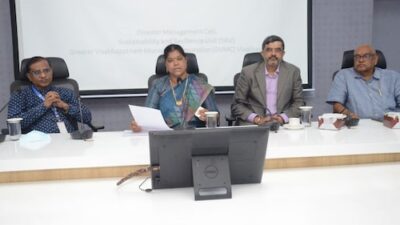
In this context, the BJP’s core committee convened at the official residence of Deputy Chief Minister Brajesh Pathak in Lucknow, representing a notable shift from established norms. Traditionally, these meetings during Chief Minister Yogi Adityanath’s nine-year administration have occurred either at his residence on 5, Kalidas Marg, or at the party headquarters. This marks the first instance of hosting a core committee meeting in a deputy CM’s residence, highlighting both urgency and a potential change in internal dynamics.
With CM Adityanath away in Noida and unable to return in time, the meeting continued with senior leaders present, including state BJP president and Union Minister of State for Finance Pankaj Chaudhary, organisation general secretary Dharampal Singh, and Deputy Chief Minister Keshav Prasad Maurya.
Central to the discussions was a scheduled roadmap to revamp the party’s organisational framework. The BJP aims to establish district executive committees across the state by March 30, followed by announcing a new state team by April 15, and making political appointments to various corporations, boards, and commissions by May 15.
This restructuring will also encompass the party’s frontal organisations, with new presidents set to be appointed for essential morchas, such as youth, women, farmers, OBCs, Scheduled Castes, Scheduled Tribes, and minorities. Leaders who may be replaced are expected to find roles within the larger organisational structure, suggesting a strategy to balance generational change with internal stability.
The meeting concentrated on converting overarching strategic concerns into concrete actions. A key takeaway was the necessity for improved coordination between the government and the organisation, a gap highlighted by the RSS during their prior meeting. The leadership stressed the importance of presenting a unified front and avoiding any appearance of discord at all levels.
A strong focus was also placed on enhancing communication with party workers. Addressing worker grievances and ensuring that grassroots feedback is acted upon has been prioritised, reflecting an understanding that organisational strength at the base will be crucial leading up to the 2027 elections.
Another significant shift discussed was the party’s messaging strategy. The RSS has advised the BJP to prioritise nationalism over caste-based narratives as the elections approach. Leaders have been cautioned against making caste-centric statements, with a clear directive to maintain ideological coherence and avoid remarks that could lead to unnecessary controversies.
Security and governance matters were also part of the discussions. There were deliberations on measures to curb illegal religious conversions and enhance surveillance in districts bordering Nepal. Additionally, the formation of an OBC commission in relation to the upcoming panchayat elections was discussed, underlining the relationship between administrative decisions and electoral considerations.
The developments indicate that the BJP is not only recognising its organisational challenges but also swiftly addressing them through a structured and timely plan. With an emphasis on unity, coordination, and disciplined messaging, the party seems to be laying the foundation for a pivotal electoral battle in 2027, well in advance.