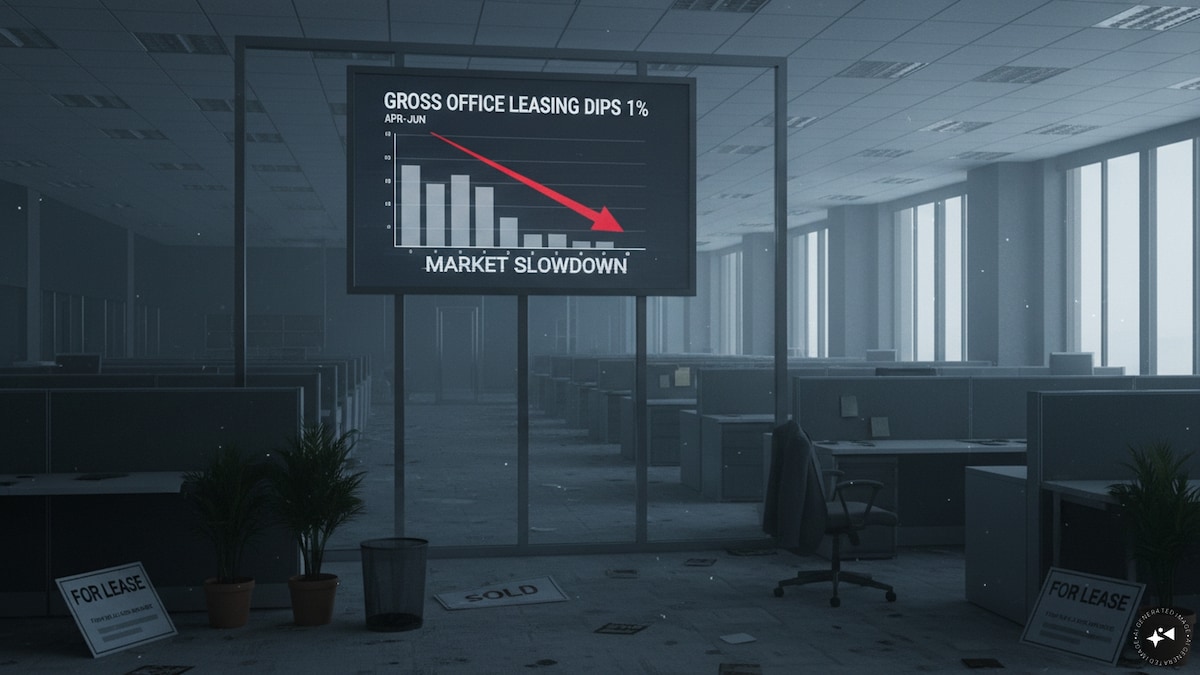
Net leasing of office spaces also saw a significant annual drop of 14.5%.
While the gross figures illustrate the total leasing activities in the market, the net leasing indicates the change in occupied spaces.
Read more: Tier-II Indian cities where property prices are increasing the fastest
On Saturday, July 4, real estate consultant Cushman & Wakefield published its office market report for eight major cities: Mumbai, Delhi-NCR, Bengaluru, Pune, Hyderabad, Chennai, Ahmedabad, and Kolkata.
In the latest April-June timeframe, net leasing of office spaces fell 14.5% year-on-year to 11.6 million sq ft, while gross leasing decreased by 1% to approximately 21 million sq ft.
The decline in net leasing was attributed to reduced availability of prime office spaces in the market.
Net absorption refers to the net change in occupied space, calculated as the difference between the occupied stock at the end of the current period and that of the previous period.
Read more: Anarock anticipates housing market recovery, predicting 8–10% value growth despite Q2 slowdown
Gross leasing encompasses all leasing activities in the market, including new take-ups, open market renewals by occupiers, and pre-leasing, serving as a barometer for overall market activity.
Anshul Jain, Chief Executive – India, SEA, MEA & APAC Office and Retail, Cushman & Wakefield, remarked, “Despite global macroeconomic and geopolitical uncertainties prompting occupiers to adopt a more cautious approach to decision-making, the underlying demand narrative remains strong.”
He added that global organizations continue to commit long-term to India, showcasing confidence in the country’s talent pool, business climate, and long-term growth prospects.
“Global capability centers are central to this momentum, with their expansion significantly influencing demand across various office markets,” Jain stated.
Regarding office space supply, he noted that many developers focused on residential projects over the last few years due to strong housing demand.
“However, with office vacancy rates tightening to post-pandemic lows, strengthening rental growth, and resilient demand, we anticipate a renewed focus on commercial development activity,” Jain commented.
He emphasized that a healthier supply pipeline is crucial for supporting the next growth phase in India’s office sector.