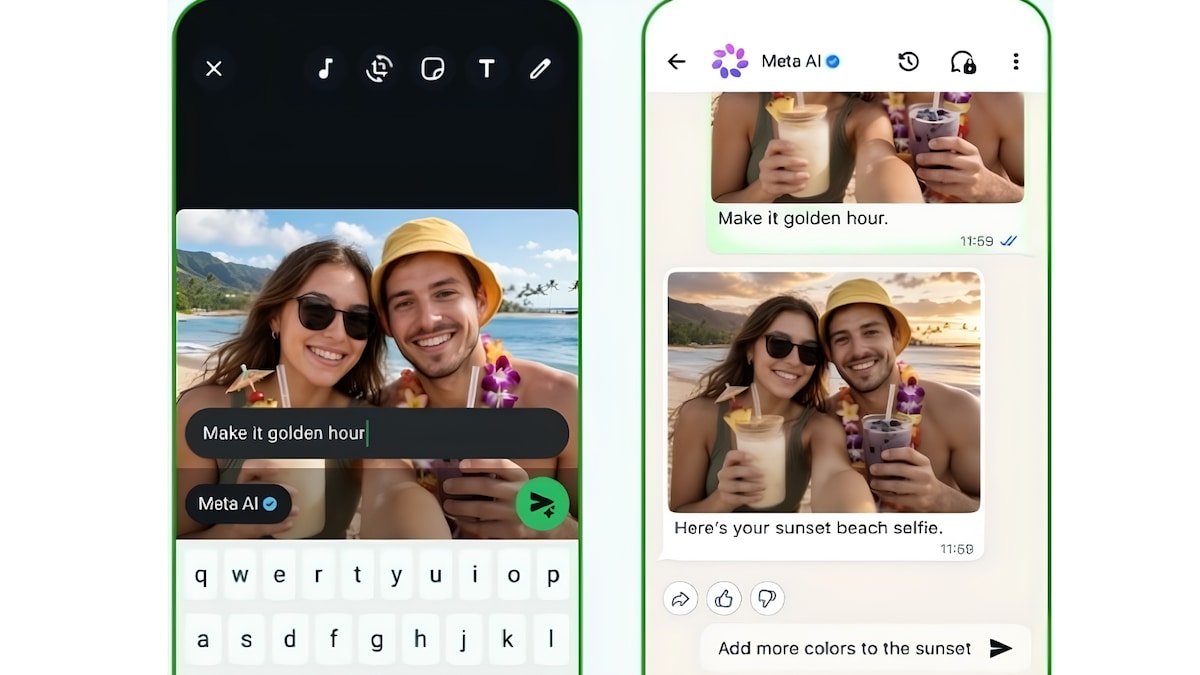
This rollout, spearheaded by the newly formed Meta Superintelligence Labs under Chief AI Officer Alexandr Wang, signifies a crucial shift to capitalize on billions invested in AI infrastructure by integrating generative media into WhatsApp, Instagram Stories, and the Meta AI chatbot ecosystem.
The internally codenamed Mango model functions as an agentic system, capable of executing code, planning canvas layouts, and leveraging live search data for its graphic outputs.
While the application offers standard creative tools such as text-to-image presets, prompt-based background removal, and automated QR code generation, its social architecture has faced backlash from data privacy advocates.
The Opt-Out Architecture Problem
The main concern revolves around the tool’s account-manipulation design. Users within the Meta AI application can use an “@mention” to draw upon publicly available images from any non-privated Instagram profile directly into the generative workspace.
This platform subsequently allows users to alter, restyle, or place that individual’s likeness into automated scenes without notifying the person involved.
Meta’s official documentation highlights that users retain control over their data through a setting in the account privacy options, permitting them to manually disable this co-option feature. The company indicates that users have the power to decide if their public Instagram content can be reused for AI generation via a specific account setting, which can be deactivated at any time. Meta has clarified in Instagram’s Settings that allowing the reuse of public content for features like Remix also permits others to use that content with Meta’s AI tools, with the option to opt out by disabling the reuse setting. Nonetheless, by defaulting this configuration to active, Meta replicates a data-harvesting strategy that has previously attracted regulatory scrutiny.
Computational Cost and Capital Pressures
The vigorous integration of Muse Image into essential consumer interfaces illustrates the growing financial pressures on the tech giant.
After a structural reshuffle in May 2026 that resulted in the loss of 8,000 corporate jobs, Meta has streamlined its capital strategy to focus on high-performance computing clusters, establishing infrastructure partnerships with CoreWeave, Google, and Oracle.
Fiscal Strategy: To mitigate the substantial operational costs of these infrastructure investments, Meta is launching a freemium model. Basic creation remains free, but power users and commercial creators will need to transition to the ‘Meta One’ subscription framework once usage limits are exceeded.
The corporate strategy also aims at enhancing Meta’s principal advertising engine, with intentions to integrate Muse Image into its Advantage+ creative platform for automating high-volume variation testing for global brands. Internal benchmarks shared by the company position Muse Image at No. 2 on global text-to-image leaderboards, claiming superiority over Alphabet’s Nano Banana 2 in multi-image composition, although it still lags behind OpenAI’s GPT Image 2.
The Biometric Legacy
This rollout ignites long-held concerns about Meta’s historical data practices. In 2019, the company was hit with a record $5 billion fine from the Federal Trade Commission for the improper collection of user profiles during the Cambridge Analytica incident, and in 2021, it was compelled to dismantle its automated facial-recognition tracking system amid growing biometric lawsuits.
While Meta aims to reassure regulators by integrating invisible “Content Seal” watermarks in all Muse-generated files, the automatic inclusion of non-consensual user likenesses suggests that the company is prioritizing user engagement over precautionary compliance.
With a complementary video version, Muse Video, already in private model training, Meta’s strategy appears geared towards the complete normalization of synthetic identity across its social networks unless regulatory interventions are enacted to halt this trend.