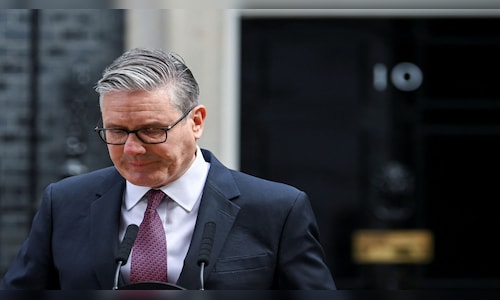
Starmer, who achieved one of the biggest electoral victories in British history, is stepping down after less than two years, marking the sixth leader to resign in a decade—the highest rate of political turnover in almost 200 years.
Like those before him, Starmer was unable to address public discontent over stagnant living standards that have remained unchanged since the 2008 financial crisis, compounded by rising national debt from global crises like the COVID pandemic that limited government spending.
Additionally, the failure to manage illegal immigration has created significant political rifts.
Anthony Seldon, a historian known for chronicling the fortunes of UK prime ministers in works like “The Impossible Office,” noted that following Starmer, Britain is in a precarious position as leaders like Liz Truss and Boris Johnson failed to build confidence and trust by articulating a clear direction.
Referring to Starmer’s likely successor, he told Reuters: “If Andy Burnham fails as prime minister, the outlook for Britain is bleak.”
Once a pillar of strength
Britain was once regarded as a bastion of political and economic stability, home to leaders like Margaret Thatcher and Tony Blair, whose combined 21 years in office reshaped the nation.
However, the global financial crisis severely impacted Britain, which heavily depended on a large financial sector for economic growth, while ensuing public sector austerity left the country unprepared for subsequent challenges.
The last prime minister to win an election on her own and serve a full term was Blair from 2001 to 2005. Whereas Britain once derided Italy’s frequent leadership changes, it now looks to Giorgia Meloni with envy, as she is poised to become Italy’s longest-serving head of government with nearly four years in power.
While many analysts trace Britain’s instability back to the Brexit referendum ten years ago this week, Jill Rutter, a former finance ministry official and senior fellow at the Institute for Government (IfG) think tank, argued that the decline began with the crash.
“There has just been a general sense that we don’t see our lives getting better, nor do we see our children’s lives improving,” she stated. “And successive governments have seemed unable to change that.”
In 2016, Britain dramatically shifted its long-term foreign policy by voting to leave the EU, reigniting the independence movement in Scotland, where voters had opted to remain.
The financial response to the COVID-19 pandemic and Russia’s full-blown invasion of Ukraine drove national debt levels to nearly 100% of GDP.
Although countries like Japan, Italy, the United States, and France have higher debt-to-GDP ratios, Britain faces elevated borrowing costs due to persistent inflation and concerns regarding foreign investment reliance to fund its deficit.
This restriction on spending has severely affected living standards.
Data from supermarket Asda and the Centre for Economics and Business Research in 2025 indicated that while average real disposable income was rising in the UK, the lowest-earning 40% experienced diminished spending power compared to 2021.
Why nothing works
Sam Freedman, a former government adviser, argued in his recent book “Failed State: Why Nothing Works and How We Fix It” that Britain is overly centralized and its key state offices are too small to effectively handle current demands.
Moreover, IfG’s Rutter and Roger Gale, one of Britain’s longest-serving parliamentarians since 1983, noted that the culture of British politics has deteriorated. Continuous news channels and social media pressure politicians to make swift decisions.
Gale, a Conservative parliament member, told Reuters that government operations need to be more deliberate. “There is too much legislation. A lot of it is poorly crafted,” he stated.
“We require more mature governance.”
Starmer faced criticism for entering government without a solid plan to address issues ranging from soaring electricity costs to boosting investment, improving healthcare, and increasing defense expenditures.
His rival Burnham, a seasoned politician recently serving as the mayor of Greater Manchester, might take over in a matter of weeks, needing to establish a cabinet and outline a clear vision for the nation.
Rishi Sunak, the last Conservative prime minister defeated by Starmer in the 2024 election, emphasized that Burnham needs a strategy.
“Without that, he’ll become yet another prime minister awake at night, worrying about why it’s not working,” he wrote in the Sunday Times.
Also Read: Keir Starmer to quit as Labour Party leader, remain UK PM until successor is chosen