Coach Amir Ghalenoei didn’t specify who ordered the earlier than expected departure. The team had planned to stay overnight in California to facilitate normal post-game recovery, only to receive word after the match that everyone needed to board a plane for the 140-mile journey back to Tijuana.
“They didn’t even give us time to recover,” Ghalenoei said via an interpreter.
“After the game today, they told us, ‘You have to leave immediately.’ It’s essential for us to have time for recovery, yet we are directed to get on a plane and head back to our camp in Tijuana, which is quite distressing.”
The Iranians’ World Cup journey has faced turmoil since the US and Israel started hostilities against Iran on February 28. Despite this, Iran chose to participate even after FIFA denied its request to relocate its three group-stage matches out of the US.
Team captain Mehdi Taremi mentioned that they endured a five-hour ordeal of travel and security checks during what is typically a short trip from Tijuana to the Los Angeles area on Sunday.
“To be honest, we don’t understand why we are being sent back,” Ghalenoei stated. “It feels rather bizarre. It seems like the planning is being done for us. The decisions affecting us are being made elsewhere. We were meant to arrive two nights before the game and stay for recovery; now we have no idea why we’re being rushed.”
”I believe our team is possibly the most oppressed in this World Cup.”
Both Taremi and Ghalenoei lamented the absence of several key staff members—including the president of Iran’s football federation and various coaching and media officials—who faced visa denials from the US, further complicating the team’s preparations.
“We must leave Los Angeles immediately, and it’s detrimental to us,” Taremi expressed about an hour after the match. “I think FIFA needs to assist us more than this. … Everything feels like a disaster, truly.”
Ghalenoei noted that several players suffered cramps during the match, which was held in mild weather. He linked these injury issues to inadequate preparation time due to the bureaucratic and diplomatic challenges faced by Iran.
“Before the game, I mentioned that we lacked time to acclimate due to travel,” Ghalenoei explained. “Many players cramped up, leading to substitutions. It wasn’t for technical reasons but due to injury and cramping. They will be assessed (Tuesday) by our technical team, but the delayed arrivals and our forced early return without recovery time complicate our situation.”
Iran’s upcoming two group-stage matches will be against Belgium in Inglewood on Sunday, followed by a trip to Seattle to play Egypt next week.
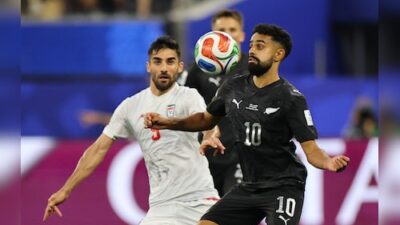
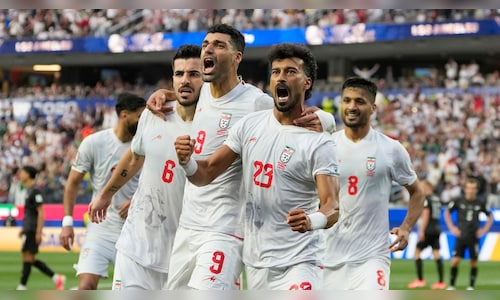
Iran initiated its World Cup campaign with a disappointing draw against a team ranked 65 places lower in FIFA’s standings. However, the Iranians managed to overcome two deficits during an exhilarating match, equalizing with a goal from Mohammad Mohebi in the 64th minute, all before a passionately pro-Iranian crowd at SoFi Stadium in Los Angeles, home to the largest Iranian population outside Iran.
The event was charged with energy from a conflicted diaspora, many of whom remain displeased with the current Iranian administration but continue to support Team Melli.
While hundreds of Iranian Americans protested outside against the government, many fans from the diaspora turned their backs and jeered during the national anthem. Numerous Lion and Sun symbols—the emblem of Iran’s flag prior to 1979—were visible in the crowd, despite FIFA’s efforts to keep them away, with many fans donning T-shirts featuring the emblem.
Nevertheless, once the match commenced, a large majority of the audience vocally cheered for the Iranian players.
“The atmosphere during the game was incredible for all 90 minutes,” Taremi remarked. “It felt like home.”
Elijah Just scored early in each half for New Zealand, but Iran responded with two stunning goals, including Mohebi’s header from a perfect pass by Ramin Rezaeian, who had previously scored with a strike from the side of his boot in the first half.
Mohebi appeared to imitate shooting a gun after scoring, which sparked criticism online. He also performed the now-famous “ice in my veins” gesture, popularized nearby by Los Angeles Lakers rookie D’Angelo Russell a decade ago, before raising a heart to the applauding fans.
“The Iranians in Los Angeles create a fantastic atmosphere,” Mohebi said. “That celebration came to mind, and I did like this” — gesturing to his arm — ”for everyone. It was merely a celebration.”
Players from both teams embraced and exchanged jerseys after the final whistle. While Ghalenoei sat alone in the dugout, his players joined together, applauding their thousands of cheering, flag-waving fans.
Both of Iran’s subsequent matches appear tougher on paper, jeopardizing their chances of advancing from the World Cup group stage for the first time. Iran, Belgium, Egypt, and New Zealand all stand on one point each after the initial round.
“We face more obstacles, but we won’t allow that to deter us from performing our best,” Ghalenoei declared. “Today was one of the finest matches of the World Cup so far, and fans inside and outside the stadium truly appreciated it.”