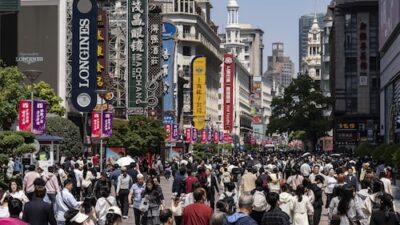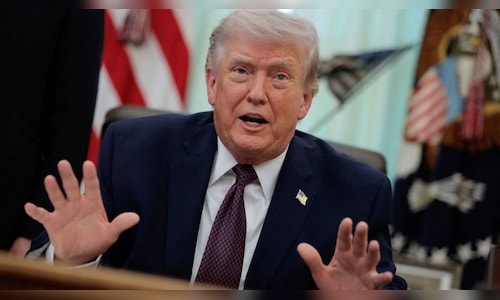
However, the strong economic connections between Beijing and Iran, along with ongoing trade tensions stemming from tariff threats since Trump’s first term, may dampen the positive atmosphere when he arrives in Beijing this week. Despite this, the Republican president has consistently praised Xi, viewing him as a formidable competitor deserving of respect and admiration.
Trump generally dislikes long flights and extended absences from the White House or his residences in Florida and New Jersey. He is set to spend only parts of three days in China.
While there will be elaborate ceremonies, the event is not anticipated to match the grandeur of Trump’s inaugural trip to China in 2017, which was labeled a “state visit-plus” by Beijing.
“Even before the recent conflict with Iran, they weren’t planning to offer a state visit-plus this time due to the tense atmosphere,” stated Jonathan Czin, a former director for China at the National Security Council during the Biden administration.
During Trump’s first-term visit, China gave him a warm welcome, complete with military music and children waving flags, chanting “Welcome.”
Xi provided a tour of the Forbidden City, where Trump and first lady Melania Trump enjoyed a private dinner, marking the first time since the People’s Republic of China’s establishment in 1949 that a foreign leader experienced such a privilege.
Another welcoming ceremony occurred the next morning at the Great Hall of the People, featuring a military parade and a state banquet in Trump’s honor, showcasing video highlights from Xi’s prior visit to Florida, including a clip of Trump’s granddaughter Arabella singing in Chinese.
Most visiting foreign leaders do not receive such a display from Beijing. For instance, when British Prime Minister Keir Starmer visited the Forbidden City in January, Xi was absent, and the site remained accessible to the public, leading Starmer to navigate through tourists.
Ali Wyne, a senior U.S.-China research and advocacy adviser for the Washington nonprofit Crisis Group, indicated that the “Chinese delegation will likely strive to ensure that Trump departs Beijing believing he has just had the most remarkable state visit of his two presidencies.”
Nonetheless, he noted that the “pomp and circumstance will serve a different purpose now than during his first visit to Beijing,” given that “Xi has a considerably enhanced understanding of Trump, and the administration’s national security strategy recognizes China as a near-peer.”
Lower expectations for tangible outcomes are likely this time, Czin noted, as he anticipates that Chinese officials may avoid making substantial concessions on trade or other matters, believing that “as Election Day approaches, their leverage will increase.”
The GOP is focused on maintaining congressional control, despite polling indicating widespread discontent among Americans regarding Trump’s economic policies and perceptions that the U.S. has overstepped in Iran. Still, the White House contends that Trump’s earlier firmer stance on tariffs with Beijing—later invalidated by the Supreme Court—will keep the U.S. in a robust position.
“President Trump prioritizes results over symbols,” said White House spokesperson Anna Kelly. “Nevertheless, the president maintains an excellent rapport with President Xi, and the upcoming summit in Beijing will hold both symbolic and substantive significance.”
Trump might have four meetings with China’s leader within eight months.
After his Beijing visit, Trump intends to host Xi at the White House. He may also attend the Asia-Pacific Economic Cooperation meeting in Shenzhen, China, in November, and Xi could participate in the Group of 20 summit at Trump’s resort in Doral, Florida, the following month.
Czin pointed out that Xi also prefers not to travel excessively, implying that not all planned meetings may materialize. He mentioned that Xi does not cultivate personal connections like Trump often does, noting Xi had initiated a military purge in January that replaced officials with longstanding familial associations.
However, Wyne asserted that Xi “recognizes he is unlikely to encounter another U.S. president who holds him in such high regard and embraces a limited view of strategic competition.”
This suggests that Xi may “aim to secure as many economic and security concessions from Trump as he can,” Wyne suggested.
In a 2024 interview with The Wall Street Journal’s editorial board, Trump remarked that Xi “was actually a really good … I don’t want to say ‘friend.’ I don’t want to act foolish. ‘He was my friend.’ But we got along excellently.”
Trump also implied at that time that military intervention might not be necessary to dissuade Chinese troops from encroaching on Taiwan, given that China’s leader “respects me,” although Trump has since discussed the possibility of supplying arms to Taiwan.
Trump has continued to commend the bilateral relationship since his return to the White House, even as his Beijing visit, initially slated for March, was delayed due to the early phase of the Iran conflict.
He unsuccessfully urged China to assist in reopening the Strait of Hormuz after Iranian forces blocked it, causing disruptions to global economies. Nevertheless, China utilized its position as the leading buyer of Iranian oil to persuade Iran to accept what has remained a tenuous ceasefire.
Beijing’s strong economic links to Tehran could be threatened by the war, which is projected to slow its economic growth. However, if China can facilitate lasting peace, it may strengthen its negotiating position on trade issues with the Trump administration.
During his 2017 visit, Trump proclaimed $250 billion in nonbinding trade agreements, though some never materialized. Additionally, a set of trade deals announced in 2020, valued at $200 billion, mostly did not come to fruition before the conclusion of Trump’s first term.
Trump’s announcement last year regarding steep global tariffs led China to halt U.S. soybean purchases and restrict exports of rare earth minerals critical for American manufacturing.
Tensions have eased somewhat since the two nations reached a trade truce last fall, limiting tariffs on both sides. The administration continues prioritizing the reduction of the U.S. trade deficit with China, insisting this can be achieved while promoting trade between the countries.
Also Read: New York reading room showcases 3.5 million pages of Jeffrey Epstein records
“I foresee great stability in the relationship,” Treasury Secretary Scott Bessent commented, “But that doesn’t imply our trade deficit can’t continue to decrease.”
Kelly, the White House spokesperson, asserted that Trump “never travels without returning home with deliverables for our country.”
”Americans can anticipate the president securing beneficial deals for the United States during his time in China,” she added.
Also Read: Modi attends Bengaluru programme, to unveil Telangana projects and hold Hyderabad rally today