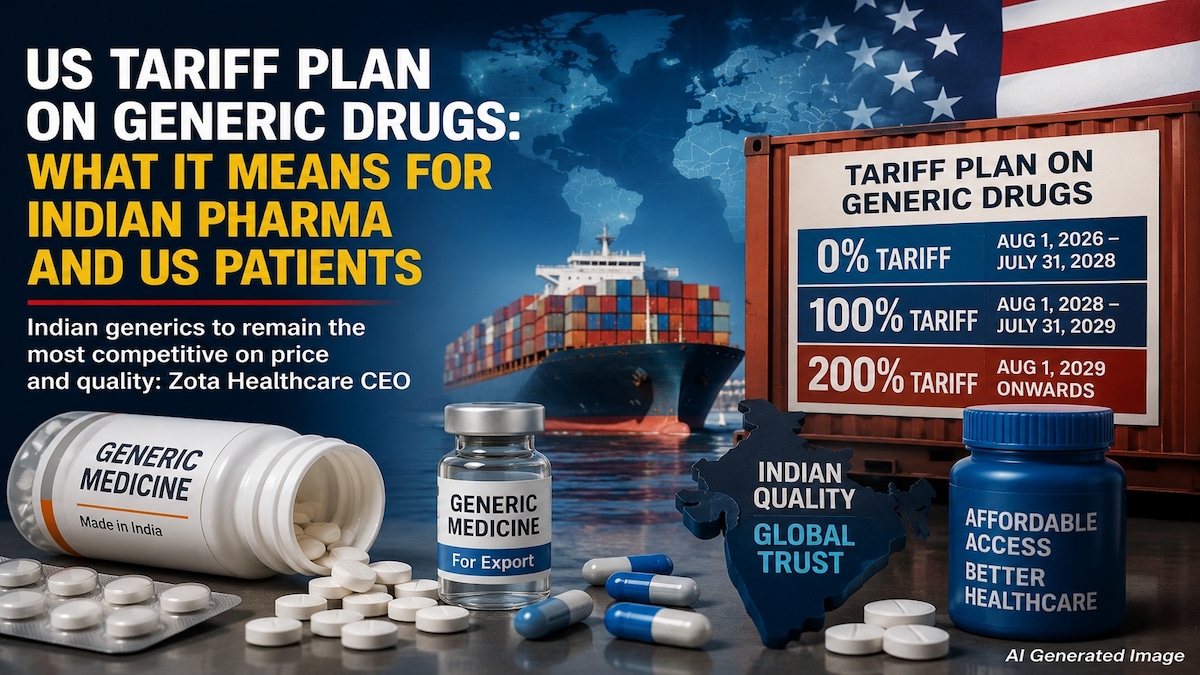
This announcement significantly impacts an industry that India has developed over many years. The US is India’s largest pharmaceutical export market, with Indian companies supplying almost 40% of the generic drugs consumed there, amounting to exports of nearly $9.7 billion just last year. However, the implications extend well beyond India. American patients, insurers, and hospital systems have long depended on affordable Indian generics to stabilize drug prices, and any disruption in that supply chain could lead to increased costs for US consumers, as well as tighter profit margins for Indian exporters. Other generic manufacturing hubs, including China and parts of Europe, will also be closely monitoring this policy, which affects all countries exporting generics to the US, not just India.
Dr. Sujit Paul, Group CEO of Zota Healthcare, which operates Davaindia, India’s largest generic pharmacy retail chain, shared his insights with CNBC-TV18 regarding the potential impact of these tariffs on Indian exporters, American patients, and the broader generics market.
Edited transcript:Q: Trump’s tariffs on generic drugs rise to 200% by 2029 following a two-year zero tariff window. What was your initial reaction, and how serious is this issue for you?Paul: This announcement is highly significant as it affects one of India’s strongest export sectors. However, I view it more as a strategic signal than an immediate disruption. The two-year zero-tariff period suggests the aim is to incentivize manufacturers to invest in US facilities instead of causing major trade disruptions. Nevertheless, Indian pharmaceutical producers should not feel entirely secure; they need to begin evaluating their supply chains and production strategies now. This development opens up opportunities for new Indian pharmaceutical companies in different markets.
Q: India exported nearly $9.7 billion in pharmaceuticals to the US last year, mainly in generics. How vulnerable is the Indian generics industry to this initiative?Paul: The vulnerability is significant since the US is India’s largest pharmaceutical export market, accounting for roughly one-third of total exports, with Indian companies providing about 40% of all generics in the US. However, it’s crucial to recognize that both nations are interdependent. The US healthcare system relies on affordable generics from India. Therefore, while Indian manufacturers face commercial risks, the US will similarly suffer from supply shortages or increased price controls. Regardless of tariffs, Indian generics will likely remain competitive in terms of price and quality.
Q: The stated goal of this initiative is to “reshore” generic manufacturing to the US. Do you believe American manufacturers can realistically achieve cost efficiency comparable to that of India in this timeframe?Paul: It will be extremely challenging. India has developed its competitive edge through years of significant investment in manufacturing excellence, a skilled workforce, an advanced API supply chain, regulatory competence, and other factors that contribute to reduced costs. While constructing new facilities is one aspect, obtaining regulatory approval, product qualification, establishing supply channels, and achieving commercial readiness are completely different challenges. Creating this entire infrastructure within a mere two years will be extraordinarily difficult, especially for generics that can’t support high production costs.
Q: What actions should Indian pharma companies take during the two-year grace period — invest in US plants, diversify markets, or adopt a wait-and-see strategy?Paul: The best approach involves pursuing multiple strategies simultaneously rather than choosing one path. Companies with significant exposure in the US should consider expanding their manufacturing presence there through greenfield investments, acquisitions, or contract manufacturing partnerships where feasible. Additionally, they should increase efforts to explore markets in regions such as Europe, Latin America, Africa, and developing Asia while advancing into higher-value products like complex generics or injectables. There is also a substantial opportunity in the domestic market, which requires high-quality generic medicines. A passive waiting strategy could prove detrimental given the uncertainty surrounding trade policy.
Q: If the tariffs do come into effect in 2029, who bears the cost — Indian exporters or American patients through higher drug prices?Paul: The cost burden would likely be shared among various stakeholders; however, American patients might bear a substantial portion. Initially, Indian producers may have to accept reduced profits and market share; nevertheless, with the slim margins typically associated with generics, it would be challenging for them to absorb tariffs as high as 100% or 200%. Increased import costs will eventually translate into higher medicine prices, insurance rates, or government healthcare expenditures.
Q: Some analysts suggest that this could be more of a negotiating tactic than a firm policy, given that it hasn’t yet gone through formal rule-making. Do you perceive it in that way, or are you preparing as though it is certain?Paul: The announcement does carry a negotiating element, as numerous details regarding implementation, exemptions, and regulatory approval remain unclear. Nevertheless, companies should act as though this announcement will materialize into a concrete measure. Decisions in pharmaceuticals involve long-term investments, so postponing action for certainty may hinder a company’s ability to respond promptly when timing is crucial. It is wise to treat the announcement as a risk and be prepared for potential changes to the current policy.
Q: With over half of India’s healthcare expenditure being out-of-pocket, how much can affordable generics alone address this issue compared to insurance or public health reform?Paul: Affordable generics are vital in tackling affordability, as they directly lower medicine costs, which constitute a significant portion of consumer healthcare expenses. However, generics cannot singularly resolve the affordability crisis. A considerable portion of out-of-pocket spending arises from diagnostics, hospitalization, specialist care, and the lack of insurance coverage. An effective approach would integrate affordable medications with enhanced insurance coverage, a more robust public healthcare system, and preventative healthcare initiatives.
Q: Government-supported Jan Aushadhi stores are promoting affordable generics. How can a private player distinguish itself from public-sector competitors?Paul: Affordability alone is insufficient for market success. Companies compete based on the breadth of product offerings, drug availability, supply chain reliability, the role of pharmacists, online purchasing and delivery options, patient education, and customer support. Trust and convenience, along with affordability, play crucial roles in consumer choices regarding medications. Private retail generic pharma chains like Davaindia are essential in adapting to market changes swiftly and introducing innovative service models.
Q: Where do you envision Indian generics in five years — still a low-cost export center, or transitioning towards complex generics and biosimilars?Paul: India will maintain its leadership in providing affordable generic medicines for both domestic and international markets, but it will increasingly produce more sophisticated products, particularly for Western markets. The production of complex generics, biosimilars, and specialized formulations is already underway, and the next phase of development will likely merge India’s traditional manufacturing capabilities with increased investment in R&D and advanced technologies.
Q: If large, export-focused Indian pharma companies shift capacity towards domestic markets due to the US tariff threat, how might this reshape competition in India’s generics sector?Paul: Yes, a greater domestic focus by export-oriented firms could lead to heightened competition. Larger companies may expand their product lines, improve infrastructure, and compete more aggressively on pricing and market share. While this may impact profitability for some, it could ultimately benefit patients by providing high-quality products at lower prices. We may also see industry consolidation as companies seek to enhance efficiency and scale.
Q: Is it feasible for a company to construct a fully operational plant within a two-year timeframe?Paul: For most pharmaceutical companies, especially those dealing with regulated generics in the US, two years is a very ambitious timeline. Constructing a facility represents just one step in the process — companies also need to validate their production methods, recruit qualified personnel, establish a compliant supply chain, secure necessary permits, and finalize qualification at a commercial scale.
The way forward
Dr. Paul’s assessment of the situation is pragmatic rather than alarmist: while the policy lacks sufficient regulatory detail, Indian pharma cannot afford to adopt a complacent stance. His broader assertion is that regardless of the form the tariff threat ultimately takes, it is unlikely to undermine India’s advantages in cost and quality for generics — even as exporters are compelled to hedge their strategies by investing in US manufacturing, exploring new export opportunities, and advancing into more complex generics and biosimilars. For a company like Zota Healthcare, which is largely shielded from direct US exposure, the more significant narrative may unfold domestically: if large, export-dominant players redirect resources to serve the Indian market, the generics sector may experience intensified competition, accelerated consolidation, and, if Dr. Paul is correct, better medicines at lower prices for Indian consumers.
Whether or not Washington’s tariff strategy remains intact or undergoes adjustments before 2029, the two-year countdown has commenced — and how India’s pharma industry adapts during this time might prove more crucial than the exact tariff percentage itself.