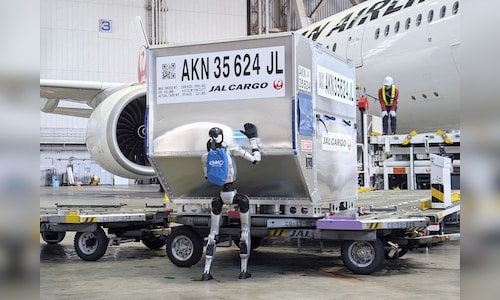
Ground handling encompasses operations such as aircraft towing, as well as baggage and cargo loading and unloading. These activities primarily rely on manual labor, whereby staff manage various types of Ground Support Equipment (GSE) in confined spaces near aircraft. Existing automated systems and specialized robots have often found it challenging to adapt to these environments and workflows.
The companies believe that humanoid robots may provide a feasible solution. Their human-like structure enables them to function in similar scenarios as human workers without necessitating significant modifications to airport infrastructure or the aircraft themselves.
Japan Airlines will trial humanoid robots for baggage handling and aircraft cleaning at Tokyo’s Haneda Airport starting in May, citing workforce shortages and rising tourist numbers pic.twitter.com/XJ9ImcN3UO
— Reuters (@Reuters) April 29, 2026
Why airports are exploring humanoid robots at this time
The aviation industry in Japan is currently experiencing a labor shortage, fueled by an increase in inbound tourism and a declining working-age population. Ground handling tasks require skilled personnel and often involve considerable physical effort.
According to data from the Japan National Tourism Organisation, over 7 million visitors came to Japan in the first two months of 2026. The previous year saw a total of 42.7 million visitors. Projections indicate that Japan may require upwards of 6.5 million foreign workers by 2040 to sustain its growth.
Tomohiro Uchida remarked: “While airports may seem highly automated and standardized, their back-end operations still rely heavily on human labor and are grappling with acute labor shortages.”
The companies state that the trial will assess whether humanoid robots can alleviate labor needs and reduce physical demands while upholding safety protocols.
What the robots will be tasked with and the trial’s structure
The demonstration will unfold in phases starting in May 2026. Initially, airport operations will be analyzed to determine safe working conditions for the robots. Following this, trials will take place in controlled airport-like settings. Only after these preliminary steps will robots be integrated into actual operations.
The robots are anticipated to assist with various responsibilities such as transporting baggage and cargo, cleaning aircraft interiors, and potentially operating GSE in the future.
During a media showcase, a humanoid robot standing approximately 130 cm tall was observed moving cargo onto a conveyor belt and engaging with staff. These machines are capable of functioning for two to three hours on a single charge.
Yoshiteru Suzuki commented that robots handling labor-intensive tasks would “inevitably alleviate the burden on workers and offer substantial benefits to employees.” He also emphasized that essential responsibilities like safety management will continue to be overseen by human personnel.
The broader context: Why humanoids are viewed as the next frontier in AI
Japan Airlines, along with its partners, aims to establish a sustainable operational model where robots complement human labor. This project integrates AI technology with robots engineered to mimic human movement.
The GMO Internet Group has proclaimed 2026 as the “First Year of Humanoids.” The organizations assert that this trial is part of a larger initiative to bolster the integration of AI and robotics across various sectors.
Humanoid robots are being developed as versatile machines. In contrast to stationary industrial robots, they can adjust to a variety of tasks within environments designed for human interaction. This adaptability makes them particularly relevant for industries such as aviation, where workflows are intricate and frequently evolve.