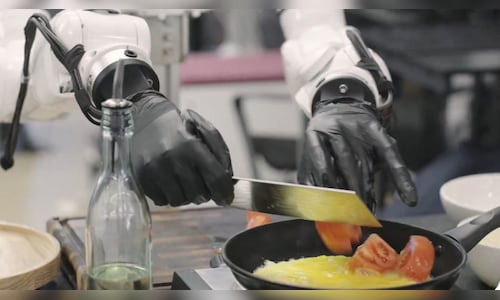
The company characterizes it as a significant milestone in the quest for general-purpose robots that can perform real-world tasks with accuracy, flexibility, and skill. GENE-26.5 is engineered to carry out a broad spectrum of activities using a unified model, hardware platform, data framework, and control architecture.
From cooking and lab experiments to solving a Rubik’s Cube and even playing the piano, the system highlights the progress robotics is making towards achieving practical, real-world intelligence.
Genesis posits that over 80% of manual labor entails manipulation, yet much of this data has never been digitized. The company considers data from human interactions essential for expanding robotic intelligence.
We are back. After one year of quiet building.
Introducing GENE-26.5, our first robotic brain that takes a major step toward human-level capability.
For years, robotics has struggled to learn from the world’s largest and valuable data source: Humans.
Solving it means… pic.twitter.com/ewHNRGuNnH
— Genesis AI (@gs_ai_) May 6, 2026
Why manipulation is robotics’ hardest challenge
According to Genesis, manipulation is the most critical challenge in robotics. While navigation and locomotion primarily deal with movement and obstacle avoidance, manipulation demands that robots physically engage with objects in chaotic environments. This necessitates an understanding of shape, weight, friction, timing, and force.
“At Genesis, we regard manipulation as the fundamental issue in robotics. If a robot can consistently and intelligently manage physical interactions with the environment, everything else becomes auxiliary,” the company stated. They argue that real-world labor goes beyond simply traversing the environment; it involves altering it.
A full-stack robotics approach
Genesis asserts that robotic manipulation cannot be resolved through AI model training alone. Unlike digital AI systems that function solely in software realms, robotics relies on ongoing collaboration among various physical and computational layers, encompassing sensors, actuators, control, data, and the AI model itself.
“Limitations in any single layer can hinder the entire system and ultimately limit overall effectiveness. Thus, developing capable and dependable robots necessitates not just optimizing individual elements but excelling across the whole stack,” they added.
Robotics-native foundation model
GENE-26.5 is trained on multiple data types at once, including language, vision, tactile feedback, proprioception, and robotic movements. This enables the robot to comprehend both commands and physical interactions in real-time.
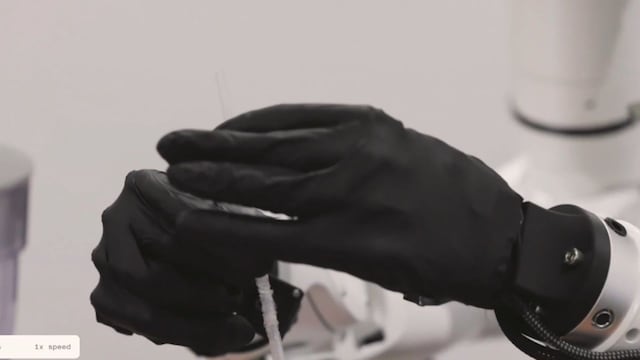 Human-like robotic hand | Genesis also debuted ‘Genesis Hand 1.0,’ a robotic hand crafted to closely replicate the size and motion of a human hand. It boasts 20 active degrees of freedom and soft-contact surfaces to imitate the gentle-contact physics of human skin.
Human-centric data collection
To enhance training data gathering, the company created a non-invasive glove that can capture finger movements, tactile signals, and physical interactions. The objective is to record natural human behaviors without interrupting workflows, enabling robots to learn directly from authentic human actions. “The glove is crafted to be minimally invasive, seamlessly integrating into existing processes, transforming real work into data collection with minimal disruption.”
What GENE-26.5 can do
GENE-26.5 was showcased performing a diverse array of intricate tasks, all executed autonomously at real-world speeds using identical model weights.
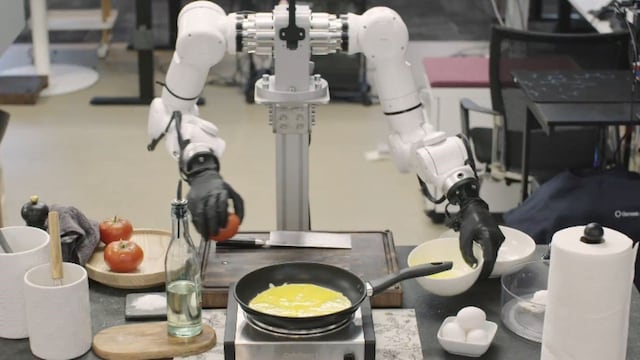 Cooking tasks | The robot completed a four-minute cooking routine comprising more than 20 subprocesses. It cracked eggs one-handed, chopped vegetables, utilized cooking tools such as knives and spatulas, and coordinated both hands to transfer ingredients.
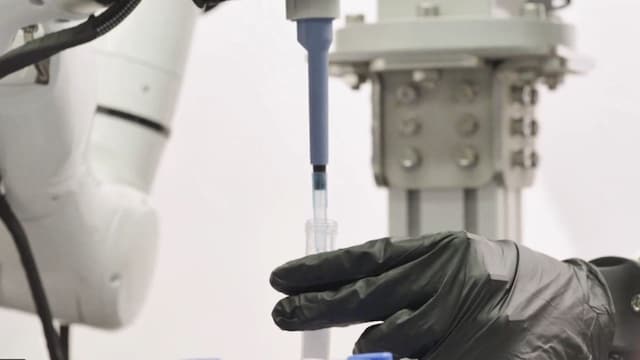 Lab pipetting | During lab demonstrations, the robot managed pipetting, liquid transfers, tube sealing, and centrifuge loading, executing tasks demanding delicate control and precise positioning.
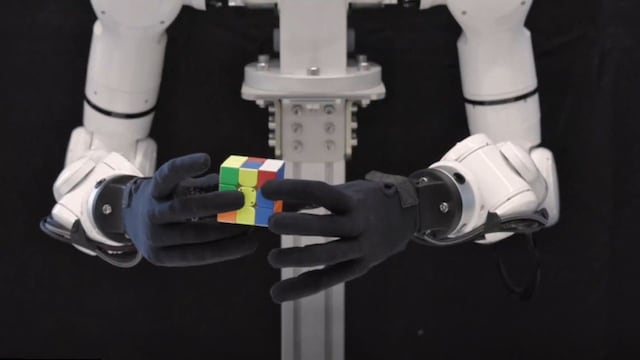 Solving a Rubik’s Cube | Genesis claims this marks the first occasion a general-purpose bimanual robotic system has solved a Rubik’s Cube without specialized mechanical fixtures.
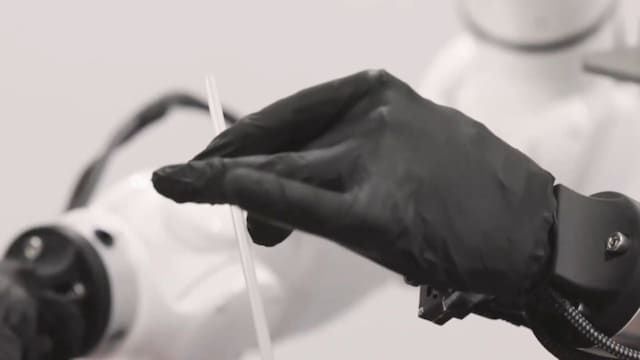 Smoothie preparation and straw handling | In a subsequent demonstration, GENE-26.5 was assigned the task of manipulating a straw and its plastic cover — challenges due to their lightweight and translucent properties.
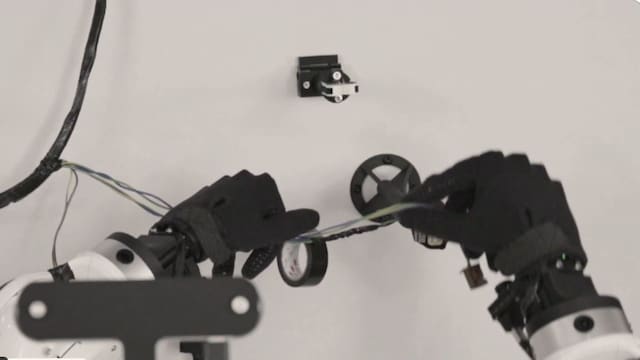 Industrial wire harnessing | One of the standout demonstrations featured wire harnessing — a task reputedly challenging in the automotive sector due to the pliable and malleable nature of cables and tape. It bundled the wires, carefully positioned them on stands, and secured them with tape.
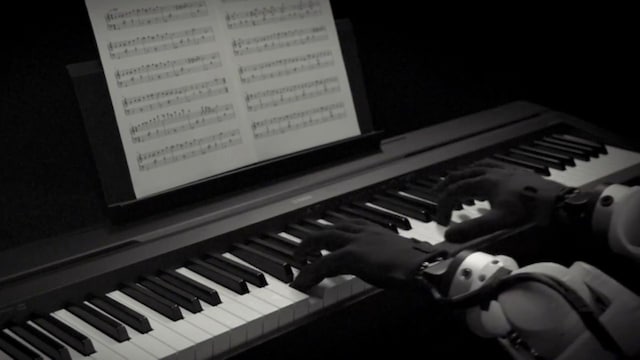 Piano playing | For entertainment and to evaluate the control stack, Genesis trained the robot to play the piano. “We tested it on two pieces – Ferris Wheel and Rush-E,” the company mentioned.