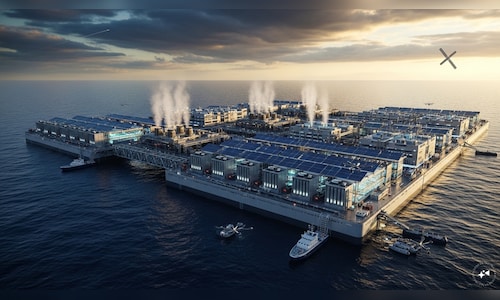
The Oregon-based startup believes its offshore computing facilities could cater to the rising energy demands of artificial intelligence while sidestepping many obstacles faced by traditional land-based data centers.
Panthalassa has invested nearly a decade in developing technology that harnesses electricity from ocean waves. The name Panthalassa (Greek for ‘all sea’) reflects its mission, and the company has been testing its Ocean-2 prototype off the Washington coast, where wave motion drives a turbine capable of generating up to one megawatt of continuous electricity.
The firm aims to roll out its first commercial units by 2027. These floating installations will house chips and computing hardware specifically designed for AI operations, with data communications handled via satellites.
CEO and co-founder Garth Sheldon-Coulson described the project as ‘totally crazy,’ yet a solution for energy and cooling challenges. “What we’re doing is totally crazy. We’re the first company that’s going to the middle of the ocean to do this,” he told Forbes.
“We operate in deep ocean waters where wave energy is most plentiful, unlike shallow coastal areas. Our nodes are self-propelled and can autonomously reposition. There’s no connection to the seafloor,” Sheldon-Coulson explained.
This concept emerges as SpaceX investigates the feasibility of deploying solar-powered data centers in orbit. Reports suggest SpaceX plans to start launching orbital data centers by 2028, though the company has acknowledged the significant technical challenges and untested technologies involved.
“Our efforts to advance orbital AI compute and the industrialization of lunar and interplanetary locations are still in the initial phases, entail considerable technical complexity and unproven technologies, and may not reach commercial viability,” stated the company in an excerpt from its S-1 filing.
Panthalassa argues that operating data centers at sea could be significantly less expensive than deploying similar structures into space.
“When you compare the cost of launching a ton into the ocean versus a ton into space, the reality is that it’s a hundred times more expensive to launch it into space. Thus, we have a 100X cost advantage. Even if we’re off by a factor of 1, we still maintain a 10X cost advantage,” said Gigascale founder Mike Schroepfer.
In May, Panthalassa secured $140 million for its initial commercial deployment in a Series B funding round, backed by Peter Thiel, John Doerr, Marc Benioff’s TIME Ventures, Max Levchin’s SciFi Ventures, and tech funds such as Gigascale Capital.
Panthalassa’s leadership team features chief engineer Daniel Place from SpaceX, while its engineering staff brings talent from tech and aerospace giants like Google, Blue Origin, Apple, Boeing, Amazon, and Tesla.