He mentioned that the company is gearing up to enhance its production capacity as the demand for electric vehicles, premium motorcycles, and exports continues to increase.
Despite logistics challenges due to the crisis in West Asia, Sharma noted that demand remains robust in markets such as Africa and Latin America. Moving forward, Bajaj Auto aims to boost its annual production capacity from roughly 7 million units to over 9 million units.
Sharma emphasized that exports, electric vehicles, and motorcycles over 150cc are the company’s primary growth drivers. He pointed out that the company faced capacity limitations in electric two-wheelers, premium motorcycles, and larger three-wheelers during the April-June 2026 quarter. Regarding electric vehicles, Sharma estimated that nearly 80% of customers are transitioning from Internal Combustion Engine (ICE) scooters to electric scooters rather than motorcycles.
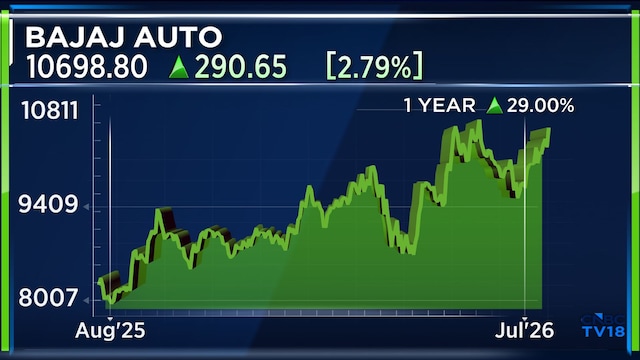
Bajaj Auto’s market capitalization stands at ₹2,98,801.36 crore, with the company’s shares rising by over 29% in the past year.
This is an edited transcript of the interview.Q: Exports are still showing strong growth, and you’re optimistic that the 2.5 lakh mark will be maintained month after month going forward. What insights can you share about the export market? Is there a chance that your overall volume growth for the year will exceed expectations? A JM Financial report suggests that driven by exports, your volume growth could reach 14% this year, compared to the previous estimate of 11%.A: Yes, exports showed significant growth and were a highlight this quarter despite the logistics challenges stemming from the West Asia crisis. Our exposure to that region is less than 3%, so while there are no sales impacts, we faced supply chain challenges that reduced availability by 10% to 15%. We were looking at an additional 100,000 to 120,000 units.
Looking ahead, if logistics conditions improve, we should surpass the 250,000 mark for the remainder of this quarter and into the third quarter.
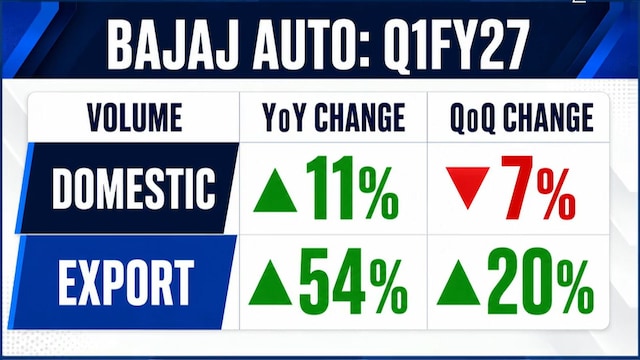
Q: Do you believe you can achieve low teens volume growth for the full year, combining exports and domestic business?A: Yes, the segments we are involved in appear very promising. Exports have increased from 200,000 to approximately 250,000. The electric segment, particularly in three-wheelers and two-wheelers, is strong. E-autos in three-wheelers have seen a doubling in demand, and the industry for electric scooters is expanding at 70%.
The segment focusing on sports bikes over 150cc is another growth area; in Q1, VAHAN registrations for two-wheelers increased by about 14%.
However, with such a diverse industry, a single number can obscure valuable insights—electric two-wheelers, around 175,000 units, are experiencing 70% growth, while 100cc bikes see a 3% increase, and bikes above 150cc are up by 25%. This diversity is now evident, indicating that a single figure can mask deeper interpretations.
As we analyze further, the segments where we are actively engaged—exports, the 150cc-plus segment, and electric vehicles—are all showing strong potential. However, predicting the final growth figure amid such volatility is challenging; we are assessing it on a monthly and quarterly basis.
Q: That 250,000 export figure is sustainable, correct? We can expect to see that every month.A: Forecasts suggest we should breach the 250,000 mark in the near term. However, from October to December, we typically experience a seasonal slowdown in exports due to Christmas and related holidays, which affects shipments to Latin America. Nonetheless, the outlook remains positive for now.
Interestingly, despite the ongoing crisis, many international markets have demonstrated surprising resilience. Africa, led by Nigeria, shows almost 50% growth, with our retail sales there doubling, also driven by Nigeria.
Although growth in Latin America has slowed, it remains positive, growing at 5% to 6%, and our retail sales are increasing by 30%. The situation in Asia is more muted, largely due to conditions in the Indian subcontinent; however, markets like the Philippines, where we have a solid presence, are performing well.
The underlying demand is robust, and our competitive stance allows us to capture a disproportionate share of this growth. Therefore, we remain optimistic about maintaining this export level.
Q: Chetak is now EBITDA-positive, and the electric segment is rapidly expanding. Are ICE scooter users shifting to electric vehicles, or are motorcycle users also transitioning to electric scooters? Is it predominantly one over the other?A: Quantifying this transition precisely is challenging, but research indicates that the majority of the cannibalization is occurring in the ICE scooter segment.
Both electric and ICE scooters perform similarly in limited usage scenarios, with average trips covering about 30 to 40 kilometers, easily manageable for electric scooters.
Motorcycles, typically used for longer distances, introduce range anxiety, making it less likely for long-distance riders to switch to electric scooters. However, some motorcycles are indeed used for short-distance trips, like by delivery personnel, but those riders also face range challenges.
Thus, I would estimate that about 80% of the movement is from ICE scooters to electric scooters.
Q: Demand is a crucial factor, and with capacity expansion underway, others are also increasing their capacity. What can you tell us about our current positioning and future capacity for both Bajaj Auto and the industry?A: I can’t comment on others’ plans, but I can say that demand for our products has outstripped capacity significantly in Q1. This was exacerbated by disruptions in April and May due to LPG shortages and labor issues.
We are currently facing capacity challenges in three main areas: electric two-wheelers, high-end bikes above 250cc across our KTM, Triumph, and Pulsar brands, and specific segments within the three-wheeler market, particularly larger-format models, where we’ve excelled in both electric and ICE categories both in India and internationally.
These three areas warrant capacity increases, and looking ahead, we anticipate needing a substantial capacity expansion. Our current capacity is about 7 million units annually, and we project that it will need to increase by approximately 25%, taking us beyond 9 million units due to the anticipated demand in our segments.
For the complete interview, view the accompanying video

Catch all the latest updates from the stock market here