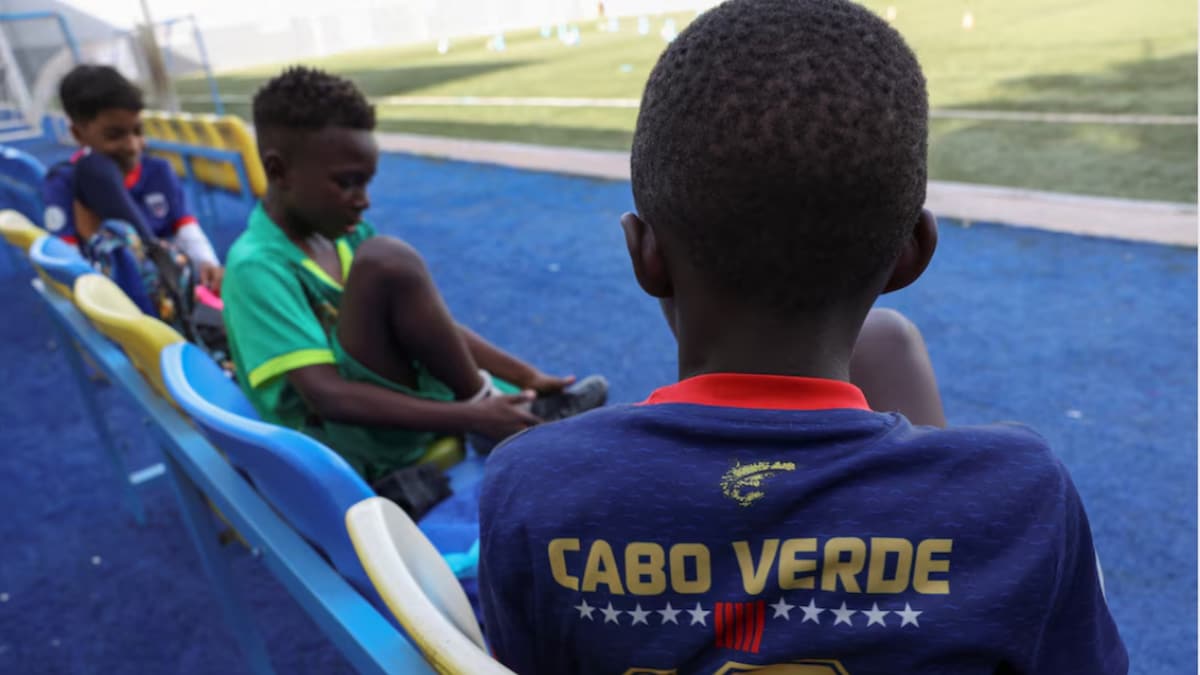
In downtown Praia, students as young as nine at one of the nation’s leading training academies express that this is merely the beginning of Cape Verde’s evolution into a football powerhouse.
From their surprising group-stage draw against the formidable Spain to a narrow 3-2 defeat to reigning champions Argentina, the “Blue Sharks” challenged some of the top strikers globally and showcased their own scoring abilities, pushing Lionel Messi’s team into extra time.
Fan Renato Ribeiro expressed his delight in witnessing his team, representing a small West African nation with a population of around 500,000 — the least populous nation ever to advance to the World Cup knockout stages — exceed the world’s low expectations.
“They gave us just a 1% chance, but I’ve always believed that 1% means a lot for us,” he shared with Reuters during a celebration at a fan zone on Sunday, where the players made an appearance.
“I take great pride in seeing that our national team will inspire young people to play more.”
Aspiring for greatness
The motivational impact of the Blue Sharks’ impressive performance is already being felt at Praia’s Bola Pra Frente — “Ball Forward” — Academy, which was established in 2010 and rapidly became a premier center for national development.
“The future of football in Cape Verde, for both women and men, is promising — it’s significant,” remarked Silveria Nedio, the head coach of the academy and the women’s national team.
The academy has been a foundational training ground for several players on the men’s World Cup team for 2026, including defender João Paulo Fernandes and midfielder Kevin Pina, who scored Cape Verde’s inaugural World Cup goal in a group-stage match against Uruguay.
Currently, about 240 players aged between four and 17 are training at Bola Pra Frente, all motivated by the recent accomplishments of the Blue Sharks.
“I aspire to reach the pinnacle where football can lead me,” shared César Alexandre França, 12, who has been training at the academy since he was six. “I love my family and want to make them proud.”
Marcelo Pereira Valera, 9, has spent three years at the academy and dreams of being selected for the national team. “I want to achieve great things in football,” he expressed.
Financial challenges
Bola Pra Frente is among more than 20 football academies located in Praia, with others distributed across the 10 volcanic islands of the archipelago, according to Mario Semedo, president of the national football federation.
“I believe we have indeed made tangible investments,” he remarked, noting that this has significantly contributed to the development of our national team.
However, the national program still grapples with financial hurdles, leading many young talents to pursue development opportunities abroad. Nedio emphasized that this can benefit the country by exposing players to new experiences.
“Every time a child from Cape Verde departs for Portugal at 13 or 15, it’s an advantage for us,” she stated.
Even before the World Cup commenced, Nedio was working to elevate Cape Verdean soccer’s profile, achieving the women’s team’s first qualification for the Africa Cup of Nations tournament, set to begin later this month in Morocco.
This further demonstrates that the national soccer program is gaining momentum, she noted.
“From this point onward, things could transform entirely — both in football and in the country.”