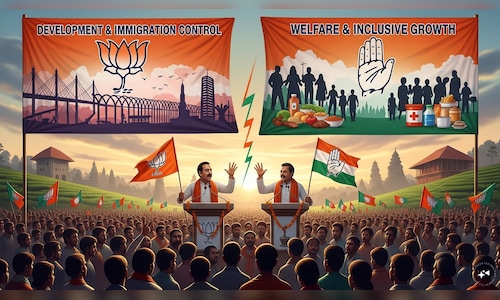
The manifestos were released within days of each other. Their tones and priorities differ significantly, though they share some common ground regarding welfare and land.
BJP manifesto: focus on identity, land rights, and enforcement
The BJP’s 31-point ‘Sankalp Patra,’ unveiled in Guwahati by Nirmala Sitharaman, emphasizes continuity. The party ties its proposals to what it describes as a decade of transformation in the State.
Key proposals include progressing towards a Uniform Civil Code, with exceptions for Sixth Schedule areas and tribal groups, as well as a stronger stance on immigration enforcement. The manifesto advocates for the application of the Immigrants (Expulsion from Assam) Act, 1950, addressing encroachments, and securing land rights for ‘genuine citizens.’
ALSO READ | Assam elections: Parties market familiar promises with renewed enthusiasm to tea tribes
Chief Minister Himanta Biswa Sarma emphasized safeguarding land and cultural identity. The document also recommends new laws to address what it refers to as ‘love jihad’ and ‘land jihad.’
In terms of welfare and the economy, the party promises free education from KG to PG for underprivileged sections, an increase in teaching staff, and a gradual rise in Orunodoi assistance to ₹3,000 with broader coverage. They pledge ₹5 lakh crore in investments to position Assam as an ‘Eastern Gateway,’ prioritizing connectivity.
The manifesto also discusses the timely execution of peace accords alongside a special mission led by the Chief Minister.
ALSO READ | Assembly Elections 2026: No exit polls allowed from 7 am on April 9 until 6:30 pm on April 29, says EC
Congress manifesto: emphasis on welfare and institutional reforms
The Congress’ ‘Raijor Istahar,’ launched by Rahul Gandhi and state leaders like Gaurav Gogoi, details 28 commitments. The focus is on institutional reform and targeted welfare measures.
Highlighted promises include granting Scheduled Tribe status to six communities, establishing an Anti-Corruption Commission to investigate alleged scams, and producing a white paper on state finances. Additionally, they propose an Urban Flood Mitigation Plan.
Five ‘guarantees’ include financial support of ₹50,000 for women starting small businesses and land rights for 10 lakh indigenous people. The plan outlines specific timelines—100 days for initial actions, one year for institutional reforms, and five years for broader changes.
Additional commitments range from universal healthcare and complete school enrollment to police reforms, fast-track courts, and decentralised governance with public accountability. Sector-specific initiatives encompass welfare boards for gig workers and transport operators, revitalizing the tea industry with better wages, and climate-conscious planning.
ALSO READ | Assembly Elections 2026: How to access the complete candidate list, affidavits, and more information
Other proposals touch on culture and professions, including a Zubeen Garg Fellowship, a Centre for Art and Culture, an Advocates’ Welfare Fund, and subsidized land for qualified journalists.
Notable overlaps and significant differences ahead of the April 9 vote
Both parties commit to land rights and enhanced welfare. The distinctions are more pronounced concerning identity laws, enforcement, and the establishment of new institutions. As the campaign enters its final phase, voters evaluate delivery records against proposed timelines.