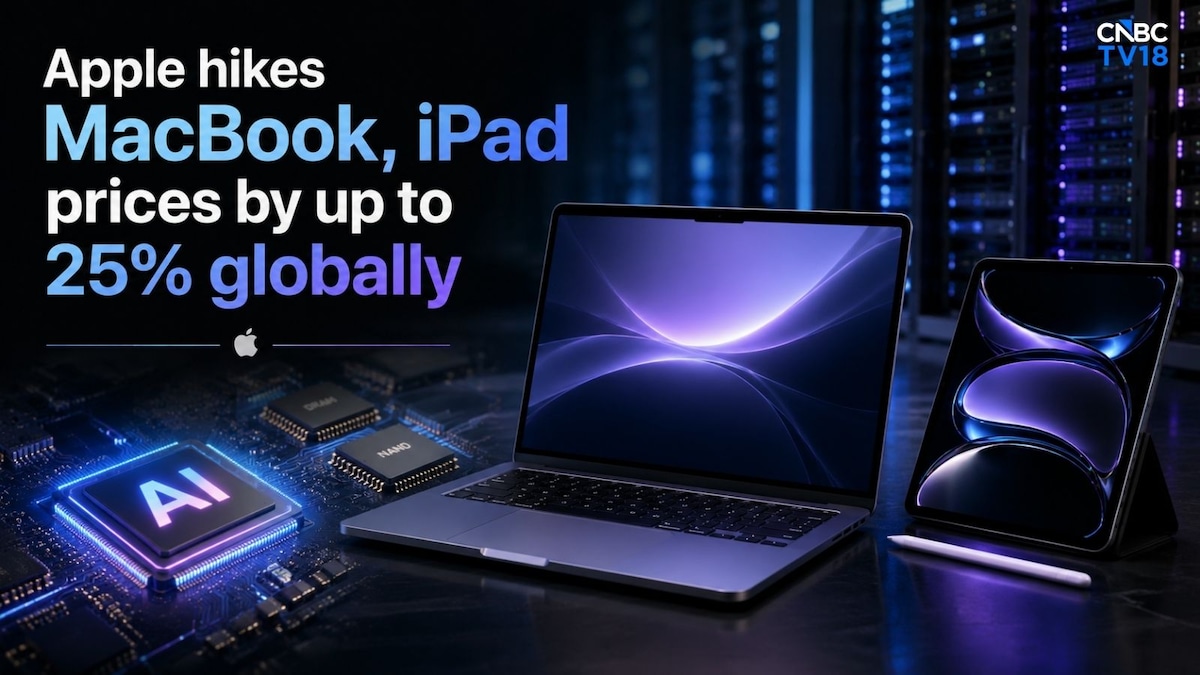
The global price adjustments, revealed on Thursday, affect the MacBook Neo, MacBook Air, MacBook Pro, iPad Air, and iPad Pro, while iPhone prices remain stable.
“The rapid growth of AI data centers has led to an unprecedented demand for memory and storage,” the company stated. “We recognize this news may not be well-received, and we are working diligently to find alternatives.”
Read more: Apple Under Tim Cook: 20x growth in market cap, quadrupled sales, and more
The entry-level MacBook Neo now begins at $699, up from $599, while the MacBook Air is now listed at $1,299 instead of $1,099. The starting price for the 14-inch MacBook Pro has risen to $1,999, from $1,699.
| Product | Previous Starting Price | New Starting Price | Price Hike |
| MacBook Neo | $599 | $699 | 17% |
| MacBook Air | $1,099 | $1,299 | 18% |
| 14-inch MacBook Pro | $1,699 | $1,999 | 18% |
| 11-inch iPad Pro | $999 | $1,199 | 20% |
| iPad Air | $599 | $749 | 25% |
Additionally, the starting price for the 11-inch iPad Pro has increased to $1,199 from $999, and the iPad Air now begins at $749, up from $599.
In India, the MacBook Air’s new starting price is ₹1,49,900, an increase from ₹1,19,900, while the MacBook Neo is now priced at ₹79,900, up from ₹69,900. The MacBook Pro M5 now starts at ₹2,39,900, compared to ₹1,69,900 earlier, and the 11-inch and 13-inch iPad Pro models have increased to ₹1,39,900 and ₹1,99,900, respectively.
This move represents one of Apple’s most extensive product price adjustments in recent years. Traditionally, the company has limited price changes to the release of new products or specific markets instead of implementing widespread global increases across various categories.
CEO Tim Cook had previously indicated that price increases this year would be “unavoidable” due to the “unsustainable” costs associated with memory and storage.
Apple noted that it had absorbed most of the increases in memory and storage costs until now, but these expenses have soared to unprecedented levels, leaving little choice but to pass some of the costs onto customers.
Also read: Apple marks 50 years, celebrates 2.5 billion devices and a garage-to-global journey
The memory crisis has been fueled by significant investments in AI infrastructure, with chip manufacturers increasingly prioritizing the production of high-bandwidth memory (HBM) utilized in AI servers over conventional DRAM and NAND memory found in consumer devices.
Despite previously avoiding price hikes due to supply chain challenges during the COVID-19 pandemic and tariff-related uncertainties, this latest action highlights how the AI infrastructure boom is affecting costs throughout the consumer electronics sector.
Apple is joining numerous technology firms that have raised prices in response to increasing memory costs. Laptop manufacturers Dell, HP, Lenovo, and Asus have already signaled higher prices, while Samsung recently increased the prices of two Galaxy S26 smartphone models in the US.
The global memory market is primarily controlled by Micron Technology, SK Hynix, and Samsung Electronics, all of which have benefited from the rising demand for AI-focused memory chips as major players like Google, Meta, and Amazon expand their AI infrastructure.
Despite comprehensive price increases across its Mac and iPad lineup, Apple has not announced any changes to iPhone pricing, which continues to represent roughly half of the company’s revenue.