
“My model has a higher score.” “Mine boasts a larger context window.” “Ours reasons better.” “And we just secured another couple billion in funding.”
Every few weeks, a new launch emerged—a more intelligent model, a quicker model, a model capable of coding, drawing, reasoning, searching, planning, and perhaps reminding you to contact your mother. The goal was straightforward: create the smartest AI.
That competition isn’t finished. Yet, another one has quietly emerged, potentially even more significant. Boardrooms are no longer inquiring, “How smart is your AI?” Instead, they are asking a much less glamorous question: “How much revenue will it generate—or save—for us?”

This is a subtle change. However, it’s the kind that transforms industries.
Remember when the internet was focused on page views? Eventually, it shifted to profitability. Recall when cloud computing centered on shiny new infrastructures? Over time, investors prioritized recurring revenue over server capacity.
Smartphones followed a similar path. Initially, it was about megapixels and processor speeds. Then, the winners turned out to be the firms that developed ecosystems that became indispensable. AI appears to be entering this stage. While the excitement around capabilities hasn’t waned, capability alone is increasingly insufficient. The dialogue is shifting from intelligence to economics.
A notable deal this week illustrated this transition effectively. HCLTech agreed to a $1.14 billion partnership with a Fortune Global 50 company based in Europe to create an AI-driven operational model for its digital workplace and enterprise network.
This contract is set to run until December 2031 and, crucially, isn’t a renewal or extension. It’s entirely new business. That distinction is significant. Throughout the past two years, AI announcements primarily centered on pilots, proofs-of-concept, and experiments. This isn’t an experiment. It represents a company committing billions and several years to integrating AI into its operational model. This conversation is markedly different.
When organizations transition from experimentation to deployment, they start asking questions that engineers often find uncomfortable. What’s the return on investment? What are the costs? Can we achieve similar outcomes for less?
This leads us to one of the more compelling discussions in AI today. Palantir CEO Alex Karp recently criticized the token-based pricing structures used by cutting-edge AI companies like OpenAI and Anthropic.
On the surface, it might seem like a pricing discussion. However, it’s about how businesses approach problems. Developers may focus on tokens as that’s how large language models process information. In contrast, chief financial officers perceive another line item on the expense report. As AI models grow more powerful—and costlier to operate—companies are starting to ask a rather traditional question: Does spending twice as much on AI result in double the business value?
Karp suggested that many enterprises are becoming increasingly amenable to using open-weight models if they yield similar results at a lower cost. This isn’t a technology debate; it’s an economic one. And typically, economics prevails.
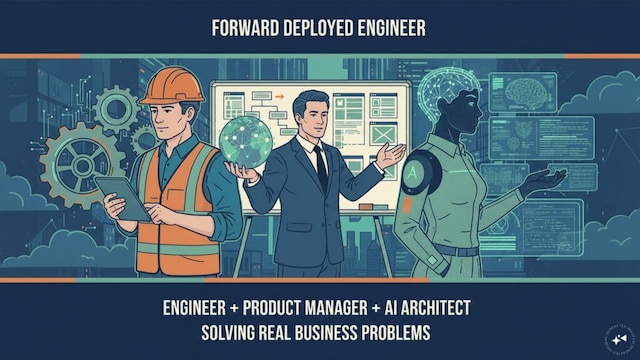
This shift is not only altering how companies procure AI; it’s also transforming whom they hire. One job title that has recently gained significant attention is the Forward Deployed Engineer, or FDE. Think of them as translators—part engineer, part product manager, part AI architect.
Their role extends beyond merely building AI. They enter a client’s business, identify existing issues, and determine where AI can genuinely create value. Speaking to CNBC-TV18, Fundamentum co-founder Sanjeev Aggarwal argued that India could become a global hub for this type of talent.
‘India can be the FDE factory for the world.’
What is a Forward Deployed Engineer (FDE) and why is it becoming AI’s hottest new job?
Speaking to Shereen Bhan on Young Turks Reloaded, Fundamentum Co-founder Sanjeev Aggarwal says FDEs combine the skills of an engineer, product… pic.twitter.com/VYA8JUV0ln
— CNBC-TV18 (@CNBCTV18News) July 3, 2026
The rationale is clear. India has spent decades honing expertise in IT services, enterprise software, and technology implementation. These skills may prove just as crucial in the AI era as during previous technological revolutions.
Aggarwal even posits that AI-native firms centered around FDEs could yield considerably higher revenue with smaller teams than conventional IT services companies. Whether that prediction materializes remains to be seen.
Nonetheless, it raises an intriguing question. Perhaps India’s greatest AI opportunity doesn’t lie in creating the next frontier model. Instead, it may be in becoming the nation that helps the rest of the world effectively utilize them. This could represent a remarkable Indian success story—not necessarily inventing every technology, but becoming essential in its deployment.
The investment community appears to be arriving at a similar conclusion. Startup funding in India fell to $165.8 million across 22 deals during the week ending on July 2, down from over $1 billion the previous week, largely due to CRED’s fundraising.
Weekly funding figures can be unpredictable. One substantial investment can create an illusion of a thriving ecosystem. However, beneath the fluctuations, investors seem to be asking increasingly challenging questions. Who’s paying? Who utilizes the product? Can this evolve into a real business? Innovation remains crucial, but commercial viability is becoming even more important. And this trajectory likely applies to AI as well.
Let’s be clear: The race for frontier models is very much alive. OpenAI, Anthropic, Google, Meta, and others will continue to pursue smarter, faster, and more autonomous AI. Those breakthroughs remain significant. Yet, for enterprises, the real competition may be turning elsewhere. Who can deploy AI at scale? Who can seamlessly integrate it into daily operations? Who can manage costs effectively? Who can demonstrate tangible results instead of merely impressive demonstrations? In essence, who can convert intelligence into value?
The initial phase of the AI revolution centered on convincing everyone that artificial intelligence could achieve remarkable things. The forthcoming phase will focus on substantiating that these extraordinary accomplishments are worth the investment. And that might be the defining battle that determines the true winners.