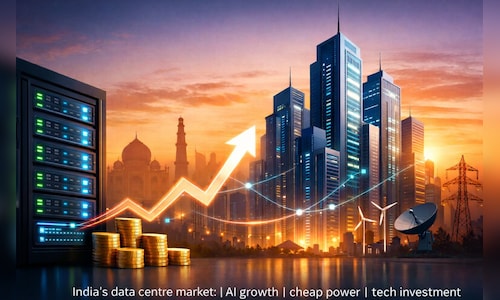
This growth correlates with an almost 30-fold increase in data usage since 2017. India now boasts nearly 900 million internet users, with a rapid rise in artificial intelligence (AI) adoption.
Capacity Growth
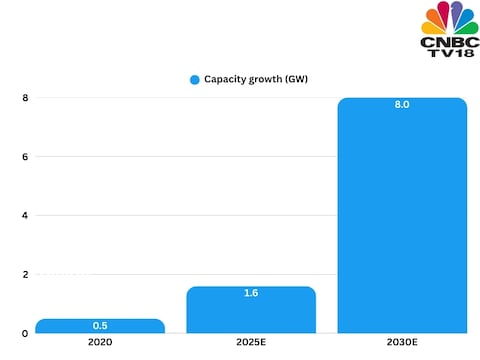
Source: Jefferies
The year was marked by a series of significant announcements. Reliance Industries launched the world’s largest data centre in Jamnagar, alongside a 1 GW AI facility in collaboration with Nvidia. TCS introduced HyperVault, aiming for 1–1.2 GW over five years. OpenAI also allocated 1 GW of capacity.
In total, 2025 witnessed $63 billion in announcements ($43 billion excluding Reliance), according to Bernstein.
Key 2025 Investments
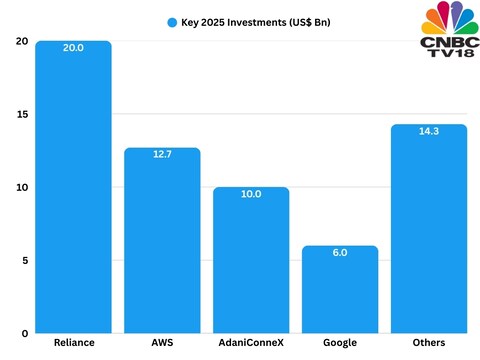
Source: Bernstein
Hyperscalers secured nearly 98 MW in just the first half of the year, maintaining a high occupancy rate of around 97%. Mumbai continued to lead, accounting for half of India’s capacity, aided by its undersea cable connections.
Capacity by City
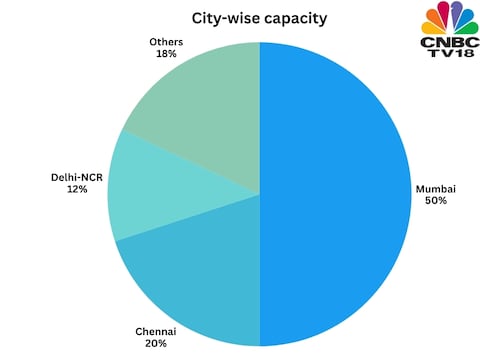
Source: Jefferies
Power and Infrastructure Gain Momentum
Power is emerging as a crucial factor for India’s data centre expansion. The country achieved a record addition of 30 gigawatts (GW) of renewable energy in FY24–25, ranking third globally. This growth was supported by affordable solar energy and robust policy backing — a significant advantage as AI data centres require five to six times more energy than traditional facilities.
Global demand for data centre power is escalating rapidly, projected to grow at approximately 17% annually until 2030. In India, the anticipated growth rate is even higher, around 33% per year.
Meanwhile, prolonged wait times for power access in the US and Europe, coupled with their permitting challenges, are making India a more appealing location for new capacity.
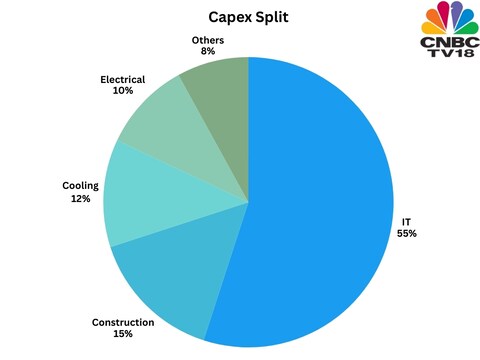
A substantial portion of the investment potential lies outside IT.
Nearly 45% of data centre capital expenditure is allocated to construction, cooling, electrical systems, and other essential equipment.
Data Centre Capex Distribution
Source: Bernstein
This presents opportunities for EPC contractors, cooling technology firms, wiring manufacturers, and power equipment suppliers as new data centres emerge.
India has a solid foundation of companies supplying the non-IT equipment required for data centres, including engineering services from L&T, backup power solutions from Cummins, cooling systems from Voltas, and wiring from Polycab.
Revenue Projections
| Year | Estimated Revenue ($ bn) |
| 2025 | 1.5 |
| 2030 | 8 |
Source: Jefferies
2026 and Beyond: A Multi-Year Opportunity
The next phase of capacity development will necessitate substantial investment, with Jefferies estimating that each megawatt of data centre capacity in India costs about $4–5 million. To achieve the additional 6.4 GW projected by 2030, the sector will require nearly $30 billion in capital expenditure.
This could create downstream opportunities across various sectors, including real estate ($6 billion), electrical and power systems ($10 billion), racks and fit-outs ($7 billion), cooling solutions ($4 billion), and network infrastructure ($1 billion).
This investment wave is poised to benefit a diverse range of stakeholders, including telecom providers, EPC firms, power suppliers, and IT companies operating within the data centre value chain.