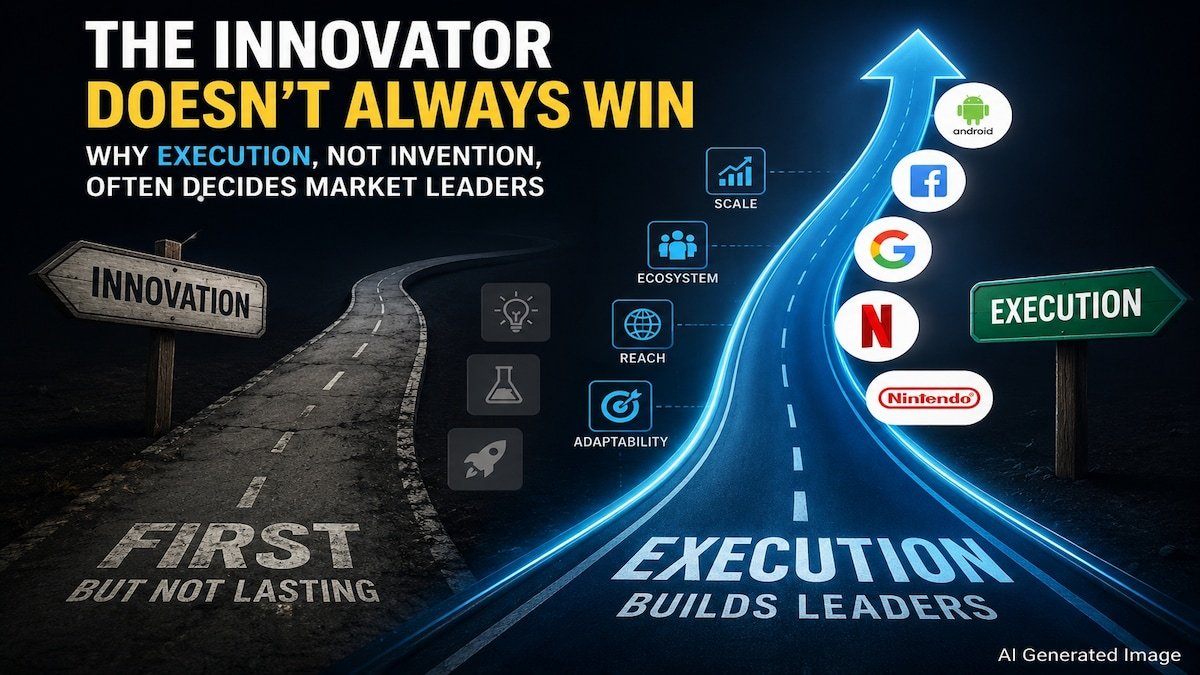
While first movers may establish new markets or redefine existing ones, challengers often capture the most substantial value by enhancing products, broadening distribution, and fostering stronger ecosystems.
Below are five instances where a later entrant or challenger surpassed an early market leader:
1. Android surpassed Apple’s iOS in smartphone market share
Apple revolutionized the smartphone market with the introduction of the iPhone in June 2007, setting new standards for modern touchscreen devices and app-centric mobile operating systems.
In October 2008, Google released Android as an open-source operating system, less than 18 months later. Unlike Apple’s cohesive hardware model, Android collaborated with multiple manufacturers like Samsung, HTC, and Motorola, enabling rapid scaling across various price points and regions.
By late 2010, Android had emerged as the world’s leading smartphone operating system, eventually surpassing iOS. Today, it holds approximately 70% of the global smartphone operating system market.
2. Facebook eclipsed the early social networking leader
MySpace launched in August 2003 and rapidly became the premier social networking site, garnering millions of users and achieving a multibillion-dollar valuation.
Facebook entered the scene in February 2004, initially catering to Harvard students before expanding to the public in September 2006. It set itself apart with a cleaner interface, stronger identity verification, a more engaging news feed, and reduced spam.
About 20 months after going public, in April 2008, Facebook surpassed MySpace in global monthly visitors. By 2009, it also overtook MySpace in U.S. traffic, marking a significant shift in the social media landscape.
3. Google revolutionized web search
Prior to Google, search engines like Yahoo (launched in 1994), Lycos (launched in 1994), and AltaVista (launched in 1995) dominated internet search and web directories.
Google entered the market in 1998 with PageRank, a search algorithm designed to rank pages based on relevance instead of merely listing websites. It also provided a fast, uncluttered homepage that stood in stark contrast to portal-style competitors.
By 2000, Google had become Yahoo’s search provider and quickly established itself as a leading search engine. The company’s name eventually became synonymous with internet searching, reflecting its market dominance.
4. Netflix outlasted Blockbuster
Blockbuster developed one of the largest video rental chains globally through thousands of physical outlets since the late 1980s.
Netflix entered the DVD rental space in 1997 with a mail-order subscription service that eliminated late fees, later transitioning to subscription-based video streaming in 2007.
While Blockbuster struggled with debt and declining foot traffic, Netflix continued to invest in new delivery models and digital distribution. Blockbuster filed for bankruptcy in 2010, while Netflix evolved into one of the largest streaming services in the world.
5. Nintendo revived the gaming industry
Despite Magnavox launching the first home video game console in 1972, Atari popularized the category with the Atari 2600 in the late 1970s. However, decreasing software quality and market oversaturation led to the video game crash of 1983.
Nintendo entered the North American market in October 1985 with the Nintendo Entertainment System. It emphasized stringent quality standards for game developers and heavily invested in exclusive franchises that fortified its ecosystem.
By 1988, Nintendo had gained control over the majority of the North American console market, aiding the revival of the industry while pushing Atari’s hardware business into decline.
Execution creates lasting advantages
These instances demonstrate that being first in a market is just one aspect of building a thriving business. The companies that ultimately prevailed did more than innovate; they executed more effectively, scaled swiftly, enhanced their products, built robust ecosystems, and adapted efficiently to evolving customer needs.
For both businesses and investors, the takeaway is clear: while first-mover advantage may offer an initial boost, long-term market leadership is generally achieved through superior execution and the ability to adapt with the market.
Also Read: US Senate passes sweeping sanctions bill that could affect countries buying energy from Russia