
Dugar has expressed optimism regarding loan growth, noting that inflows from foreign currency non-resident bank (FCNR(B)) deposits are likely to pick up as the September 30 deadline approaches.
Regarding business expansion, Dugar mentioned that the bank is aiming for mid-teen loan growth with a positive outlook, while retail deposits are projected to increase by around 11.5-12%.
He also confirmed the bank’s guidance on credit costs, maintaining it at 50-60 basis points, with a tendency towards the lower end, while remaining vigilant about developments in West Asia.
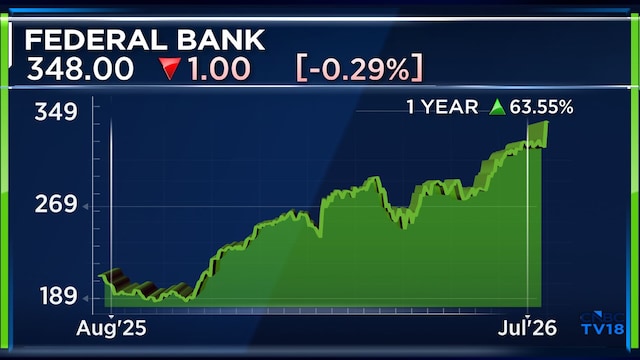
Federal Bank, with a market capitalization of ₹85,772.96 crore, has achieved over 63% returns in the past year.
He also foresees continued growth in the gold loan portfolio, albeit at a moderated pace, projecting it could represent 15-18% of the overall loan book over time.
These are edited excerpts from the interview.Q: Let’s begin with CASA; it shows a quarter-on-quarter decline, yet an increase year-on-year. Can you provide insights on this trend? How dependent are you on current accounts versus wholesale deposits?A: CASA remains a focus area for us, and on a YoY basis, it’s up by approximately 188 basis points. Various factors, such as increasing the number of products per customer and targeting the mid-market and small MSME sectors, have contributed to this. We are committed to enhancing our CASA ratio over the medium term to around the mid-30s, specifically about 36%.
We are guiding for 35%-36% in the medium term, with improvements expected quarter-on-quarter. The seasonal variations in quarter one compared to quarter four are typical, as quarter four usually experiences higher activity, while the first half is generally weaker.
However, looking at the year-on-year performance, it remains strong.
Another important aspect often overlooked is the average CASA. The average level has been increasing significantly, which in turn has positively impacted our cost of funds and contributed to improvements in net interest margin (NIM).
Q: What do you define as the medium term?A: Two to three years, or 24 to 36 months.
Q: Could you discuss the FCNR(B) scheme? How much has been processed through Federal Bank?A: We’ve introduced the FCNR Max scheme, offering a leveraged product to our customers, which we recently launched after securing our lines for leverage provisions.
The anticipated growth in FCNR(B) deposits has been slower than initially expected for various reasons. Tax implications in US and European markets, where interest income is taxed on a gross basis, have particularly affected inflows, with only a smaller segment benefiting from markets in West Asia and Singapore.
Moreover, the ongoing crisis in West Asia has also influenced people’s decisions. Comparatively to 2013, the current difference between US and Indian rates isn’t as attractive, affecting interest in leveraged products.
That said, it’s still early to evaluate fully; we have about two and a half months left, and I am quite optimistic that inflows will increase as we progress.
Q: When did you launch this, and what has been the response so far?A: We launched this last quarter and have begun offering it to our customers. We have noticed some traction, but it’s likely to gain more momentum as customers tend to compare banks and seek clarity on tax implications.
As September 30 approaches, we expect to see an increase in interest and activity, especially in August and September, leading to higher engagement.
From what we observe, our share in the FCNR(B) market will also see growth.
Q: What is your current market share?A: Our market share in the FCNR(B) segment stands at about 2.5%. We project to capture around 2.5%-3% of the incremental FCNR(B) inflows.
Initially, estimated inflows ranged from $60 billion to $80 billion, but discussions have now shifted to a lower range of $50 billion to $55 billion, which appears to be the industry’s consensus.
Q: Do you believe you’ll reach the $50 billion to $55 billion target?A: That’s the industry outlook, and I anticipate we will.
Q: Is the slower growth due to tax implications in the US and Europe, as well as the less favorable interest rate differential compared to 2013?
A: Additionally, the situation in West Asia continues to affect inflows.
Q: With dollar rates recently increasing, doesn’t this further complicate matters?A: The FCNR(B) offers dollar-denominated returns, so it shouldn’t directly impact inflows. However, the anticipated inflows initially were larger than what we’ve seen. The rupee’s appreciation following the RBI announcement has recently converted to depreciation.
Q: Current loan growth is at 15%, and deposit growth is at 11.4%. What’s your outlook for the full year, and are you comfortable with the gap between these growth rates?A: We continue to project mid-teen loan growth, maintaining a favorable outlook.
On the deposit side, we expect growth around 11.5%-12%, with retail deposits performing strongly at about 14.5%-15%.
We’ve intentionally moderated corporate or wholesale deposit growth for two reasons: the higher pricing associated and our desire for a more granular deposit base. Moreover, with FCNR(B) funds incoming, we want to avoid offering higher rates that could inflate our wholesale deposits.
Focusing on granular retail deposit growth has yielded solid results. Additionally, CASA has shown improvement on a YoY basis, with the share of current accounts and savings accounts increasing by 60 to 90 basis points, contributing to growth and reducing funding costs.
Q: Your credit cost is at 41 basis points. Your guidance is 50-60 basis points. Is there potential to lower this?A: We’re not altering our guidance now, but we do have a positive bias. We may land on the lower end of our guidance, although we are not officially predicting it.
It’s worth noting that developments in West Asia could impact this projection, and we are monitoring the situation closely. For now, our guidance of 50 to 60 basis points remains with a positive bias toward the lower end.
For the full interview, watch the accompanying video

Catch all the latest updates from the stock market here