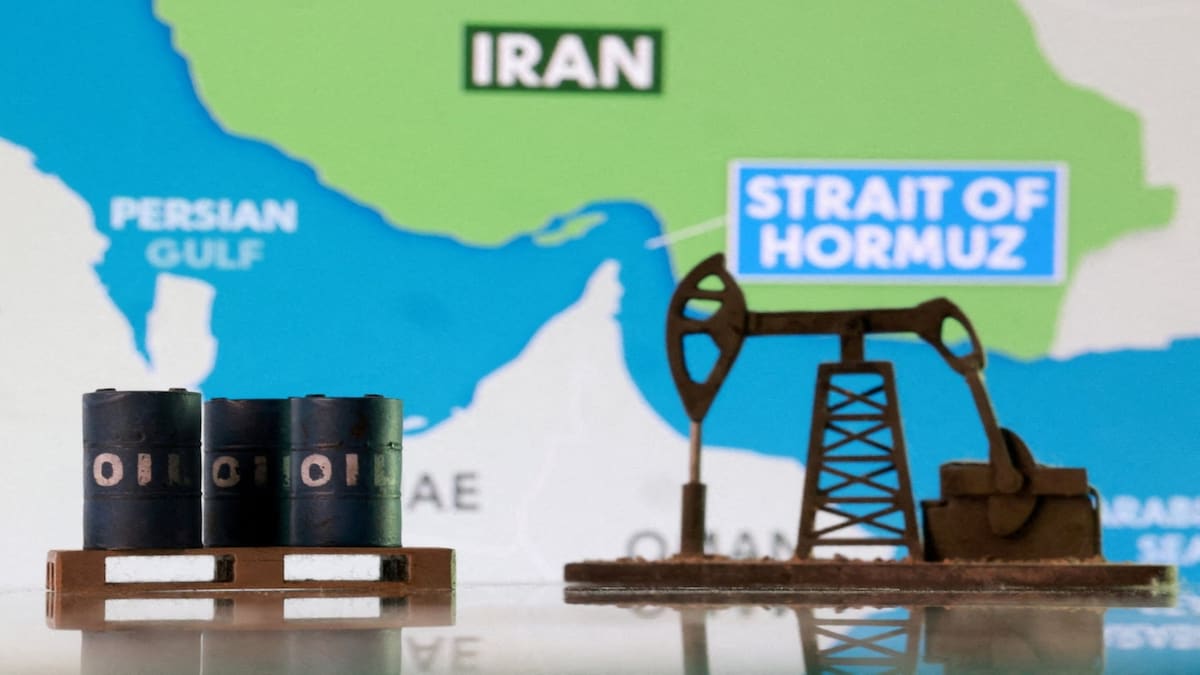
Beyond the immediate military skirmishes, a larger concern for the global economy is whether Iran could respond by disrupting shipping through the Strait of Hormuz — the most critical oil transit chokepoint in the world.
Geo-economic analyst Ahmad Salehi notes that this option remains Iran’s primary leverage if the US continues to impose stricter sanctions on its oil exports.
Why is the Strait of Hormuz so vital?
The Strait of Hormuz is a narrow passage linking the Persian Gulf to the Gulf of Oman and the Arabian Sea. It serves as the primary export route for crude oil and liquefied natural gas from Gulf nations such as Saudi Arabia, Iraq, Kuwait, the UAE, and Qatar.
Any interruption to shipping through the strait raises immediate alarms about global oil supplies, freight costs, and energy prices. Even the perception of increased risk can lead to higher crude prices as traders factor in the potential for supply disruptions.
This explains why every escalation between Washington and Tehran brings the Strait of Hormuz back into the spotlight.
Why does Iran consider the Strait its strongest bargaining chip?
After the most recent exchange of strikes, the US revoked a temporary sanctions waiver that had permitted Iran to continue limited oil exports.
Salehi contends that if Iran loses its ability to export oil by sea, it may choose to restrict others from doing the same.
“Whether Iran is exporting oil or not, no other country would be able to do so either.”
He asserts that Iran does not need to sink ships or cause significant damage to make its threat credible.
“When Iran’s stance is to control the Strait of Hormuz, it indicates that they do not need to launch hundreds of missiles or inflict extensive damage,” Salehi stated. “They just have to make this threat believable.”
This approach is more about generating uncertainty than causing widespread destruction, leading shipping companies, insurers, and energy traders to hesitate in operating in the region.
Can sanctions fully isolate Iran?
Salehi believes that a complete economic blockade would be challenging.
Iran shares land borders with 15 neighboring countries, providing multiple trade routes even if maritime exports become more challenging.
“A nation with this many neighbors cannot be entirely blockaded.”
However, he recognized that land trade cannot substitute for oil exports carried by sea. Oil remains Iran’s principal source of foreign exchange and is crucial for economic stability.
Could the US endure a prolonged conflict?
Salehi also raised doubts about whether Washington would be prepared to engage in a lengthy military endeavor.
He highlighted that US strategic petroleum reserves are significantly lower than during the previous understanding with Iran, limiting America’s capacity to withstand a prolonged disruption to global oil supplies.
He also referenced President Trump’s earlier remarks suggesting that a long-term conflict could severely impact oil availability, arguing that current market conditions make a full-scale war less probable than political rhetoric implies.
Why are markets reacting so strongly?
Former Indian Ambassador Rajiv Dogra posits that the greatest risk for financial markets stems from uncertainty rather than mere military action.
He noted that contradictory statements from Washington have made it challenging for investors to predict the trajectory of the situation.
On one hand, Trump has suggested that negotiations with Iran might continue. On the other, he declared the withdrawal of Iran’s oil export waiver while simultaneously warning of renewed military actions.
“So what is the market expected to make of that?” Dogra questioned.
“Should oil be priced at X dollars, X plus $10, X minus $10, or somewhere in between?”
According to Dogra, this unpredictability is likely to impact not just crude prices but also inflation, transport costs, and industrial planning globally.
Could the conflict escalate further?
Dogra cautioned that once military exchanges commence, controlling escalation becomes increasingly challenging.
He mentioned that wars seldom follow predictable trajectories and can quickly extend beyond their initial goals due to retaliation and counter-retaliation.
“War is a perilous venture. It cannot be managed by simply flipping a switch.”
While he expressed hope for a resumption of diplomacy, he warned that further strikes would complicate negotiations significantly.
How did the recent crisis unfold?
The latest tensions escalated after the US accused Iran of attacking three vessels near the Strait of Hormuz, including a Qatari-flagged LNG tanker. Iran neither confirmed nor denied the claims.
In retaliation, the US military stated it targeted over 80 Iranian positions, including air defense systems, command centers, and ships belonging to the Islamic Revolutionary Guard Corps near the Strait.
Washington also revoked Tehran’s temporary oil export waiver.
Iran subsequently struck back by launching attacks aimed at Bahrain and Kuwait. Kuwaiti authorities reported intercepting two ballistic missiles and 13 drones with no casualties or major damage.
What lies ahead?
Whether Iran will indeed try to disrupt shipping through the Strait of Hormuz remains uncertain. Such an action would involve substantial economic and geopolitical risks, not only for the US but also for Gulf nations reliant on this route for energy exports.
Nonetheless, the latest escalation underscores why the Strait is considered one of the world’s most strategically sensitive waterways. As long as sanctions, military actions, and diplomatic efforts continue to overlap, even the mere potential for disruption is likely to keep oil markets on alert.
For the full discussion, watch the accompanying video