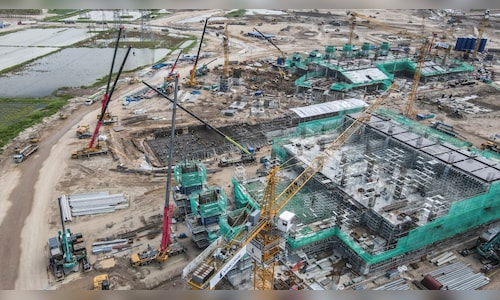
At the site, located approximately 25 kilometers (15.5 miles) south of central Hanoi, thousands of workers are toiling around the clock to ensure the venue is finished by July 2027, a Vingroup representative informed Reuters during a recent site tour. This timeline is set a year ahead of the original schedule revealed in December.
The stadium will feature “the largest seating capacity in the world” as well as the most extensive fully retractable roof, according to Vingroup, which is concurrently engaged in several other initiatives such as a high-speed railway, urban developments, and wind power projects.
Currently, the largest venue globally, as recognized by the International Olympic Committee, is the Rungrado Stadium in Pyongyang, North Korea, which is reported to hold 150,000, though some experts have disputed this figure and estimated the actual capacity to be under 120,000 seats.
Vingroup indicated that the scale of the project is aimed at accommodating large sporting and cultural events, including concerts.
“Though football enjoys immense popularity in Vietnam, relying solely on domestic football attendance to justify a 135,000-seat stadium seems unlikely,” stated James Walton, leader of the sports business group at Deloitte Asia Pacific. He pointed out that during the 2023-24 season, the average attendance for matches in Vietnam’s top-tier V.League 1 was fewer than 6,000 spectators.
While Vingroup did not disclose financial projections, it expressed confidence that the venue would be commercially sustainable over time.
The company faces greater challenges from its financial obligations, which reached $36.7 billion last year, comprising over 4% of Vietnam’s total private debt in 2025. This figure excludes the debts of its private affiliates.
The Trong Dong Stadium, named after a traditional Vietnamese bronze drum, is part of a $35-billion “Olympic Sports City” initiative led by Vingroup, which spans over 9,000 hectares (22,200 acres) on the outskirts of the capital and is intended to host significant global events.
“Connecting the project to broader urban development can enhance its long-term financial viability,” noted Walton, who emphasized that many modern national stadiums typically have a capacity of 60,000 to 80,000.
The initiative is part of a significant effort to modernize Vietnam’s infrastructure and achieve an annual economic growth rate of at least 10% until the decade’s end, a goal explicitly outlined by the ruling Communist Party.
Authorities have announced numerous large-scale projects anticipated to cost around $200 billion by 2030, encompassing airports, seaports, bridges, and railways.
Quynh Nguyen, a finance lecturer at Hoa Sen University in Ho Chi Minh City, acknowledged the necessity of modernization while urging caution regarding banks’ exposure and funding risks.
“In a growing nation like Vietnam, infrastructure often needs to be built ahead of demand,” remarked Tran Thi Mong Tuyen, a researcher at the Hawaii-based Pacific Forum, also highlighting the risks of underutilized infrastructure and delayed returns on investment.