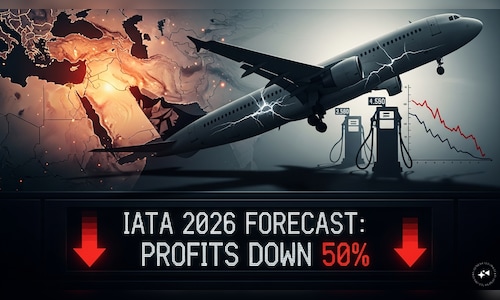
The profitability of the global airline sector is anticipated to shrink by 50% in 2026 due to the ongoing conflict in the Middle East and a considerable increase in fuel expenses impacting carriers around the globe, according to the latest industry outlook from the International Air Transport Association (IATA).
IATA now forecasts a collective net profit of $23 billion for airlines in 2026, a drop from the estimated $45 billion for 2025 and nearly half of the earlier projected profit of $41 billion for this year.
The industry’s net profit margin is estimated to decrease to 2%, down from 4.2% last year, while net profit per passenger is expected to fall to $4.50, about half of the $9.10 achieved in 2025.
“Disruptions related to the war in the Middle East and escalating fuel costs have shifted airlines’ outlook negatively,” stated Willie Walsh, IATA’s Director General.
“Gulf carriers are facing operational uncertainty following a near-total airspace shutdown at the conflict’s onset. These airlines are doing remarkable work maintaining connectivity, but significant financial impacts are unavoidable,” he added.
The primary challenge for airlines this year is fuel. IATA forecasts that average jet fuel prices will rise to $152 per barrel, almost a 70% increase from $90 per barrel in 2025. Consequently, the industry’s fuel expenses are projected to soar from $252 billion to $350 billion, making up over 31% of total operating costs.
Despite the challenges on profitability, air travel demand remains robust. Passenger traffic is anticipated to hit a record 5.1 billion travelers this year, while airlines are expected to achieve an unprecedented load factor of 84%, indicating that more seats will be occupied than ever before.
Total industry revenues are projected to increase by 9.4% to a record $1.165 trillion, spurred by higher fares, strong passenger demand, and growing ancillary revenues. However, operating expenses are expected to rise even faster at 13%, hindering airlines’ ability to convert revenue growth into profits.
The Middle East is anticipated to be the most adversely affected region, with airlines expected to report a collective loss of $4.3 billion in 2026, compared to a profit of $7.2 billion last year. Flight cancellations, airspace limitations, reduced transfer traffic, and heightened operating costs are likely to heavily impact carriers in this region.
In contrast, airlines in Europe, North America, and Asia-Pacific are expected to remain profitable, although earnings across all regions have been revised lower due to increased fuel expenses and a more subdued global economic outlook.
IATA also cautioned that aircraft supply-chain issues continue to inhibit growth. The industry’s backlog has surged to 18,100 aircraft, accounting for more than half of the world’s active fleet, forcing airlines to employ older aircraft longer and escalating maintenance costs.
While the industry is set to achieve record revenues and transport more passengers than ever, the latest outlook underlines how susceptible airline profitability is to geopolitical disruptions and fuel price fluctuations.
For an industry projected to carry over five billion passengers this year, airlines will ultimately earn just $4.50 per passenger, a reminder of the slim margins that characterize global aviation.