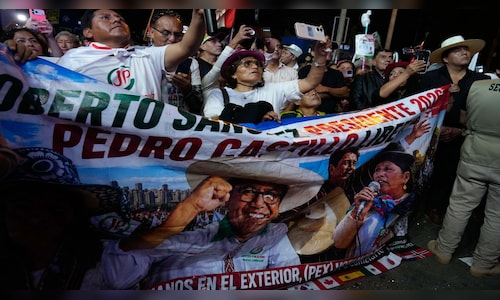
Keiko Fujimori and Roberto Sánchez triumphed over 33 other candidates in an April contest, both pledging to tackle the escalating crime rates, which have become the chief concern for Peruvians as homicide rates have doubled and extortion cases have surged over the past ten years. Nevertheless, each candidate garnered less than 20% of the vote.
The results from Sunday are anticipated to be closely contested, with the final outcome possibly taking days to be confirmed. Electoral authorities took more than a month to announce Fujimori — daughter of the late convicted former president Alberto Fujimori — and Sánchez — an ally of imprisoned former President Pedro Castillo — as the winners of the April 12 election.
Here’s what to know about the election.
Voting is compulsory for Peruvians aged 18 to 70. Over 27 million people are registered, with around 1.2 million expected to vote from abroad, primarily from the United States and Argentina.
Many of these voters have expressed uncertainty about their choices.
“There is a large group of undecided voters … I think that’s where the emotionally driven anti-votes will play out the final battle,” political analyst Iván García mentioned.
The principal concern among Peruvians is the rise in crime, especially extortion, which has triggered frequent protests. A 2025 national survey by the National Institute of Statistics and Informatics revealed that 84% of urban respondents feared being victims of crime within the upcoming year.
Experts point to the increased influence of organized crime in Peru due to the profits earned by longstanding criminal groups from illegal gold mining in the Andes and the Amazon. In 2025, Peru exported 100 tonnes of illegally mined gold, nearly matching its legal gold exports.
Over the last five years, extortion complaints in the country have surged fivefold, reaching 28,948 cases last year, while homicides doubled, totaling 2,226 in 2025, according to official statistics.
The Ministry of Economy estimated in July that crime costs Peruvians approximately $5 billion annually. This estimation includes government spending on police operations as well as private investments in surveillance and security.
Despite the rampant crime and political instability, characterized by a rapid succession of three presidents since October, Peru’s economy has shown resilience. Benefitting from its position as the world’s second-largest copper producer, the country achieved over 3% growth in both 2024 and 2025.
Fujimori, 51, is making her fourth bid for the presidency.
Throughout her campaign, she has vowed to adopt a tough stance on crime. Her strategies include using technology to monitor extortions, militarizing borders, and increasing police and military presence in high-risk zones. She also stated that prisoners would be required to work to “repay society.”
In her only debate before the runoff, Fujimori defended her father’s administration and asserted she could combat crime as effectively as he did against the Shining Path terrorist group.
She assured voters that if elected, they could expect “more affordable chicken, lower gas cylinder prices, and reasonably priced fertilizers for their crops,” along with a promise that they would “return home safe and sound.”
In recent weeks, however, Fujimori has attempted to soften her hardline image with friendly overtures to former political rivals, such as ex-President Pedro Kuczynski, who defeated her in the 2016 race.
Kuczynski resigned in 2018 amid calls for his removal, largely driven by Fujimori’s party, which later expressed regret for the instability they caused.
“I understand that I have made mistakes in my political career, and I have learned from them,” Fujimori acknowledged during the debate.
On the other hand, Sánchez, a former minister, has sought to alleviate investor concerns regarding his candidacy, assuring that he will not nationalize assets belonging to transnational companies involved in mineral or gas extraction in Peru.
He has also committed to fighting corruption within the police and advocating reforms that would enable military support for security measures.
During the debate, Sánchez, who enjoys popularity among rural voters, stated he would consider “all options to generate jobs and progress” while also highlighting his support for Chinese investments.
He informed The Associated Press that he plans to renegotiate mining contracts, including with the Chinese state-owned company Minmetals, which controls Las Bambas, one of the world’s largest copper mines.
The 57-year-old, often seen wearing a wide-brimmed peasant hat gifted to him by Castillo, has distanced himself from ultranationalist ally Antauro Humala — a former military officer and brother of imprisoned former President Ollanta Humala — who is advocating for the death penalty in corruption cases.