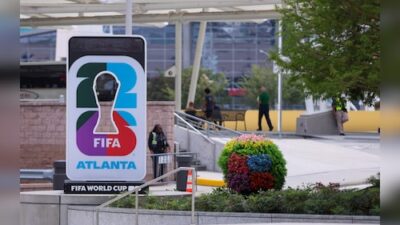
As the Georgia state capital prepares to host World Cup games this summer, it aims to present a revived image to the world. The event is projected to attract 500,000 visitors, with an economic impact estimated between $500 million and over $1 billion, based on a study commissioned by the Metro Atlanta Chamber of Commerce.
Atlanta has acquired new trains for its transit system, enhanced downtown aesthetics with vibrant murals, and revitalized the Mercedes-Benz Stadium in preparation for eight World Cup matches, including a semi-final.
Democratic Mayor Andre Dickens has prioritized addressing homelessness. Two years ago, a $60 million initiative was initiated, marking the largest effort in Atlanta’s history. By May, the program was close to fulfilling its goal of constructing 500 tiny apartments for transitional or permanent housing for those experiencing homelessness.
The estimated homeless population stands at around 3,000 in a city of half a million, according to federal figures, which is relatively low compared to many other U.S. metropolitan areas.
However, advocates for the homeless argue that there is still too much focus on displacing individuals rather than providing the necessary support.
Donald Whitehead, executive director of the National Coalition for the Homeless, indicated that while Atlanta has made progress in its dealings with homeless individuals since the 1990s, the city continues to clear camps without sufficient services or housing alternatives.
Michael Nolan, a counselor with years of experience working with Atlanta’s homeless population, shares a similar perspective.
“Today, the city emphasizes outreach, safety, shelter referrals, and housing placements,” he noted. “Some of that may be genuine… Yet the ultimate goal remains the same: moving the poor and homeless out of view.”
Another black eye?
During the 1996 Olympics, police made 9,000 arrests of homeless individuals for minor offenses such as loitering and panhandling, according to the Brookings Institution.
“What occurred during the Olympics remains one of the most disgraceful episodes for the homeless in America,” Whitehead remarked.
“Individuals were arrested, jailed for minor crimes, and given one-way bus tickets,” he recounted. “It served as a blueprint for how not to approach the issue.”
Atlanta still occasionally conducts sweeps of homeless camps.
In the last two years, city workers have dismantled several camps around downtown, including ten near the Mercedes-Benz Stadium, as reported by the Atlanta Journal-Constitution.
Last year, a city bulldozer tragically killed a man sleeping in his tent. Following this, a task force was convened to recommend ongoing outreach and tent check-ins, including notifying encampment residents of impending sweeps and giving them relocation options to shelters or, when feasible, permanent housing.
Some individuals experiencing homelessness believe that the upcoming World Cup has drawn increased scrutiny.
Benjamin Brown, 54, who has been living on the streets since 2017, reported that police had instructed him and others to vacate downtown three times recently, where the games will take place.
“It’s all about the World Cup,” stated Brown, who works as a contractor and sells loose cigarettes. “They didn’t offer us any help or gift cards; we simply had to move.”
Reuters found him along with 25 others, including children, living in tents in Mechanicsville, approximately two miles (3 km) from downtown.
In a statement to Reuters, Atlanta police affirm their commitment to ensuring a safe, orderly, and compassionate environment for all city residents, including those facing homelessness.
Mayor Dickens, who did not address Reuters’ interview requests, mentioned that encampments pose safety concerns.
Atlanta City Council member Kelsea Bond noted that city officials assert the recent sweeps have no connection to the World Cup, but she warned that the spotlight on Atlanta would return.
“We could face another negative incident; it will depend on the city’s response,” Bond cautioned. “I’m concerned that police will increase arrests downtown. This is a critical moment to observe.”