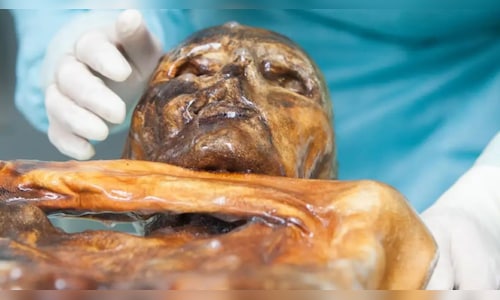
Scientists examining the 5,300-year-old mummy have pinpointed a distinct blend of ancient microbes, along with contemporary microorganisms that seem to have inhabited the body during its conservation, according to Springer Nature.
About the preservation of the Copper Age individual
Ötzi has remained naturally preserved within the icy environment of the glacier for over five millennia before his discovery in the Ötztal Alps. The freezing temperatures served as a natural barrier against decomposition and restricted microbial growth. His remains were unearthed in 1991 in the Ötztal Alps, close to what is now the border between Austria and Italy.
After the discovery, scientists applied a special phenol-based solution to the mummy to inhibit fungal growth. They quickly recognized that maintaining a frozen environment was crucial to preserving the ancient remains and avoiding microbial contamination.
Currently, Ötzi is housed in a specially designed refrigeration chamber at the South Tyrol Museum of Archaeology in Bolzano, Italy. This chamber is maintained at a steady temperature of -6°C and a humidity level of 99%, closely mimicking the glacier conditions that preserved the mummy for millennia. The only significant difference is a slightly elevated oxygen concentration due to altitude variations.
Uncovering ancient microbial communities
To gain deeper insights into the microorganisms associated with the mummy, researchers utilized a combination of scientific techniques, including amplicon sequencing, metagenomics, and genome analysis. Their results indicated three primary sources of microbes: bacteria that naturally emerged post-mortem, ancient microorganisms preserved from the glacier environment, and modern microbes that were introduced during conservation efforts.
Analysis of tissue samples revealed several ancient gut bacteria that appear to have persisted for over 5,000 years. These microorganisms closely mirror those found in ancient human populations, offering valuable insights into the gut ecosystem of Copper Age individuals.
Additionally, researchers noted significant changes in the microorganisms inhabiting the mummy’s exterior. A number of cold-adapted yeast species, including Glaciozyma watsonii, Mrakia robertii, Phenoliferia glacialis, and Goffeauzyma, have seen an increase in prevalence in recent years.
While the bacterial communities inside the Iceman have remained relatively stable, researchers identified a marked rise in certain yeast species residing on the mummy’s surface between 2010 and 2019. These microorganisms exhibited fewer indicators of ancient DNA damage, suggesting they are modern microbes that have recently colonized the mummy rather than remnants from ancient times.
Why preservation conditions matter
A critical question regarding the Iceman is whether the current storage conditions completely halt microbial activity or merely slow it. The freezing temperatures inhibit the growth of most organisms responsible for decomposition, yet they may permit the activity of cold-adapted microorganisms.
Scientists have pondered whether these storage conditions might still allow cold-adapted microorganisms to function and potentially contribute to gradual degradation over time.
Prior studies have detected microbial DNA within the mummy’s tissues, but they could not ascertain whether these microorganisms were dead, dormant, or biologically active. Thus, researchers have lacked a comprehensive understanding of the long-term risks posed by microbial activity in the mummy’s preservation environment.
More than a static relic
The research indicates that Ötzi should not be regarded merely as a static artifact. Instead, researchers characterize him as a dynamic biological interface where ancient microorganisms that have survived millennia coexist with modern microbes that have recently colonized the mummy.
The presence of both ancient gut bacteria and newly introduced microorganisms suggests that some microbial activity may still be ongoing, even under freezing conditions. These findings underscore the necessity of maintaining rigorous storage protocols to safeguard the ancient remains.