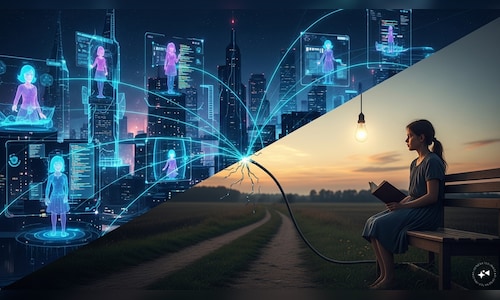
However, in many communities across India where I’ve worked, girls are still battling for access to something far more fundamental: a reliable internet connection, personal digital devices, and the security to navigate the online world safely.
Discussions surrounding AI often presume universal participation. Yet millions of girls have yet to gain entry into the digital realm that is shaping this technology.
Having spent over a decade at the crossroads of gender equality, education, and youth leadership, I’ve witnessed firsthand how digital inequity subtly dictates who has access to opportunities and who is left behind.
In rural and underserved areas, technology is frequently seen as a resource more “beneficial” for boys. Girls are expected to maneuver around limited access, shared devices, domestic duties, and social constraints that continue to influence their engagement with education and innovation.
As artificial intelligence rapidly changes economies and institutions, these disparities are not diminishing; rather, they are intensifying.
The narrative often paints AI as a neutral instrument capable of democratizing opportunities. However, technology cannot be genuinely neutral when the societies developing it are marked by inequality.
AI systems learn from existing data, structures, and human interactions. When women and girls, especially from the Global South, are excluded from digital environments, their realities become obscured within systems that increasingly determine public life.
The identities of those who create technology are crucial. The representation of language matters. The inclusion of experiences in datasets is vital.
Currently, most AI systems are heavily influenced by English-language data and perspectives from wealthier regions. Meanwhile, millions of youth across the Global South are maneuvering through digital ecosystems that fail to fully acknowledge their cultural contexts, languages, or experiences.
This leads not only to technological exclusion but also a growing concentration of authority in the hands of those already privileged to influence innovation.
This is particularly alarming for girls.
In numerous communities, girls are encouraged to consume technology but seldom empowered to create it. They are taught digital skills as users, not innovators. Even when girls integrate into STEM fields, they encounter obstacles ranging from online harassment and safety issues to the absence of mentorship, representation, and institutional support. Too many young women still perceive technology as something produced elsewhere, by someone else, for someone else.
Simultaneously, the future of work is increasingly connected to AI literacy, adaptability, and technological fluency. If girls are shut out of these systems today, they may face exclusion from future economies altogether.
The divide in AI is rapidly becoming an economic divide, a leadership divide, and ultimately a power divide.
What concerns me the most is that talks about inclusion often remain superficial. Young people, especially girls from the Global South, are frequently invited to global dialogues as symbols of resilience and inspiration, while decisions regarding technology governance, investment, and infrastructure continue to be made without their input. Representation without genuine access alters very little.
True inclusion requires far more than mere symbolic presence. It necessitates investments in digital infrastructure, accessible internet, localized and multilingual AI systems, online safety measures, and meaningful opportunities for girls to take on leadership roles in STEM and technology fields. Additionally, it necessitates that governments, institutions, and technology companies cease regarding gender equality as a secondary topic rather than a fundamental prerequisite for ethical innovation.
We cannot cultivate a fair technological future while half the world continues to struggle to access the digital present.
Artificial intelligence will influence how societies learn, work, communicate, and govern for years to come. However, if existing inequalities go unaddressed, AI risks perpetuating the very exclusions that the world claims it aims to resolve.
The question has shifted from whether AI will dictate the future to who will be allowed to shape that future and who will remain digitally unseen.