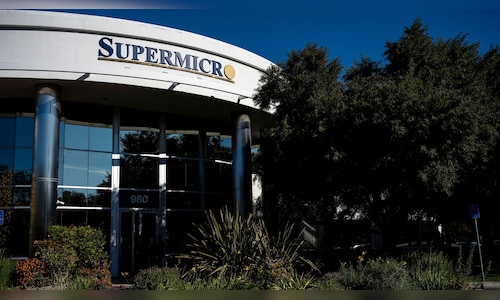
The earnings, excluding specific items, are projected at 65 cents to 79 cents per share for the period ending June 30, according to a statement from Super Micro on Tuesday.
Fiscal fourth-quarter revenue is expected to range between $11 billion and $12.5 billion. Analysts surveyed by Bloomberg had anticipated an average profit of 57 cents alongside sales of $11.2 billion.
Sales of the company’s servers equipped with Nvidia Corp. chips have surged as customers aim to enhance their capabilities in training and executing artificial intelligence operations. With the rollout of new Nvidia processors, Super Micro, along with competitors like Dell Technologies Inc. and Hewlett Packard Enterprise Co., is investing in securing contracts and accelerating new products for clients.
A recent legal issue has raised concerns that Super Micro’s clients might consider switching to other vendors. However, the forecast suggests that demand continues to be strong in a market facing supply constraints that limit purchasing options.
The company also announced an adjusted gross margin of 10.1% for the fiscal third quarter ending March 31, surpassing analysts’ expectations of 6.75%. The adjusted profit reached 84 cents per share, exceeding the analysts’ average estimate of 63 cents.
Read More: Samsung reaches $1 trillion valuation milestone, joining TSMC in an elite club
“Our margin recovery and the swift growth of our DCBBS business illustrate the resilience of our operations,” stated Chief Executive Officer Charles Liang, referencing the company’s division that sells integrated hardware, software, and service solutions. “With the addition of our new manufacturing facilities in Silicon Valley, we are exceptionally well-positioned to address the tremendous demand.”
The Data Centre Building Block Solutions, or DCBBS, unit provides products that integrate various types of equipment including chips, networking, and cooling systems, as well as software for managing backup batteries and large-scale server racks. These offerings are enabling Super Micro to increase sales to clients and boost profitability, Liang mentioned during a conference call with analysts after the results were announced. DCBBS “is expected to soon account for over 25% of our total profit in the coming years,” he added.
The shares climbed approximately 18% in after-hours trading after settling at $27.83 in New York. However, the stock has decreased by 4.9% over the past year.
In March, U.S. prosecutors charged Super Micro co-founder Yih-Shyan “Wally” Liaw with illegally rerouting billions of dollars in Nvidia-powered servers to China, violating U.S. export controls, which caused the company’s shares to plummet. Super Micro is not named as a defendant in the case. The San Jose, California-based firm has stated it is cooperating with authorities and has placed Liaw, who resigned from the board, on administrative leave. The company appointed DeAnna Luna as chief compliance officer; she previously managed export licensing at Intel Corp.
“I am personally shocked and saddened by these allegations,” Liang expressed during the call.
Super Micro has faced challenges related to accounting, inconsistent sales flows, and the necessity to manage costs associated with building and delivering its servers. In October, the company unexpectedly announced preliminary results for the fiscal first quarter that significantly underperformed expectations, attributing it to delayed contracts. Consequently, those contracts bolstered results for the fiscal second quarter.
Revenue for the third quarter more than doubled to $10.2 billion, compared to analysts’ average estimate of $12.4 billion. Sales were impacted by delays at several client sites, according to Liang, who refrained from naming specific clients during the call.
“This represents a purely short-term delay,” he noted. “Several customer sites have not yet been equipped with the necessary power and networking for their cloud deployments, and we anticipate capturing this revenue in the upcoming quarters.”
Super Micro forecasts sales between $38.9 billion and $40.4 billion for the current fiscal year, stating earlier its goal of achieving $40 billion in annual revenue.
Additionally, Super Micro has been working to resolve issues related to financial reporting, having missed an August 2024 deadline for filing its annual statement. Its auditor, Ernst & Young LLP, resigned due to concerns over the company’s governance and transparency. Ultimately, Super Micro managed to file financial statements but later warned it had discovered further issues with its financial controls.
In August, the company indicated that it had commenced remediation efforts to address a “material weakness” in its controls, but also noted the potential for additional issues to arise in the future.