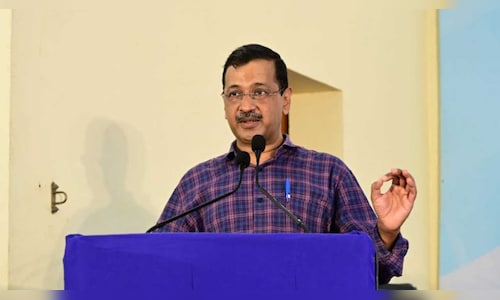
On Monday, the Delhi High Court denied AAP leader Arvind Kejriwal’s request for Justice Swarana Kanta Sharma to recuse herself from the liquor policy case, stating that entertaining such motions would compromise judicial independence.
Rejecting the application, Justice Sharma challenged the underlying premise of the request, asking, “Why should a judge undergo an agnipareeksha (being judged by a litigant)?” Kejriwal presented his arguments personally in court, claiming that there was a perceived bias warranting her withdrawal.
The former Chief Minister of Delhi alleged a conflict of interest, asserting that Justice Sharma’s children are part of the Central government and have received assignments from Solicitor General Tushar Mehta, who represents the CBI in this case. He also pointed to her involvement in events associated with RSS-linked organizations, claiming that his political stance against that ideology raised bias concerns.
However, the court firmly dismissed these assertions, maintaining that recusal should not be grounded in “unfounded suspicion” or “fabricated allegations.” Justice Sharma remarked that “a politician cannot be allowed to cross the line and cannot evaluate judicial competence,” emphasizing that such judgments belong to higher courts.
“Allowing a recusal could suggest that judges are affiliated with specific political parties or ideologies. This court cannot permit this, as it would lead to a dangerous precedent,” she warned.
The judge highlighted that the allegations were devoid of solid evidence, founded on “aspersions, insinuations, and doubts” regarding her integrity. “If I were to approve these requests, it would create a concerning precedent. I must address it with courage,” she stated.
Responding to concerns about her children’s roles in government, Justice Sharma indicated that no clear connection to the case was demonstrated. “Even if relatives are on government panels, the litigant must establish relevance and impact on this case. Such a connection has not been shown,” she remarked.
She further explained that a litigant cannot dictate the professional paths of a judge’s family unless misuse of office is proven. “A judge cannot recuse to appease a litigant’s baseless suspicion of bias,” she concluded.
Read More: Who is Swarna Kanta Sharma, the judge Arvind Kejriwal wants off his case
On matters regarding public perception and social media discussions, the court deemed them irrelevant, asserting that judicial decisions rely on evidence, not narratives. “A lie, no matter how many times repeated, does not transform into truth,” Justice Sharma noted.
The court also emphasized that accepting such arguments would prevent judges from addressing numerous cases involving the Union government, which is an untenable position.
This case arises from the CBI’s appeal regarding a trial court decision that acquitted Kejriwal and several others in the alleged liquor policy matter. Following the denial of recusal, the High Court is set to hear the CBI’s arguments on April 29-30.