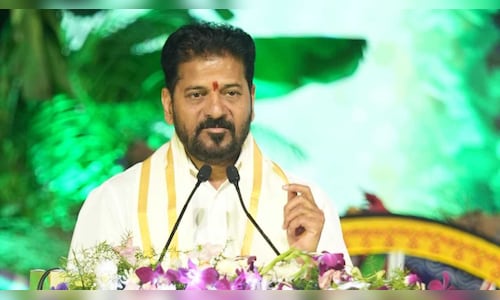
Telangana Chief Minister Revanth Reddy has intensified his opposition to the proposed expansion and delimitation of Lok Sabha seats, reaching out to Prime Minister Narendra Modi and Tamil Nadu Chief Minister M. K. Stalin to promote a unified stance among southern states.
In his correspondence with the Prime Minister, Reddy expressed his apprehensions regarding the plan to raise the number of Lok Sabha seats to 850, warning that a pro-rata (population-based) model could disrupt the federal balance. He emphasized that issues of women’s reservation, delimitation, and seat expansion are separate and urged the government to implement a 33% reservation for women immediately within the current 543 seats.
“Delimitation can involve redrawing constituency lines, but the proposal to increase Lok Sabha seats to 850 is contentious. A pro-rata allocation model could create a serious imbalance within the federal structure,” he stated.
The Chief Minister highlighted that southern states, including Telangana, have successfully implemented population control measures and achieved improved human development indicators, yet they now face the risk of diminished political representation under the proposed framework.
In a separate note to Stalin, Reddy advocated for a collaborative effort among southern states against what he described as a “disguised” initiative to reinstate a population-based model through the pro-rata formula. He referred to the delimitation conference held in Chennai in 2025, emphasizing the necessity for solidarity in opposing such proposals.
He pointed out that while all states might see an increase in absolute seats, the relative variation in representation would significantly widen. For example, he noted that the disparity between Tamil Nadu and Uttar Pradesh could further expand under the suggested model, thereby diminishing the relative political clout of southern states.
“This effectively suggests that the voice and influence of southern states in Parliament will lessen in relative terms, even as their contributions to the nation increase. Progress will be penalized while population growth is rewarded,” Reddy cautioned.
Revanth Reddy also raised concerns regarding financial inequalities, mentioning that southern states already experience resource allocation disparities despite their substantial contributions to the national economy. He warned that the proposed adjustments would compound existing economic imbalances with “political injustice.”
As an alternative, he proposed a “hybrid model”: “Half of the additional seats can be allocated based on population, while the other half should be determined by economic contributions and development metrics like GSDP. This approach will ensure no state is penalized for its advancements while upholding fair representation,” he suggested.
He urged the Centre to convene an all-party meeting and called for a collective effort among southern and like-minded states to address this issue at the national level.
Meanwhile, Union Minister G. Kishan Reddy dismissed the Chief Minister’s concerns, accusing him of politicizing the matter.
“In 2010, Congress failed to pass the Women’s Reservation Bill, using it for political leverage. They are attempting to gain from it once again. Our approach is clear, and we will proceed accordingly,” he remarked.
In response to the delimitation argument, Kishan Reddy questioned the rationale behind linking seat allocation to economic contributions.
“If delimitation in Telangana is based on that premise, would you agree to allocate 70% of seats to Hyderabad since it generates 70% of the state’s revenue? Will you decrease the number of seats in Adilabad?” he inquired.
The debate has heightened the political discourse surrounding delimitation, as southern states increasingly express concerns over representation and federal equilibrium.
Revanth Reddy also reached out to Karnataka CM Siddaramaiah, highlighting concerns about the proposed increase in Lok Sabha seats based on a pro-rata model, which he argues would exacerbate the political representation gap between northern and southern states. He stressed that a population-based allocation would disadvantage southern states despite their notable contributions to economic growth and effective population control and recommended a hybrid model that balances population with economic performance.
“Adopting a pro-rata model means the relative voice of southern states will lessen even as their contributions to the nation soar. This method risks creating a structural imbalance in political representation, widening the gap between states. If enacted, it will lead to a systemic power shift that disadvantages states committed to progress and population stabilization. We must collectively oppose any initiative that prompts such political injustice and strive for a fair, balanced alternative,” the Telangana CM stated.