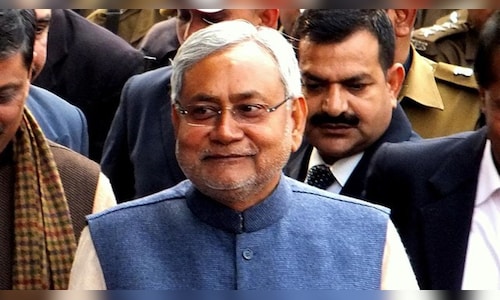
As per a notification from the cabinet secretariat department, the meeting is scheduled for 11 am. Afterward, Bihar’s longest-serving CM, who was recently elected to the Rajya Sabha, is anticipated to resign to Governor Syed Ata Hasnain.
Earlier, Kumar’s close associate and JD(U) national working president Sanjay Kumar Jha mentioned to reporters that the formation of a new government was likely to “commence after April 13”.
Concurrently, the BJP, cautiously approaching the possibility of having its first chief minister in the state, appointed Shivraj Singh Chouhan as a “central observer” to oversee the transition.
A statement from the BJP’s headquarters in Delhi announced that the parliamentary board has designated Chouhan, a Union minister and former multiple-term CM of Madhya Pradesh, as the “central observer for electing the leader of the legislature party in Bihar”.
Senior JD(U) leader and Minister for Parliamentary Affairs, Vijay Kumar Chaudhary, stated earlier in the day, “The new chief minister will be chosen by the NDA, upon the BJP’s recommendation, which will play a significant role”.
Speculations suggest that Deputy Chief Minister Samrat Choudhary, who manages the pivotal Home portfolio in the outgoing government, is currently the frontrunner among candidates for the top position.
BJP leaders in the state, who have been making numerous trips to Delhi lately, are keeping their options private.
“Who will serve as the next CM is a decision for our central leadership,” remarked minister Dilip Jaiswal, a former state BJP president, adding, “I am not in the race at all”.
Besides Choudhary, who joined the BJP less than a decade ago, other names circulating include Union Minister of State for Home Nityanand Rai and state ministers Lakhendra Paswan and Shreyasi Singh.
BJP sources indicate that all these leaders have their unique strengths. Choudhary is a ‘Koeri’, and his advancement could maintain the ‘Luv Kush’ (Kurmi Koeri) alignment fostered by Kumar throughout his 20-year tenure, ensuring the NDA’s favor after the JD(U) leader’s exit.
Rai, being a Yadav, brings the potential support of Bihar’s largest caste group, historically aligned with Lalu Prasad’s RJD, the BJP’s main rival in the state.
Paswan is a Dalit, and his rise could assist the BJP in overcoming its “pro-upper caste” reputation, which poses challenges in the Hindi heartland due to the lingering impact of the 1990s Mandal agitation, according to the sources.
Singh, in her 30s, is an upper-caste Rajput, yet her promotion could be seen as the party favoring youth.
Furthermore, the party has been striving to present itself as a proponent of gender equality, pushing for the ‘Nari Shakti Vandan Adhiniyam’ that guarantees 33 percent reservation for women in both Houses of Parliament.
Nevertheless, BJP sources acknowledged a substantial chance of the central leadership surprising everyone, referencing instances in other states governed by the party where unexpected leaders have ascended to top positions recently.
Actor-turned-politician Shatrughan Sinha, a Trinamool Congress MP who spent nearly three decades within the BJP, commented on Bihar’s political climate, stating that “we have plenty of deserving candidates here, but we must be cautious of a baba who might come with a parchi”.
This was a reference to Rajasthan, where Bhajan Lal Sharma was appointed chief minister two years ago at a legislature party meeting, where Defence Minister Rajnath Singh was seen producing a piece of paper listing the name of a first-term MLA.