
Mahyavanshi noted that Turtlemint will persist in its historical growth trajectory, driven by the expansion in service earnings before interest, taxes, depreciation, and amortization (EBITDA), a decreased corporate overhead relative to revenue, and an increasing number of active insurance partners. The company aims to onboard 1.45-1.5 lakh new partners in FY27 while ensuring steady monetization and views regulatory initiatives like Insurance for All by 2047 as long-term growth catalysts.
In Q4FY26, Turtlemint FinTech reported its first profitable quarter, marking a net profit of ₹3.1 crore compared to a ₹39.4 crore loss a year prior. Revenue surged 42% year-over-year to ₹357 crore, and the EBITDA loss significantly narrowed to ₹4.1 crore from ₹37.3 crore. Service EBITDA surged 60% to ₹60 crore, underscoring the company’s improving operating leverage.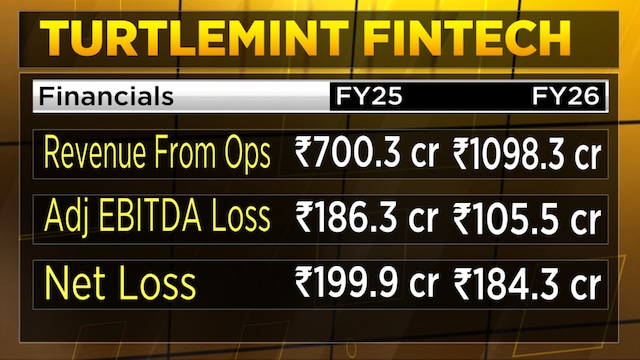
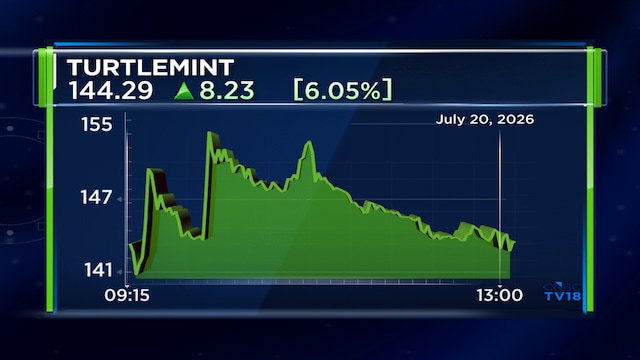
Shares of the Mumbai-based insurtech firm have increased nearly 5% over the last five trading days, bringing its market capitalization to approximately ₹4,224.30 crore. Turtlemint debuted on the BSE and NSE on June 29, 2026.
This is an edited transcript of the interview.Q: This is the first quarter you have reported after listing, discussing your January-March 2026 (Q4FY26) performance. Revenue from operations grew around 42%. Now that the April-June 2026 (Q1FY27) quarter has concluded, can you provide insights on how it fared compared to Q4?
A: This was our inaugural results post-listing, coinciding with our reporting process. Q4 was a remarkable quarter for us, with revenue increasing by approximately 42% and service EBITDA expanding over 60%, resulting in a full-year service EBITDA growth exceeding 70%.
To detail our business, service EBITDA yields operating leverage, allowing margins to improve as it grows. The second factor is corporate overhead; since the platform’s infrastructure is established, corporate costs remain largely stable. As revenue escalates, corporate expenses as a percentage of revenue diminish, thereby enhancing EBITDA.
Q4 was successful on both fronts. It marked the first quarter in our 11-year history where we achieved profitability, built on the steady growth in revenue, service EBITDA, and overall EBITDA over the past five to six years. A crucial key performance indicator (KPI) is the number of active partners on our platform, which has expanded at a compound annual growth rate (CAGR) exceeding 45%.
Looking at Q1, we will continue executing our strategies as we have historically. The growth rates across key metrics are expected to be consistent, with both operating leverage and service EBITDA growth continuing to yield greater value.
Q: You highlighted service EBITDA and corporate overhead as contributing factors to your performance. In 2025-26 (FY26), service EBITDA surged over 70%, while corporate overhead decreased by roughly 8%. What are your targets for FY27? Can you exceed these figures?
A: Corporate overhead’s share of revenue will keep declining, although in absolute terms, it will largely remain constant, barring minor inflationary impacts.
This means that revenue growth will directly boost profitability. We improved profitability by over 50% last year, and we expect further enhancements this year, aiming for continued profitability throughout the year.
Nonetheless, there will be some seasonality. Historically, Q4 is a robust quarter in the insurance industry, and that trend is expected to persist. Year on year, we aim to maintain alignment with our historical performance.
Q: Should we anticipate service EBITDA growth of approximately 70% in FY27 as well?
A: Yes.
Q: If service EBITDA keeps growing at that rate while corporate overhead remains stable, what can we expect for FY27?
A: In Q4FY26, we transitioned from an adjusted EBITDA loss of ₹34 crore to profitability. For the entirety of FY26, our adjusted EBITDA loss stood at ₹105 crore.
The same operating leverage is projected to persist into FY27. Corporate overhead relative to revenue is expected to decline while service EBITDA expands, collectively enhancing the company’s profitability.
Q: Does this indicate that Turtlemint will achieve adjusted EBITDA profitability?
A: Yes, we will achieve that for the year.
 Q: In Q4FY26, net profit was ₹3.1 crore compared to a loss of ₹39 crore a year prior. The adjusted EBITDA margin was about 1%. What kind of exit rate should we anticipate for FY27?
A: It will reflect Q4FY26’s performance relative to the previous year. Over the last four to five years, we have consistently achieved annual growth rates exceeding 40%. The primary driver has been our key KPI—Past 3 Months (P3m) Active. As long as P3M Active continues to rise, we expect sustained operating leverage across revenue and EBITDA.
Q: Should we assume double-digit profitability for FY27?
A: For the exit quarter of FY27, we anticipate growth similar to last year. For the full year, we expect to maintain profitability.
Q: You mentioned P3M Active as another key KPI. How has it progressed, and what are your expectations for FY27?
A: P3M Active indicates the rolling three-month count of partners actively engaging on the platform.
Over the past four to five years, it has been growing at a CAGR of about 46%, and we expect a comparable growth rate in FY27.
Growth originates from two channels. Existing POSPs enhance their productivity annually by advancing up the learning curve. We support them through the Turtlemint Academy to enhance their efficiency.
The second source comes from onboarding new partners. Last year, we welcomed around 1.15 lakh new partners. This year, we plan to onboard 1.45-1.5 lakh new partners. Both groups will drive continued growth.
Q: Revenue as a proportion of platform premium has risen to roughly 20.8%. What are your expectations for this in FY27?
A: We believe it will remain in that range.
It’s important to note that we also operate a technology services business, licensing our technology to large distributors. Consequently, our revenue is not solely tied to platform premiums, as it encompasses both point of sales person (POSP) commissions and technology license fees.
Watch the full conversation here

Q: Will the Insurance Regulatory and Development Authority of India’s (IRDAI) distribution regulations or BIMA Sugam influence your guidance?
A: The government’s goal is to enhance insurance penetration, and technology platforms are the most effective means of achieving this.
Any regulatory modifications will likely aim to enhance insurance accessibility and affordability. Our role is to facilitate more participants in distributing insurance via our platform, and we will remain committed to that.
Historically, regulations like digitization, the POSP framework, and broadening products under the POSP model have been significant enablers for our business. We anticipate this trend continuing as the government advances its Insurance for All by 2047 initiative.
Catch all the latest updates from the stock market here