The US President, Donald Trump, has raised alarms by threatening to impose tariffs on Europe if Norway does not transfer Greenland to the United States. This situation has caught the attention of World Economic Forum (WEF) President and CEO Borge Brende, who anticipates tough discussions among the involved nations at this week’s Davos meeting.
“I foresee quite rigorous and open dialogues here, as is often said in diplomatic circles, regarding these issues, particularly tariffs,” Brende stated to CNBC-TV18, highlighting that the tariff debate has lingered for nearly a year among the US and various stakeholders.
With approximately 850 top CEOs from around the globe attending Davos this year, he mentioned Trump’s eagerness to participate in the forum for direct engagement with global business leaders.
Global investment in clean fuels must quadruple to achieve climate objectives: WEF
To address the global “energy trilemma” of security, affordability, and sustainability, a considerable increase in investments in clean fuels is crucial, according to the World Economic Forum (WEF).
“While progress is being made concerning the energy trilemma, the new focus on energy security stands out,” stated Roberto Bocca, Head of Energy and Materials at the WEF.
As the WEF’s Annual Meeting in Davos approaches, Bocca noted that achieving global goals for clean fuels will necessitate annual investment in production to nearly quadruple—from the current approximately $25 billion to nearly $100 billion annually by 2030. This estimate, presented in a WEF white paper on clean fuels, underscores the significant capital required to facilitate the global energy transition. “We won’t fully eliminate fuels; molecules will still be necessary, and clean fuels will serve as the bridge to that future,” Bocca emphasized.
$600 billion AI investment signifies ‘swift large-scale capital shift in modern history’: WEF’s Cathy Li
Since 2010, the world has poured nearly $600 billion into artificial intelligence (AI), with the United States and China representing about 65% of the total investment, according to Cathy Li, Head of AI, Data and Metaverse, and a Member of the Executive Committee at the WEF.
In anticipation of the WEF’s Annual Meeting in Davos, Li indicated that global AI investment is growing at an annual rate of around 33%, showcasing the rapid expansion of AI infrastructure worldwide. “From 2010 to 2024, we collectively invested $600 billion in AI infrastructure,” Li remarked to CNBC-TV18’s Shereen Bhan. “This represents the fastest large-scale capital reallocation in contemporary history.”
Global health sector faces a $200 billion funding gap as US withdrawal intensifies pressure; AI considered a potential savior
The global health system is encountering new funding challenges following the US’s withdrawal from several multilateral organizations related to healthcare, as reported by the World Economic Forum (WEF).
Shyam Bishen, Head of the Centre for Health and Healthcare at the WEF, noted that funding shortages are already hindering efforts on health system resilience and long-term capacity development. He mentioned that the World Bank has estimated the funding gap to be nearly $200 billion, necessary for constructing resilient healthcare systems capable of addressing risks like climate change and future pandemics. “We are far from achieving that,” he emphasized, referring to present funding levels.
Geoeconomic tensions emerge as the leading business risk for 2026, according to WEF’s Saadia Zahidi
Geoeconomic confrontations have surfaced as the foremost risk to the global economy over the next two years, as per the latest Global Risks Report from the World Economic Forum (WEF). Saadia Zahidi, Managing Director at the WEF, stated that business leaders are primarily concerned about US trade tariffs, investment regulations, access to essential resources, and supply chains, with geopolitical and state-based conflicts also ranking significantly on their list of anxieties.
Silver on MCX surpasses ₹3 lakh/kg for the first time amidst rising geopolitical tensions
Silver has crossed the ₹3 lakh per kilogram mark on the Multi-Commodity Exchange, hitting a peak of ₹3,01,315 for a kilogram. This marks the first occasion where silver has reached this level on the MCX, coinciding with geopolitical uncertainties and potential trade disruptions stemming from Trump’s threats of a flat 10% tariff on European nations opposing Greenland’s transition to the US, along with those supporting it.
Artificial Intelligence exacerbates the global wealth divide
Artificial Intelligence (AI) is projected to impact nearly 400-800 million jobs by 2030, according to a McKinsey report. While job displacement attributed to AI is only beginning to escalate, the transformative technology is already intensifying the global wealth disparity. A recent Oxfam report indicates that billionaire wealth is growing at three times the average annual rate observed over the preceding five years.
Central Asian security: An Indian viewpoint from a former diplomat
India’s strategy towards Central Asia is characterized by strategic outreach that is cautiously proactive, also shaped by significant power dynamics in the region. While future competition is anticipated, India is engaging Central Asia through avenues like connectivity, commerce, collaboration, and capacity-building, all under the umbrella of strategic autonomy and multi-alignment.
India is actively coordinating and consulting with Russia on matters of shared interest, remaining aware of its sensitivities. Talks regarding the revival of the ‘Primakov Triangle’ involving Russia, India, and China (RIC) are also underway. However, the mutual interests of RIC in Central Asia may either converge or diverge based on how they are navigated. Meanwhile, all parties, including India, will seek to leverage their positions in the region strategically, albeit with differing political and philosophical approaches.
Significant earnings reports and interest rate outlook concerns could impact markets next week
The trajectory of company earnings and interest rate outlook will illuminate the future of a broadening stock market.
Stocks appear set for a downward week following a shaky commencement to the fourth-quarter earnings season. Among the major banks reporting, the retail banking sector — featuring JPMorgan, Citigroup, Bank of America, and Wells Fargo — faced declines this week after disappointing shareholder expectations. Conversely, investment firms like Goldman Sachs and Morgan Stanley have seen gains, indicating a promising year ahead for dealmaking.
ICICI Pru AMC vs HDFC AMC: Similar businesses, divergent paths
ICICI Prudential AMC and HDFC AMC, two of India’s largest asset management companies, released their quarterly results this week, revealing a stark contrast between rapid growth fueled by scale and yield, versus superior profitability realized through stringent cost management.
Both AMCs reported steady earnings growth amid favorable equity markets and resilient domestic inflows; however, ICICI Prudential AMC outstripped its counterpart in revenue and profit growth, while HDFC AMC retained a clear lead in profitability margins. Which of these would you choose to invest in?
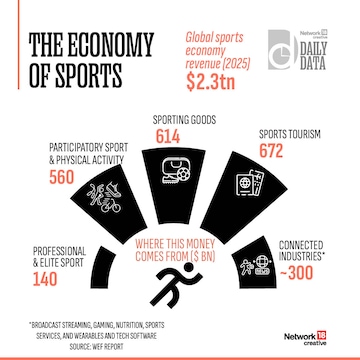
Daily Data | Sport transcends traditional boundaries; it now fuels a $2.3 trillion global industry.