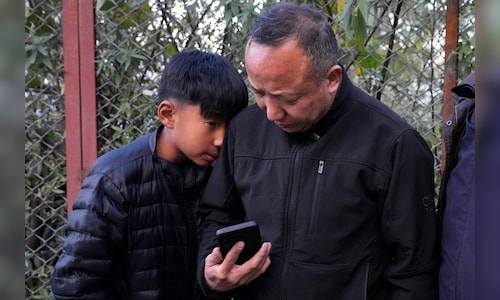
Sonam Tashi is determined that his son will not inherit the same fears.
Once an active participant in the Free Tibet movement in Kathmandu, Tashi found himself silenced. Since he couldn’t secure identity documents for his son, he relocated to the Tibetan capital in exile in India this year, giving his son access to an education he cannot receive at home.
In India, he took part in a rare protest in a city that echoes the Kathmandu of old — where monks stroll freely and the Dalai Lama’s image is not a threat.
An investigation by The Associated Press revealed that much of the Chinese technology used for surveilling Tibetans in Nepal originated from American companies. Despite alerts that Chinese firms were replicating or outright stealing their designs, these companies have supported and enhanced China’s surveillance network over the past twenty-five years.
Born in Nepal to Tibetan refugees, Tashi dedicated years to activism, frequently protesting outside the Chinese embassy in Kathmandu. Initially, arrests were short-lived — merely a day or two — but by 2015, police began detaining protesters for weeks. Attendance dwindled, and eventually, Tashi was among the last to continue showing up.
Also Read: How the next Dalai Lama will be chosen — and where India stands
Surveillance followed them outside the protests.
Police arrived hours before any event could begin, asking questions they shouldn’t have known: What are your plans for tomorrow? Where are you headed?
The presence of cameras multiplied — around Tibetan communities, in temples, and even near private residences. In Boudha, the comfort found beneath the stupa’s omnipresent gaze soured.
Now 49, Tashi concentrates on his 10-year-old son. Once an activist, he has shifted to being a father aiming to secure his son’s future — before the situation worsens. On a winding bus journey toward the Indian border, Sonam gazed at the scenery as terraced hills gave way to forests, contemplating what lies ahead.
“There are cameras everywhere,” he remarked. “There is no future.”
This surveillance has muted Nepal’s previously lively “Free Tibet” movement. Thousands of Tibetans fled to Nepal each year, but last year, the figure fell to single digits, according to Tibetan officials in Nepal.
In Washington, DC, Namkyi’s eyes reflect the solitude that shadows Tibetans in exile.
Arrested at 15 and sentenced to three years in prison for protesting Chinese governance, Namkyi moved to the U.S. to share her story of losing a homeland.
Clad in black, with two small pins — Tibetan and American — on her coat, she describes how, under relentless surveillance, silence has become a form of survival for Nepal’s shrinking Tibetan community.
“They know they are being watched,” she stated.
Her eyes glimmer, not with certainty, but with the fragile hope that one day, being heard will make a difference.