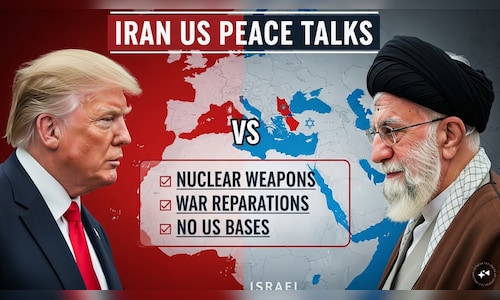
The administration under United States President Donald Trump has reportedly introduced a comprehensive 15-point ceasefire plan, while Iranian negotiators—guided by the Islamic Revolutionary Guard Corps (IRGC)—have put forward their own set of demands, leading to significant friction on pivotal issues.
The US has suggested a month-long ceasefire coupled with stringent conditions targeting Iran’s nuclear and military capabilities. Conversely, Tehran has countered with extensive political, military, and economic demands.
Here is a point-by-point examination of the primary sticking points in the negotiations:
Iran’s nuclear programme
The most critical disagreement revolves around Iran’s nuclear activities. The Trump administration seeks to completely eliminate Tehran’s nuclear capabilities, including ceasing uranium enrichment and transferring stockpiles to international oversight.
Also Read: Iran Israel War Live Updates
However, Iran maintains it has the sovereign right to uphold a peaceful nuclear energy program. This issue represents the most significant conflict between the two parties, as neither is willing to yield.
Trump has asserted that Iran has “agreed” to dismantle its program, but Iran has denounced this as a blatant falsehood.
Iran’s missile programme
Washington is also advocating for stringent restrictions on the range and quantity of Iran’s ballistic missiles, viewing them as a threat to regional allies, particularly Israel.
In contrast, Tehran regards its missile arsenal as crucial for national defense and has indicated it will not compromise on this matter, marking it as a definitive line in the negotiations.
Strait of Hormuz
Control over the vital Strait of Hormuz, a major oil transit route, is another contentious issue.
The US insists that the waterway must remain an unrestricted international shipping lane.
Also Read: US offers 15-point ceasefire plan to Iran, check what’s on the table
Tehran, however, has suggested a regulatory framework that would allow it to oversee passage and impose transit fees, akin to Egypt’s regulation of the Suez Canal.
A controlled corridor currently seems operational, with “non-hostile” vessels, such as those from India and China, coordinating safe passage with Iranian authorities.
US military bases in the Gulf
Iran has called for the closure of all US military bases in the Gulf region as a prerequisite for negotiations.
The US, on the other hand, intends to maintain its military presence as part of its regional deterrence strategy, thereby creating another significant barrier to an agreement.
Sanctions relief to Iran
The sequencing of sanctions relief remains a divisive issue. Washington proposes that sanctions be lifted only after Iran satisfies all stipulations under a final agreement.
In contrast, Iran demands the immediate removal of all international sanctions prior to entering into a broader deal.
Also Read: US-Iran ceasefire talks: What are Tehran’s demands against Trump’s proposed peace plan
The debate centers around “who takes the first step,” which may pose a potential obstacle to the peace initiative.
Regional allies and proxy groups
Reports indicate that the US proposal calls for Iran to halt funding, training, and arming allied militias like Lebanon’s Hezbollah and Yemen’s Houthis in the region.
Instead, Iran has demanded an end to Israeli attacks on groups such as Hezbollah, asserting that these entities are integral to its regional security framework.
War damages and guarantees
Tehran is also seeking financial compensation for damages inflicted by US and Israeli strikes, a request that US officials have reportedly described as “unrealistic” and “absurd.”
Additionally, Iran is pursuing binding assurances that the US will refrain from initiating future attacks, reflecting lingering distrust after the US withdrew from the nuclear agreement in 2018.
The US contends that Iran instigated the war and should therefore bear the costs of the damage. Furthermore, the US does not commit to avoiding future strikes on Iran.
With both factions holding firm on several key issues, reconciling the differences between the US proposal and Iran’s demands presents a formidable challenge to ending this conflict.
Also Read: US-Iran contacts underway; Tehran open to ‘sustainable’ proposals to end war, says report