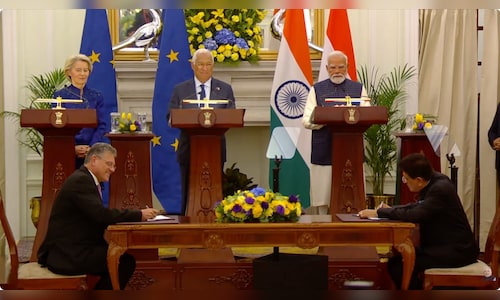
The announcement was made on Tuesday, January 27, following high-level discussions between India and the European Union, in conjunction with the signing of an extensive strategic and security partnership. The FTA is anticipated to be implemented by 2027, with the goal of strengthening economic connections between these two major economies.
In response to this development, the Confederation of Indian Industry (CII) stated that the agreement signifies a strategic advancement in India’s global trade interaction.
Chandrajit Banerjee, Director General of CII, remarked in a statement, “CII commends the announcement of the India–European Union Free Trade Agreement today. This landmark deal represents a strategic advancement in India’s global trade engagement and significantly deepens the partnership between two major democracies and economies, which together comprise nearly 25% of global GDP.”
Highlighting the extensive market access achieved through this agreement, Banerjee noted, “The remarkable preferential access granted for over 99% of Indian exports is a transformative factor for Indian industry. It significantly enhances competitiveness in the EU’s high-value market, embeds Indian manufacturers and service providers more deeply in global value chains, and accelerates investment, technology transfers, and expansion.”
CII identifies key sectors poised to benefit as textiles and apparel, leather and footwear, gems and jewelry, marine products, engineering goods, automobiles, agriculture and processed foods, IT and IT-enabled services, along with other business and professional services.
Focusing on the employment implications, Banerjee emphasized that the agreement brings “substantial benefits for labor-intensive sectors and MSMEs” and, with its mobility provisions, “establishes a foundation for sustained, inclusive, and globally competitive growth that completely aligns with India’s vision of Viksit Bharat @2047.”
Read more: What it would take for India to be a high-income country by 2047
The Federation of Indian Chambers of Commerce and Industry (FICCI) also expressed support for the agreement, labeling it as one of long-term strategic importance.
Anant Goenka, President of FICCI, stated, “Congratulations to the Government of India for advancing this strategic-scale agreement under the leadership of Hon’ble Prime Minister Shri Narendra Modi.”
Goenka highlighted that the European Union constitutes the largest and most promising market represented in India’s recent free trade agreements. He mentioned that the FTA is poised to unlock substantial untapped trade and investment prospects by facilitating deeper market access, enhancing value-chain integration, and improving export competitiveness across manufacturing and high-value sectors.
From the automotive sector perspective, Santosh Iyer, Managing Director and CEO of Mercedes-Benz India, told PTI, “The Indo–EU FTA marks a historic milestone for India and reinforces the growing significance of the Indian economy on the global stage.”
He noted that the agreement is expected to “drive technological innovation and sustainable growth in the Indian automotive sector, with a strong emphasis on future mobility.”
However, Iyer advised caution, stating, “The ultimate impacts of the FTA can only be understood once we have access to the detailed provisions of the agreement.”
Reaffirming Mercedes-Benz’s commitment to trade liberalization, Iyer said, “With the Indo–EU FTA, India’s economic growth is poised for a significant boost as borders open, creating opportunities in new markets, enhancing bilateral trade, and generating job prospects.”
Sunil Bharti Mittal, Founder and Chairman of Bharti Enterprises, noted that the pact represents decisive political leadership from both entities and strengthens the India–EU partnership.
Mittal stated that the agreement sends “a strong signal of trust, stability, and enduring partnership” at a time when the global economic landscape is evolving rapidly. He added that the FTA is expected to unveil new collaboration avenues, particularly in digital infrastructure, space connectivity, and secure networks, creating opportunities for European investors to innovate and scale alongside India for global markets.
He also pointed out the outbound investment potential for Indian firms. “This agreement also presents prospects for Indian companies like Airtel to invest in Europe’s digital infrastructure,” Mittal remarked.
Congratulating stakeholders on both sides, Mittal said, “I extend my congratulations to our leadership and the citizens of India and the European Union on this pivotal moment in our shared future.”