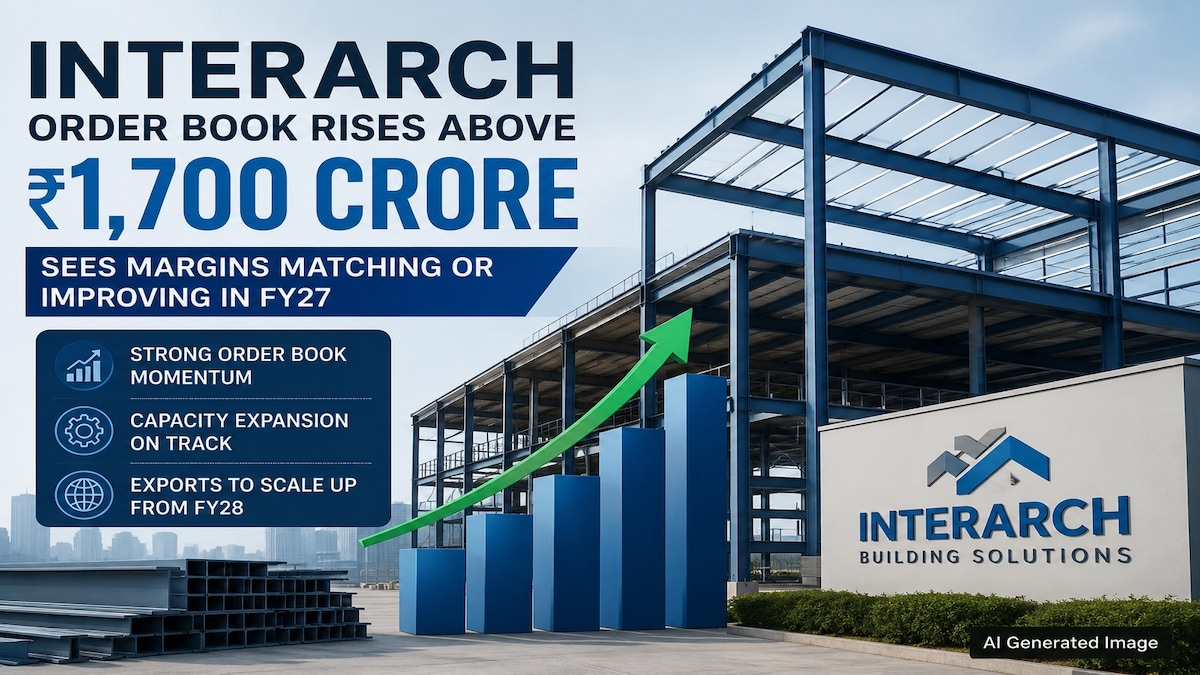
In a conversation with CNBC-TV18, Managing Director Arvind Nanda stated that the company has consistently received new orders since announcing an order book of ₹1,700 crore earlier this year, although the latest net figure is still pending finalization.
“We don’t have the net order book yet, but it is undoubtedly above the ₹1,700 crore order book we disclosed,” Nanda shared.
The growth follows Interarch’s acquisition of new contracts in June, including a domestic order valued at approximately ₹165 crore for the design, engineering, manufacturing, supply, and erection of a pre-engineered steel building (PEB) system. The firm announced additional orders totaling ₹375 crore for the month.
Nanda noted that the recently secured contracts have a longer execution timeline compared to typical projects and will help support the order book over an extended period.
“If we expect to achieve ₹2,150-2,200 crore in sales this financial year, having an order book covering eight to nine months is beneficial, unless the orders are long-term, which is the case here. In that scenario, the order book will increase,” he explained.
While demand continues to be robust, the company is effectively balancing new order acquisitions with execution capacity.
“The pipeline remains promising. However, it’s essential to align our capacity with our project delivery capabilities, which is the most critical factor in the pre-engineered building sector,” Nanda stated.
Interarch anticipates that new manufacturing capabilities coming online this year will bolster future growth. The initial phase of its Gujarat manufacturing facility is expected to be operational by early July, followed by the second phase around September or October. Combined, the Gujarat plant will contribute approximately 40,000 tonnes of annual capacity.
Meanwhile, the heavy steel structures facility in Andhra Pradesh is slated to commence operations in early August, adding another 20,000 tonnes of annual capacity in its first phase.
Regarding profitability, Nanda expressed confidence in maintaining or slightly enhancing margins this year despite increased expenditures on exports and the new heavy structures segment.
“We are on track to achieve margins comparable to last year, if not better. As turnover increases, operational leverage should positively impact our margins,” he commented.
Management expects stable steel prices, the absence of last year’s one-off labor code-related expenses, and improved internal efficiencies to bolster margins. Concurrently, the expansion into exports and the heavy structures business necessitates upfront investments in certifications, marketing, engineering, and business development before substantial revenue can be realized.
The company has recently acquired export orders valued at around ₹35-40 crore and anticipates that international business will significantly contribute from FY28 as partnerships in North America grow.
Nanda indicated that Interarch aims for quarterly order inflows of ₹500-600 crore, with the higher trajectory likely to be realized in the last quarter of FY27 as additional manufacturing capacity becomes fully operational.
The ₹165 crore domestic order is set for execution over approximately 15 months and includes a 10% advance payment secured by a bank guarantee. The contract encompasses the complete scope of design, engineering, manufacturing, supply, and erection of the PEB system.
This is an edited transcript of the interview.Q: Last time, when you joined us, you raised your FY27 revenue guidance by 10%, from ₹2,000 crore to ₹2,200 crore. Where does the order book currently stand following this acquisition, and are there any adjustments to your guidance?
Arvind Nanda: The order book is indeed on the rise. We had announced an order book of ₹1,700 crore in early May, and we have secured fruitful orders since then, in addition to making significant sales thereafter. While we do not have the net order book at this moment, it’s clearly higher than the ₹1,700 crore we previously disclosed.
We typically aim to align our order book with our expected sales revenue for the next eight to nine months. This order from the energy sector features a slightly longer timeline, with a supply period of ten to twelve months, thereby augmenting our order book.
If we are anticipating ₹2,150-2,200 crore in sales for this financial year, an order book fulfilling eight to nine months’ of demand is sufficient, unless we have long-term orders, which this one falls under. In that case, the order book will grow.
I don’t have an exact figure for the current order book, but I can assure you it’s higher than ₹1,700 crore due to the good orders we’ve secured, and our pipeline continues to look quite promising. However, balancing our capacity with our project delivery capabilities remains critical in the pre-engineered building industry. Most orders aren’t long-term; only a select few, such as this one, offer that stability, yet delivery is key. Thus, we must continuously consider our capacity in conjunction with growth.
This year, our full Andhra Pradesh plant will become operational, with its second phase coming online only last September. The Gujarat plant is set to begin operations soon, in early July. By the time both phases are completed, potentially by October or November, they will also contribute to this year’s sales. We’re striving to add capacity swiftly to maintain a robust order book and secure additional orders in the market.
Q: This order is a long-term commitment, which is rare. In such cases, how do margins function? Previously, you expressed uncertainty regarding margin guidance due to changing conditions. Is it possible to provide insight into expected margins and any cost pressures the business may still face?
Arvind Nanda: Our margin guidance remains similar to last year’s, with a slight increase anticipated from improved internal efficiencies. Larger orders typically yield better margins since they do not carry the same costs as smaller orders. However, the final picture will only emerge once we receive the results.
One factor influencing our margins is our push into exports, which requires substantial certification efforts that we embarked on last year. Export efforts involve expenses, including travel and participation in fairs and conferences, with turnover still in the buildup phase. While we’ve begun to secure export orders, scaling them up will take time.
The establishment of our heavy structures plant also incurs significant costs—both capital and operating expenses—related to market entry, sales, marketing, engineering, and other necessary activities, all of which need to be covered before production ramps up.
These additional costs must be taken into account. However, I do not foresee any sudden margin impacts from rising steel prices after we’ve placed our orders; steel prices are currently stable and following a consistent pattern, which should result in decreased costs for us.
Last year, we faced an extra burden from labor code-related costs, amounting to around ₹3.5 crore, which will not affect us this year. Therefore, I believe we are well-positioned to achieve margins similar to, if not exceeding, last year’s levels. As turnover increases, I expect operational leverage to enhance further.
Q: Mr. Nanda, you highlighted two significant points: the marketing expenses necessary for securing orders, primarily linked to the export market, and your forecast of an order inflow run rate nearing ₹600 crore per quarter, suggesting an FY27 order inflow expectation of around ₹2,400 crore. Is that still on course? How do you expect the split between domestic and international markets to look?
Arvind Nanda: The order book will gradually increase as we target ₹2,500 crore for FY28. Thus, onwards in the later quarters of this fiscal year, we expect the order book to expand to align with that turnover goal.
We aim for quarterly order inflows of ₹500-600 crore now, but delivering on that is paramount. The substantial impact of achieving ₹600 crore per quarter should manifest by the last quarter of this financial year.
Exports will not constitute a significant portion initially. Recently, we secured promising export orders worth ₹35-40 crore over the last couple of months, which we view optimistically.
We are taking a long-term approach with our export initiatives by building strong partnerships and relationships with entities that will utilize our offerings, leveraging our engineering and production expertise during their project bids.
Over the past year, we have invested more in certifications, attending fairs and conferences, and forging connections, including an existing partnership with a Canadian company. We aim to establish similar collaborations with other firms in Canada and the US, forecasting a more significant export opportunity next financial year.
Q: Lastly, you mentioned upcoming new capacities. When can we expect these facilities to be operational, specifically the Andhra Pradesh heavy steel structure facility and the Gujarat PEB facility? Additionally, what is the incremental capacity coming on board, and how do asset turns typically function for this new capacity?
Arvind Nanda: The initial phase of the Gujarat facility is set to launch next month, as previously indicated, in early July. The second phase will follow closely since most of its construction aligns with Phase I, having already completed the building and internal work, with machinery ordered. There is minimal work remaining aside from operational readiness in terms of staffing and commercial production.
We plan to transition into the second phase, targeted for September or October based on current projections.
The entire Gujarat facility will contribute approximately 40,000 tonnes to our overall capacity. While we won’t benefit from the full capacity in the initial year due to staggered phase launches, we expect to utilize the full extent of the 40,000 tonnes in FY28.
The heavy structures facility will offer an additional 20,000 tonnes annually in Phase I, which should commence by early August as planned. The uptake for this division might be slower due to its relatively novel offering. Some production will support our existing buildings, but we also aim for the heavy structures to function independently and service major orders for steel plants, power stations, and high-rise buildings, which may take some time.
Therefore, we envision a capacity increase of 20,000 tonnes, fully operational in the subsequent year. This year, we won’t set very high expectations from that plant.
Watch video for full conversation.