
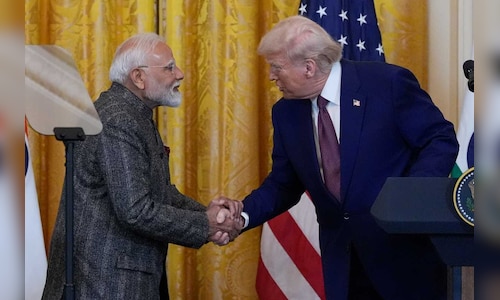
Linscott’s comments follow renewed discussions in Washington after US Commerce Secretary Howard Lutnick remarked that the deal’s failure was tied to Modi not directly calling Trump to finalize it.
In an interview with CNBC-TV18,
Linscott emphasized that focusing on phone calls diverts attention from the real obstacles in the negotiations. He noted that while Trump often plays a vital role in finalizing trade agreements, there has been considerable progress in official talks between India and the US over the past several months.
“There remains a significant gap, and that is what is hindering further progress—specifically, the reciprocal tariff rate,” Linscott stated, highlighting India’s desire for clarity on whether tariff levels would align more closely with those given to the European Union.
Lutnick’s podcast statements sparked a strong political reaction in New Delhi, with India’s External Affairs Ministry refuting the narrative and asserting that Modi and Trump had communicated eight times in 2025, including discussions about trade.
Former Indian Ambassador to the US Arun Singh pointed out that Lutnick’s assertions were not new and mirrored a longstanding divide in perceptions between Washington and New Delhi. He argued that the India-US negotiations initially appeared to be shaping up as a balanced deal, with mutual concessions, but that this approach lost traction as Trump aimed for unilateral gains domestically. Singh referenced recent US agreements with the EU, Japan, and South Korea, which included significant investment and energy purchase commitments alongside tariff concessions advantageous to the US.
Singh contended that India’s hesitance to make similar unilateral concessions marked a pivotal moment. He claimed that the US opted to increase tariffs on India instead, even at the expense of the broader bilateral relationship. “This isn’t simply about whether the leaders are communicating,” Singh remarked, suggesting that domestic political considerations in the US have overshadowed strategic factors. He cautioned that this incident has intensified perceptions in India of the US as a coercive trading partner, sparking calls to reevaluate the relationship’s trajectory.
International trade policy expert Abhijit Das expressed a more pessimistic view, contending that US expectations from India continue to escalate, despite the concessions already made. He pointed out that negotiations exemplified a pattern of ever-increasing demands from Washington, complicating efforts to arrive at a genuinely fair outcome. Das argued that India weakened its bargaining position by making concessions before formal talks began, including budgetary measures aimed at reducing trade friction with the US.
He noted that even what US officials describe as India’s best offer may still not align with Trump’s expectations. “No matter what we present, even if it’s our top offer, it doesn’t seem to meet President Trump’s hopes,” he remarked, casting doubt on the possibility of a balanced agreement.
Conversely, Linscott expressed a more optimistic perspective compared to his Indian counterparts. He downplayed the notion that the US seeks extensive additional concessions in sensitive sectors like agriculture and dairy in a first-phase deal, asserting that the main framework of an agreement is already apparent. “I’m optimistic and remain hopeful that this can be resolved relatively soon,” he stated, reiterating that tariffs are the primary unresolved issue.
Also Read | India stands by energy policy amid US tariff threat, rejects blame on Modi for stalled trade deal
The uncertainty surrounding the situation has been aggravated by legal challenges to Trump-era tariffs in the US Supreme Court. While a ruling could potentially invalidate certain levies, both Linscott and Das noted that the administration has alternative legal avenues to reimpose tariffs under different trade statutes. Das warned that even if the courts side against the government, new tariffs or other measures could emerge, perpetuating uncertainty for Indian exporters.
Taken together, the insights from the three experts suggest that the India-US trade deal is less about personal diplomatic ties and more about complex tariff calculations and domestic politics in Washington. Until there is clarity on reciprocal tariff levels and a stabilization in the US approach, the long-awaited agreement is likely to remain in limbo, regardless of how often the two leaders communicate.
Watch the accompanying video for the entire discussion.


