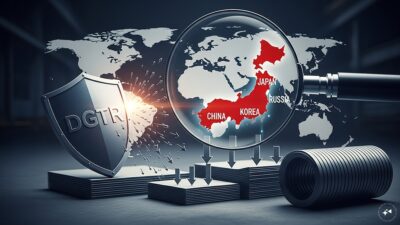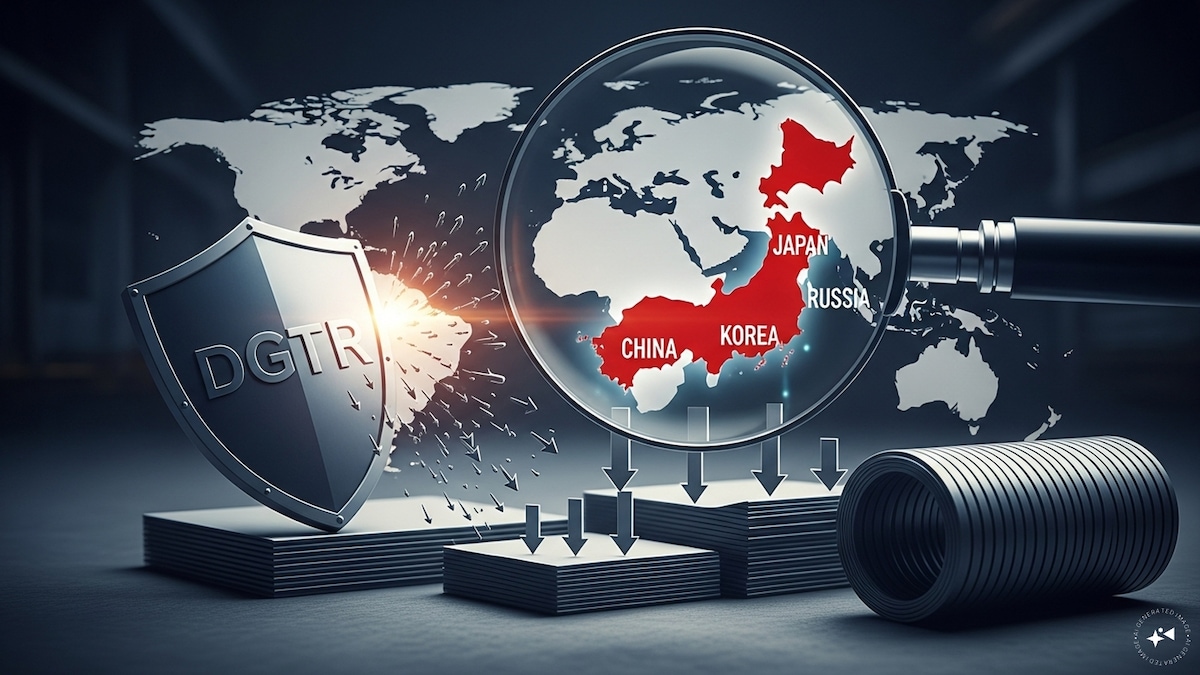
This investigation, which began on 22nd June 2026, encompasses imports from 1st April 2025 to 31st March 2026, with the injury assessment covering the timeframe from FY 2022-23 to FY 2024-25.
The complaint claimed that ‘hot rolled flat products of alloy or non-alloy steel’ exported from China, Japan, and Russia were being sold at dumped prices, causing significant harm to the domestic sector.
The DGTR will assess the presence, extent, and impact of the dumping, with initial results suggesting that the product is being exported at prices well below its normal market value. The dumping margin has been determined to exceed the minimum threshold and is substantial for exports from these nations.
Nevertheless, the Global Trade Research Institute (GTRI) has expressed concerns that imposing anti-dumping duties on a product for which India is 90% reliant on imports could increase transformer costs and hinder the expansion of the country’s power grid, as every power and distribution transformer relies on CRGO steel in its magnetic core.
This specialized electrical steel reduces energy losses and is essential for efficient electricity transmission and distribution. GTRI anticipates a surge in demand for CRGO as India allocates ₹9.15 lakh crore to enhance its power grid by 2032, intending to add 191,000 circuit kilometers of transmission lines and more than double transformer capacity to 2,342 GVA.
Annual consumption of CRGO is estimated between 4 lakh to 4.5 lakh tonnes, while domestic production remains limited to 40,000-50,000 tonnes, with nearly 90% of India’s needs fulfilled through imports, mainly from China, Japan, Korea, and Russia.
Pointing out that CRGO imports already require mandatory BIS quality certification, GTRI noted that each imported coil must adhere to Indian standards before being sold, indicating that the inquiry is more about pricing than product quality.
Also Read: Uber’s outgoing India head Prabhjeet Singh to join OpenAI as Managing Director for India
(Edited by : Navneet Singh)