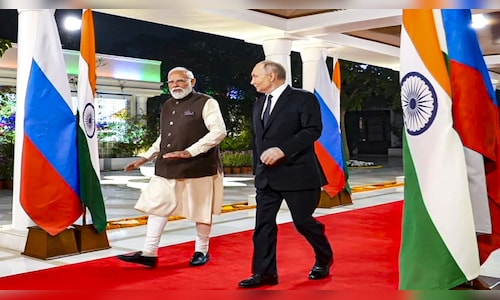
However, just two months later, Delhi and Moscow are strengthening their energy partnership, with both parties preparing for Russia to resume direct sales of liquefied natural gas for the first time since the Ukraine war began, according to two insiders. Should India proceed with the deal, which could breach Western sanctions, negotiations might wrap up within weeks, one of the sources indicated.
The discussions, occurring against a backdrop of soaring energy prices following a US-Israeli military strike on Iran, have not been disclosed previously. A “verbal agreement” to negotiate an LNG deal was established during a March 19 meeting between Russian Deputy Energy Minister Pavel Sorokin and Indian Petroleum and Gas Minister Hardeep Singh Puri in Delhi, according to those familiar with the matter.
The officials also concurred to significantly boost crude oil shipments to India, potentially doubling from levels seen in January to account for at least 40% of India’s overall imports within a month, as per three sources acquainted with their talks.
India emerged as a prominent purchaser of heavily discounted Russian crude following the invasion of Ukraine, which had become a contentious issue with the Trump administration. Last year, the world’s third-largest oil importer and consumer acquired nearly $44 billion worth of crude from Moscow, playing a crucial role in supporting the Kremlin’s wartime economy.
India has separately informed its energy importers to prepare for a revival of Russian LNG purchases, as indicated by one source. Delhi has already approached Washington regarding a potential sanctions waiver, according to that source and another individual with knowledge of the request.
India’s external affairs and petroleum ministries did not answer inquiries about the possible LNG arrangement. Foreign ministry spokesperson Randhir Jaiswal recently stated that Delhi was engaging with multiple nations to secure energy supplies, including LNG. Indian officials have also indicated that they are purchasing shipments of Russian liquefied petroleum gas, which is primarily used for cooking and remains unaffected by sanctions.
The Russian energy ministry declined to comment on any ongoing discussions with India, and the US Treasury Department did not respond to questions concerning sanctions relief.
Efforts to obtain comments from the White House and Ukraine’s embassy in Delhi were likewise unsuccessful.
“India selected the path that best aligned with its national interests, rooted in a longstanding and trusted partnership with Russia,” stated Ajai Malhotra, a former Indian ambassador to Moscow.
He added that Delhi should now “seek exemptions or accommodations as a standard part of negotiations between strategic partners,” referencing Washington.
DOUBLE WHAMMY
Even though the United States has sought India’s alignment as a strategic counterbalance to neighboring China for decades, the world’s fifth-largest economy has faced significant disruptions twice in under a year from decisions largely driven by Washington.
Following years of purchasing discounted crude from Moscow, Delhi sharply diminished its imports after Trump imposed tariffs of up to 50% on Indian goods in August, one of the most severe penalties applied to any nation. In the meantime, the US Supreme Court has ruled that Trump’s actions in imposing such tariffs were unlawful.
India’s approach swiftly shifted after the US and Israel conducted military actions against Iran on February 28. Tehran’s retaliation included targeting vessels in the Strait of Hormuz, effectively obstructing the narrow corridor through which approximately half of India’s oil and LNG supplies flow.
Since then, long lines have appeared outside several Indian gas stations, while some restaurants have run out of cooking gas.
The demand for Russian energy exports, which bypass the Gulf when supplying Asian customers, has surged across the region’s economies.
Indian state-owned refiners began placing additional orders for Russian crude just hours before the US announced on March 5 a temporary waiver allowing Delhi to purchase some sanctioned shipments. As oil prices continued to rise, Washington further relaxed restrictions.
Some Indian policymakers have expressed regret that Delhi curtailed Russian crude imports as a concession to the US, according to a government document reviewed by Reuters.
“India had reduced purchases of discounted Russian crude, which would have mitigated the situation somewhat,” the note stated, a briefing on the Middle East crisis prepared on March 20 for the cabinet secretariat.
It warned that a prolonged disruption in oil supplies from the Middle East could create a cascade of economic difficulties, “leading to higher inflation, a depreciating currency, and escalating foreign debt.”
Export growth could suffer a decline between 2% and 4%, the document cautioned, noting that wholesale inflation could rise by approximately 0.3% to 0.7%.
WARMING TIES
Russia, having maintained amicable relations with India since the Cold War, is leveraging its current position.
Should a new LNG agreement materialize, it is likely to present less favorable conditions for India compared to the 20-year supply contract that India’s state-owned GAIL signed with Gazprom in 2012, as noted by one source. “It is now a seller’s market,” the individual stated.
Executives from Russian state power grid company Rosseti, present in Delhi this month for an industry summit, also suggested collaboration with their Indian counterparts on transmission infrastructure, particularly in challenging mountainous and remote regions of the country, according to one of the sources.
If an agreement is reached, it would represent Moscow’s entry into India’s power transmission sector.
Russia is also eager to enhance air connections with India: Timofei Titarenko, an executive from St. Petersburg’s Pulkovo Airport, mentioned last week that he has been exploring Indian airports and the feasibility of increasing direct flights.
Chief Kremlin diplomat Sergei Lavrov remarked during a recent conference on Indo-Russian relations that 96% of trade between the two nations is now transacted in rupees and roubles.
“The time-tested friendship between Russia and India exemplifies how international relations should and can be constructed – grounded in equality, mutual trust, respect, and consideration for each other’s interests,” he noted.
Transactions in rupees and roubles totaling up to $1 billion can now be processed in as little as a day, more than double the speed of just a few years prior, as stated by a senior executive at the Indian branch of Russian bank Sberbank during a conference in Mumbai in March.
Also Read: Oracle Financial shares jump 7% on $100 million deal with US bank