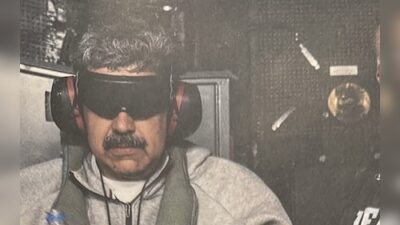
This operation was unexpected; however, sources close to the situation indicated that plans for this potentially intricate U.S. mission had been underway for quite some time, featuring comprehensive rehearsals.
Elite U.S. forces, including the Army’s Delta Force, constructed an exact replica of Maduro’s safe house to practice their entry into the heavily fortified residence.
A small CIA team had been on the ground since August, providing valuable insights into Maduro’s routine, facilitating a smoother apprehension, according to one insider.
Two additional sources informed Reuters that the CIA had an asset near Maduro to track his movements and pinpoint his location as the operation progressed.
Also Read: Nicolas Maduro’s oppressive regime in Venezuela meets its end at the hands of Trump
Having arranged the necessary elements, Trump greenlighted the operation four days prior, although military and intelligence officials advised him to postpone it for improved weather conditions and reduced cloud cover.
In the early hours of Saturday, the mission to capture Maduro commenced. Trump, at his Mar-a-Lago retreat in Palm Beach, Florida, monitored a live stream of the operation alongside his advisors.
The timeline of the hours-long operation is based on interviews with four sources familiar with the details and comments from Trump himself. “I’ve executed some impressive missions, but nothing compares to this,” Trump remarked on Fox News shortly after the operation concluded.
’MASSIVE’ OPERATION
The Pentagon coordinated a significant military build-up in the Caribbean, deploying an aircraft carrier, eleven warships, and over a dozen F-35 aircraft. Altogether, more than 15,000 troops were sent to the region for operations previously described by U.S. officials as anti-drug initiatives.
According to a source, a core team, including Trump aide Stephen Miller, Secretary of State Marco Rubio, Defense Secretary Pete Hegseth, and CIA Director John Ratcliffe, had worked intensively on this issue for months, with frequent meetings and calls—sometimes daily—and discussions with the president.
Late Friday night and early Saturday morning, Trump and his advisors convened as various U.S. aircraft took off and executed strikes on targets within and near Caracas, including air defense systems, according to a U.S. military official.
Also Read: Shocked Venezuelans remain cautious, uncertain of the future
Trump informed Fox News Channel’s ”Fox & Friends” that the number of U.S. aircraft involved was “massive.” “We had a fighter jet for every conceivable scenario,” Trump stated.
Sources have disclosed to Reuters that, in addition to fighter jets, the Pentagon had discreetly sent refueling tankers, drones, and aircraft for electronic jamming into the area.
U.S. officials indicated to Reuters that the airstrikes targeted military installations. Images captured by Reuters at the La Carlota air base in Caracas displayed scorched military vehicles belonging to a Venezuelan anti-aircraft unit.
While the airstrikes were underway, U.S. Special Forces advanced into Caracas heavily armed, equipped even with a blowtorch for cutting through steel doors at Maduro’s location. Officials did not disclose how the troops entered the city, but social media footage shared by residents showed helicopters flying low over Caracas.
Upon arriving at Maduro’s safe house, the troops, along with FBI agents, infiltrated the residence, which Trump characterized as a “very highly guarded… fortress.”
“They just broke in, and they breached areas that were nearly impregnable, you know, steel doors installed for just this purpose,” Trump noted. “They were apprehended in just seconds.”
MADURO IN CUSTODY
It remains unclear how U.S. forces managed to capture Maduro and his wife once they entered the house, but Trump mentioned that the Venezuelan leader had attempted to reach a safe room without success.
Also Read: Insights into a U.S. operation that captured Venezuela’s Nicolás Maduro
“He was trying to get inside, but they rushed him so quickly that he didn’t make it,” Trump remarked. Some U.S. personnel were injured, he said, but none lost their lives.
As the operation unfolded, Rubio began notifying lawmakers about its initiation. Communications started only after the operation commenced, deviating from the usual practice of informing key lawmakers beforehand, as stated by officials to Reuters.
Details regarding Maduro’s exit from Caracas remain sparse. Trump noted that one helicopter sustained significant damage but managed to return safely. The Venezuelan leader was transported to the USS Iwo Jima, an amphibious assault ship, and will be sent to New York for trial.