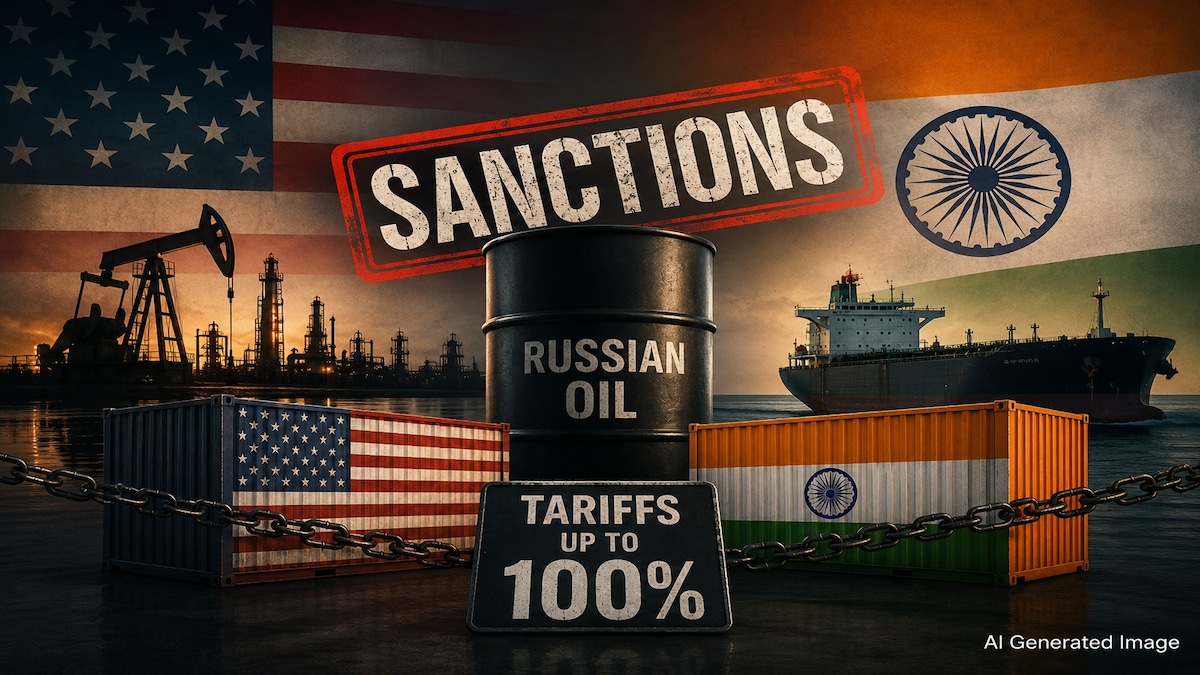
If passed, the legislation would empower the US president to impose tariffs of up to 100% on imports from nations that continue to acquire Russian energy. India, which has emerged as one of the largest consumers of discounted Russian crude since 2022, stands to be significantly impacted.
This proposal arrives at a sensitive juncture, as India and the United States engage in negotiations for a bilateral trade agreement, while also enhancing collaboration in areas such as defense, critical technologies, semiconductors, and the Indo-Pacific.
The question arises: what objectives does the bill pursue, why has it sparked a debate, and what implications could it have for India?
What is the proposed US sanctions bill?
The legislation aims to escalate economic pressure on Russia by making it more expensive for other countries to continue sourcing Russian energy.
In addition to sanctions targeting Russian officials and entities, the bill would grant the US president authority to impose tariffs of up to 100% on imports from nations purchasing Russian oil and gas. India and China are perceived as the primary nations that could be impacted, given their significant uptick in Russian crude imports in the wake of Western sanctions against Moscow.
The Senate has voted to push the legislation forward, but it must undergo the remaining legislative steps before it can become law.
Why has India continued buying Russian oil?
India has consistently maintained that energy security and cost-effectiveness are its foremost concerns.
As the world’s third-largest crude oil importer, India heavily relies on international supplies to satisfy its domestic demand. Following the imposition of Western sanctions on Russia in 2022, Russian crude began trading at significant discounts, prompting Indian refiners to increase their purchases and lower import costs.
This policy was not initially contested by Washington. Previous US administrations recognized that maintaining Russian oil flow in global markets, even under sanctions, helped avert drastic spikes in international oil prices.
Former Foreign Secretary Kanwal Sibal highlighted this earlier perspective during an interview with CNBC-TV18.
“The prior administration encouraged India to purchase Russian oil to help manage oil prices. Even the Trump administration was granting waivers to keep oil prices subdued.”
Why is the bill proposing tariffs on countries like India?
Proponents of the legislation argue that Russia continues to generate significant revenue from oil exports despite Western sanctions, and increasing the economic stakes for countries buying Russian energy could diminish those revenues and intensify pressure on Moscow.
Critics, on the other hand, claim that such measures effectively extend US sanctions to other nations, compelling them to align their energy policies with US foreign policy interests.
For nations such as India, this debate transcends Russia; it raises issues of national sovereignty, energy security, and the degree to which one nation should influence another’s trade decisions.
Why is the presidential waiver provision attracting attention?
Among the provisions generating considerable interest is the presidential waiver.
Even if the bill becomes law, the president wouldn’t necessarily need to impose tariffs immediately. The bill permits the White House to waive or suspend those measures under specified conditions, offering flexibility in interactions with allies and strategic partners.
Supporters argue this adaptability enables Washington to balance diplomatic, economic, and security priorities.
However, Sibal believes that the waiver provision could function more as a bargaining chip than merely a precautionary measure.
Reflecting on his experience as India’s ambassador to Washington, he suggested that the mere threat of tariffs might be leveraged to gain concessions during broader negotiations.
“They will hang a Damocles’ sword over the countries they aim to target, compelling those nations to approach the United States to request waivers.”
In Sibal’s estimation, this dynamic could allow Washington to extract additional concessions on matters like trade before deciding whether to grant exemptions.
Why has the bill attracted criticism?
In addition to the proposed tariffs, critics have questioned the consistency in the application of the legislation’s principles.
Some contend that while countries like India may face severe repercussions for importing Russian oil, the United States and various European nations continue to maintain certain exemptions for their own strategic or commercial imperatives.
Sibal asserts that this inconsistency undermines the broader rationale behind the legislation.
“It is the sovereign right of any independent nation to determine its trading partners. Who are the United States or the US Senate to impose restrictions on independent countries and dictate their trading decisions?”
However, supporters of the bill contend that stricter sanctions are crucial as Russia’s energy exports remain a key funding source for its military operations in Ukraine. In their view, curbing global demand for Russian oil is essential for amplifying economic pressure on Moscow.
How could it affect the India-US trade deal?
The timing of the proposal introduces another layer of uncertainty to trade discussions between India and the United States.
The two nations have been striving to address disagreements regarding tariffs, market access, and digital trade. The potential for additional tariffs related to Russian oil imports could further complicate these negotiations.
A tariff of up to 100% would substantially elevate the cost of impacted imports into the United States, potentially diminishing the competitiveness of many products should the measure be implemented.
Sibal suggests that the sanctions proposal and trade negotiations are intricately linked.
“With the threat of 100% tariffs looming over India, how can meaningful trade discussions occur?”
Regardless of whether tariffs are ultimately imposed, the possibility of their enforcement could shape the tone and trajectory of future negotiations.
What could it mean for the broader India-US relationship?
Over the last two decades, India and the United States have gradually broadened their cooperation in defense, technology, clean energy, and critical supply chains. Both governments have repeatedly portrayed each other as significant strategic partners.
However, legislation explicitly targeting nations purchasing Russian energy has the potential to create friction in a relationship already grappling with differences in trade and economic policies.
Sibal also pointed out that the notion of universal support for India across the US political landscape is misleading, arguing that this legislation illustrates that strategic alignment doesn’t eradicate divergences related to national interests.
What happens next?
The proposed legislation has yet to become law and must still complete the remaining legislative process before it can reach the president.
Even if it is enacted, much will hinge on how the White House decides to exercise the powers conferred by the legislation, including whether tariffs will be enforced, postponed, or waived.
For India, the stakes are more than just Russian oil. The discussion encompasses energy security, strategic independence, and the future of its economic relationship with the United States.
As the bill progresses through Congress, New Delhi is closely monitoring not just whether it will become law but also how Washington chooses to implement it. The outcome could influence the extent to which India and the United States can deepen their strategic partnership while addressing growing divergences in trade and energy policy.