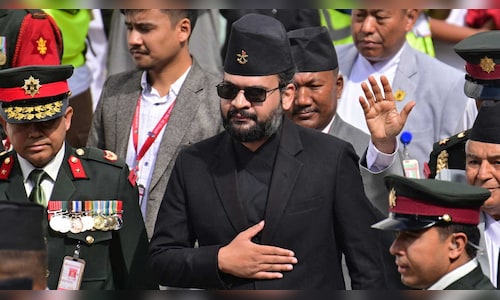
Balen, a former underground rapper and structural engineer who entered politics as an independent disruptor, has allied himself with the Rastriya Swatantra Party (RSP) in advance of Nepal’s March 5 parliamentary elections, marking his most definitive move into the nation’s formal political arena.
Under the agreement announced on Sunday, December 28, Balen, 35, is set to be positioned as the prime ministerial candidate if the RSP wins the election, while party founder and former television anchor Rabi Lamichhane will remain as party chief, as reported by party officials.
This partnership unites two figures who have gained traction outside Nepal’s established political framework — and comes at a time when public dissatisfaction with legacy politics is particularly intense.
That frustration erupted onto the streets in September, when youth-driven protests addressing corruption, governance failures, and economic distress swept across the nation, ultimately compelling Prime Minister KP Sharma Oli to resign. This upheaval, which turned violent and resulted in the loss of at least 77 lives, marked an unexpected political shift for many in Kathmandu’s establishment.
Balen was not an official organiser of the movement, but he became one of its most prominent figures. His calls for restraint after Oli’s resignation, coupled with his assertion that a new generation must author Nepal’s next chapter, resonated deeply with younger voters seeking leadership beyond mere slogans.
Political analysts view the RSP-Balen partnership as a strategic alignment with that sentiment. “Incorporating Balen and his youthful supporters is a clever move by the RSP,” political analyst Bipin Adhikari remarked to Reuters. “Traditional political parties fear losing their young voter base to the RSP.”
The mathematics highlight the potential risk. According to Nepal’s Election Commission, nearly two-thirds of the population is eligible to vote, with a significant portion of new, predominantly young voters emerging after the protests — a demographic shift that could impact tightly contested elections.
Balen’s rise has defied conventional paths.
Born in Kathmandu in 1990, Balen first drew attention through Nepal’s underground hip-hop scene, using politically charged songs like Balidan, Maobadi Laal Salam, and Hami Yuva to critique corruption, inequality, and state neglect long before stepping into public office. This music cultivated a devoted youth following and established him as a blunt, anti-establishment figure outside mainstream politics.
His credibility later led to electoral success when he won the 2022 Kathmandu mayoral election as an independent, defeating candidates supported by major parties — a result signaling a growing demand for alternatives to Nepal’s entrenched political elite and traditional party systems.
As mayor, he built a reputation for directness — often clashing with established interests while positioning himself as an approachable, results-oriented leader. During the transition period post-protests, he also contributed to establishing a temporary political arrangement under former Chief Justice Sushila Karki, aimed at stabilizing the system before the elections.
The protest movement itself was decentralized, fueled by a network of activists, students, and civic groups. Figures like Sudan Gurung, who mobilized young demonstrators through grassroots platforms, helped turn generational frustration into sustained activism. Yet Balen remained a significant elected figure to articulate that discontent from within the system.
For nearly three decades following the reestablishment of multiparty democracy, Nepal’s political authority has largely cycled between the Nepali Congress and the Communist Party of Nepal (Unified Marxist–Leninist), despite the country’s diverse political landscape. While coalition governments have been prevalent, leadership has remained concentrated among the same political class, providing limited opportunities for genuine alternatives.
That dominance is now facing scrutiny. The RSP’s rise is steering Nepal towards what increasingly resembles a three-way political contest. Founded in 2022 by Lamichhane, the RSP positioned itself as a reformist, anti-corruption entity and surprised many by achieving significant parliamentary presence during its inaugural election.
While the RSP had already shown electoral viability, Balen adds mass visibility, youth engagement, and protest-era credibility that traditional parties have struggled to match. Together, they aim to consolidate widespread anti-incumbency sentiment into a unified national challenge.
As Nepal heads into the election season, it does so amid economic uncertainty, institutional fatigue, and a discontented electorate — conditions that have prompted rare public comments from former king Gyanendra Shah, highlighting the depth of national change.
Whether Balen’s shift from protest-era symbol to executive authority will succeed will be determined at the ballot box. What is already clear, however, is that his entry into party politics has transformed the political landscape — indicating that Nepal’s generational uprising is no longer content with pressure from the streets but is now asserting its place within the corridors of power.