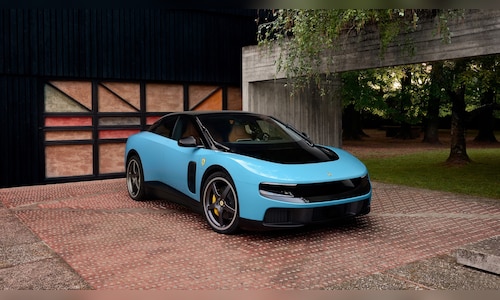
The notion that acquiring the €550,000 ($636,000) Ferrari Luce serves as a prerequisite to obtain other exclusive models has been conveyed through various segments of Ferrari’s collector network, the sources said, speaking on condition of anonymity. Ferrari has historically utilized this allocation strategy to grant repeat purchasers of standard models priority access to limited editions like the $2.1 million LaFerrari Aperta.
“It’s akin to a restaurant where getting a reservation is nearly impossible,” said Max Girardo, founder of the collector-car consultancy Girardo & Co., and a former RM Sotheby’s auctioneer. “If you dine there regularly, they eventually manage to find you a table. With Ferrari, increased purchases elevate your status as a key client.”
The suggestion to buy the Luce comes after the four-door vehicle’s challenging debut last month, which met with significant backlash over its smooth curves and rounded design.
For its inaugural all-electric model, the supercar manufacturer deviated from its usual design team, opting instead for Jony Ive’s LoveFrom studio, Apple Inc.’s former design head, to create the vehicle’s aesthetic. Critics labeled the design as unremarkable, likening it to mainstream models from Honda Motor Co. and Tesla Inc.
Bloomberg interviewed multiple investors and collectors, spanning from Italy to China, to gather information on how Ferrari interacted with clients post-Luce presentation.
One buyer noted that Ferrari made it clear that obtaining the Luce was important for maintaining a position among top clients. Another collector reported that the company is alerting many clients, particularly prospective buyers, that access to an upcoming one-off model might hinge on purchasing the Luce or more affordable entry-level options.
Ferrari confirmed that the company prioritizes clients with “long-term, strong relationships” when selecting buyers “for highly sought-after models, such as limited editions,” according to an email response. “In choosing clients, emphasis is placed on their personal connection to the model, rather than on enhancements to their client ranking.”
The company, producing fewer than 14,000 vehicles annually, has long capitalized on the limited availability of its models as a sales strategy. This approach resonates with luxury brands like Hermes International SCA, which maintains lengthy waiting lists for specific handbags and favors loyal customers who have previously bought less sought-after items.
While presenting the Luce as a means for clients to enhance their status, buyers can also show loyalty through more affordable series-production models such as the Amalfi and 296 GTB, with base prices of around €240,000 and €290,000.
Positioning the Luce as a vehicle that can facilitate future purchases might suggest that the new EV lacks the allure typically associated with Ferrari’s limited-edition cars. This strategy also poses risks for the firm, testing whether devoted buyers are willing to support a vehicle that strays from the traditional combustion engine heritage of the Italian brand.
“Many individuals seem to dislike the car and consider it unattractive,” shared Paul Welch, founder of MillionPlus, an online platform for luxury assets including Ferraris. However, “some are contemplating its purchase merely to gain access to future models and ascend the waiting list – many play that game.”
In the days following the Rome reveal, Chief Executive Officer Benedetto Vigna announced that Ferrari had secured orders from both existing and new clientele.
Although Ferrari stands apart in the automotive industry, the Maranello-based firm has experienced models that fell short in the past. The Mondial, produced from 1980 to 1993, is often referenced as a less successful model, yet even those considered less desirable can achieve a solid reputation among collectors. The entry-level Mondial boasted four seats and a mid-sized V8 engine. Designed for broader accessibility, its extra weight resulted in slower performance compared to typical Ferrari models.
According to research published this month by HSBC Holdings Plc, luxury cars are the top spending category for ultra-wealthy individuals, especially in the Middle East. Ferraris are particularly favored due to their exclusivity, heritage, and potential appreciation in value.
Prices have remained resilient amid a broader decline in the luxury market in recent years. Values for luxury vehicles have risen over 30% in the last decade, surpassing price growth in art and colored diamonds during the same period, as noted in Knight Frank’s 2026 Wealth Report.
Ferrari collectors include David Lee, the owner and CEO of Hing Wa Lee Jewelers in Los Angeles, and Canadian real estate magnate Luc Poirier.