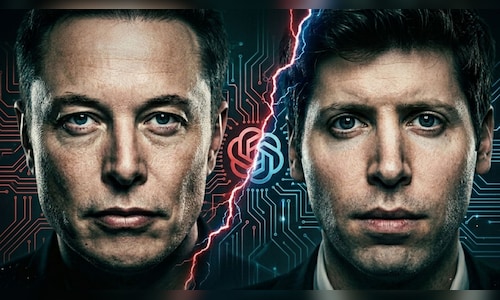
Musk’s lawsuit claims that OpenAI abandoned its mission to develop artificial intelligence for the benefit of the public, and he seeks billions in damages along with a change in management and strategy for OpenAI, which argues that Musk was fully aware of the situation and was frustrated at not being appointed CEO.
William Savitt, representing OpenAI, informed Musk that his inquiries regarding the tax advantages of his $38 million donations to OpenAI and the company’s corporate structure were intended to be straightforward, and Musk’s replies should be as well.
“Your questions are not straightforward. They’re meant to trick me,” Musk, CEO of Tesla and SpaceX, addressed a nine-member jury in a federal court in Oakland, California.
This tense exchange followed two days of questioning by Musk’s attorney, during which Musk accused OpenAI, its co-founder and CEO Sam Altman, and President Greg Brockman of initially promising to establish a nonprofit for responsible AI development before transforming into a for-profit organization in 2019 for personal gain.
OpenAI contends that Musk, who aided in financing the company’s initial growth, is motivated by a desire for control and resentment regarding its success after leaving the board in 2018. The company stated that he aims to enhance his own AI venture, SpaceX’s xAI, which is falling behind OpenAI in user engagement.
The organization also argues that Musk encouraged OpenAI to transition to a for-profit model, expressed a desire to become CEO, and prioritized profit over safety during his tenure.
Savitt questioned Musk about an email sent to Altman in 2015 recommending that OpenAI be set up as a for-profit corporation alongside a nonprofit, which was part of an endeavor to indicate Musk’s support for a profit-driven model. Musk claimed that the emails did not reflect his definitive stance.
“Discussions and brainstorming are not agreements,” said Musk, dressed in a dark suit over a white shirt, occasionally glancing at the jurors as he spoke.
In the courtroom audience, Altman and Brockman—who took notes with a red pen on a yellow legal pad—listened closely as the exchanges between Musk and Savitt intensified.
Musk repeatedly requested Savitt to refrain from interrupting him. In response to one of Savitt’s questions, Musk replied, “You tell me.” Savitt retorted, “I get to ask the questions, Mr. Musk.”
Musk is anticipated to return to the witness stand for further cross-examination on Thursday.
MUSK SAYS ALTMAN OFFER ‘FELT LIKE A BRIBE’
This trial underscores the significant rift between Musk and Altman. They co-founded OpenAI in 2015 to serve as a benevolent guardian of AI and to counter competitors, such as Alphabet’s Google. Musk testified that he departed from OpenAI in 2018 to concentrate on Tesla and SpaceX.
Microsoft, another defendant, invested $10 billion in OpenAI in 2023, a move Musk said raised his concerns about OpenAI straying from its original mission.
Jurors viewed text messages exchanged between Musk and Altman following the news of Microsoft’s potential investment. Musk informed Altman that the development felt like a “bait and switch.” Altman replied, “I agree this feels bad.”
JURY SEES ALTMAN’S TEXTS TO MUSK
Earlier on Wednesday, jurors reviewed an email Musk sent to Altman and Brockman in 2017, where he referred to himself as a “fool” for providing funding for what he believed was a nonprofit project.
“What they truly intended was to create a for-profit entity where they possessed as much shareholder ownership as possible,” Musk stated while being questioned by his attorney, Steven Molo.
OpenAI has claimed that the creation of a for-profit entity was necessary to secure private investment for acquiring computing resources and recruiting top scientists.
During cross-examination, Savitt pointed out instances where Altman appeared to keep Musk informed about OpenAI’s plans for a for-profit model and investment pursuits with Microsoft.
Savitt asked Musk whether he had replied to an April 3, 2019, text from Altman asking, “Do you have a few mins to talk about the Microsoft/openai investment?” Musk stated he did not remember if he had responded.
MUSK SEEKS $150 BILLION IN DAMAGES
OpenAI is preparing for a potential initial public offering that could be valued at $1 trillion, according to Reuters. The company also faces increasing competition from rivals, including Anthropic.
SpaceX is expected to go public this year at a valuation that could reach $1.75 trillion.
Musk is pursuing $150 billion in damages from OpenAI and Microsoft, with any awarded amount to benefit OpenAI’s charitable division. He also wants OpenAI to revert to a nonprofit model, with Altman and Brockman removed from their positions and Altman eliminated from the board.
His claims involve breach of charitable trust and unjust enrichment.
Also Read: Japan’s factory output declines as Iran-US war dents demand outlook