In a bid to undermine the prior administration, Chief Minister Joseph Vijay’s government has revealed alarming financial conditions o…


 1/5
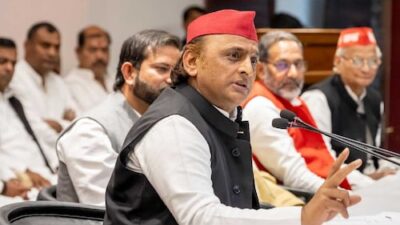
1/5On Monday, the Tamil Nadu government released a White Paper analyzing public finances from FY22 to FY26, comparing them to those of Karnataka, Maharashtra, and Gujarat. A recurring theme is that while Tamil Nadu’s counterparts have strengthened their finances post-COVID, the indicators for Tamil Nadu have worsened. Notably, this initial economic document under Chief Minister Joseph Vijay’s leadership contrasts sharply with his previous critiques of Gujarat’s economic model, governed by his rival party, the Bharatiya Janata Party (BJP), since 1995. The insights from the new White Paper highlight Gujarat’s economic performance positively compared to Tamil Nadu’s. In the image: CM Vijay within the state assembly. Source: PTI.
 2/5
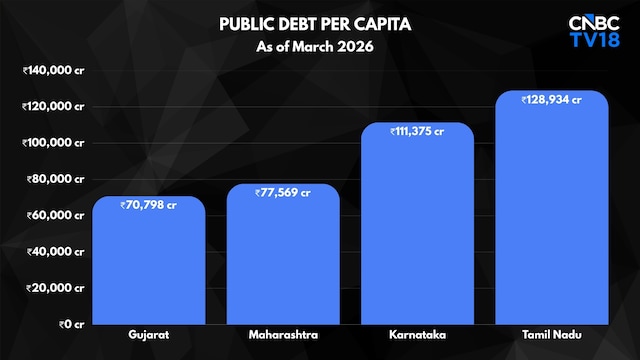
2/51. Outstanding debt has nearly doubled, with no consolidation despite recovery. Liabilities have surged to over ₹13 lakh crore by the end of March 2026, increasing at an annual rate of 14.3%. The debt-to-gross state domestic product (GSDP) ratio has remained between 27-29%, while it has decreased in peer states like Gujarat (17.6%), Maharashtra (19.7%), and Karnataka (23.4%). Per-capita liability rose to ₹1,28,934 in Tamil Nadu, the highest among its peers.
 3/5
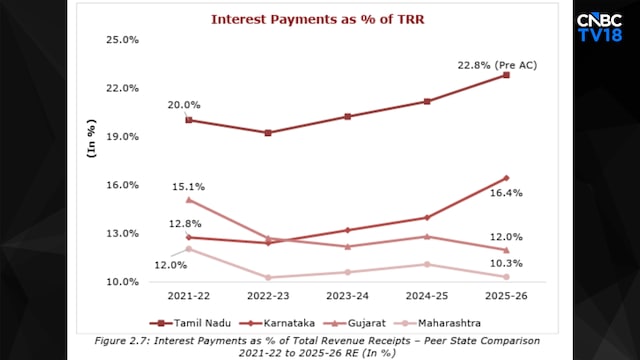
3/52. The state borrows more to service old debt than to invest in new assets. Interest payments have soared by 61% over five years to reach ₹67,050 crore, now accounting for 22.8% of total revenue receipts and 34.8% of own-tax revenue. Expenditures on salaries, pensions, and interest have escalated to 64.4% of revenue receipts (in contrast to under 50% for Karnataka, Gujarat, and Maharashtra combined). When factoring in other non-discretionary expenditures, the state is left with just 13% for growth. TRR in the chart denotes total revenue receipts.
 4/5
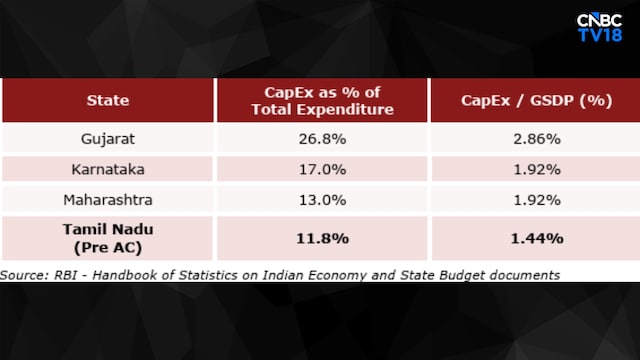
4/53. Tamil Nadu’s interest expenses have surpassed its capital expenditure (capex) since FY18, and it currently allocates the least for capex among peer states. Capex has declined from 1.79% to 1.44% of GSDP even as the debt has nearly doubled, directly jeopardizing the state’s goal to achieve a $1.5 trillion economy. The state is also aging faster than its peers, with a diminishing workforce potentially exacerbating debt levels.
 5/5
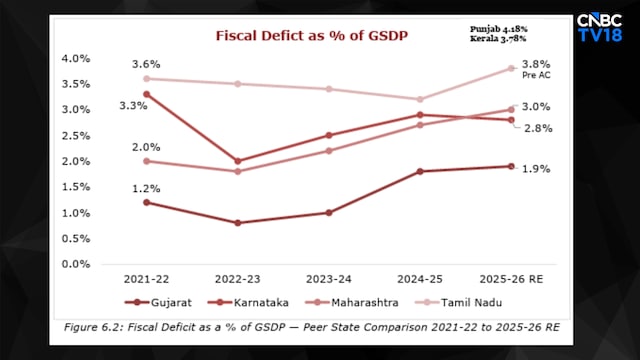
5/58. The state has consistently exceeded its own fiscal responsibility limits, modifying the law repeatedly to permit violations rather than enforce fiscal discipline. The fiscal deficit surpassed the 3% ceiling set by the TNFR Act each year, hitting a peak of 3.77% (₹1,33,208 crore) in March 2026. The Act has undergone 13 amendments, with targets for deficit reduction postponed from FY09 to FY27. Additionally, there remains a persistent disparity between budget estimates and actual figures, which the CAG has highlighted previously.