Should this antimatter encounter regular matter, even for a fleeting moment, it would be obliterated in a brief burst of energy. To investigate this, the experts at the European Organisation for Nuclear Research, commonly referred to as CERN, transported approximately 100 antiprotons over a four-hour period on Tuesday.
The antiprotons were contained in a vacuum within a specially engineered box, held securely by supercooled magnets.
After transferring them from the lab to the truck, the scientists embarked on a half-hour journey to assess whether the minuscule particles could be transported without any leakage. The antiprotons were then returned to the lab in the final segment of Tuesday’s operation.
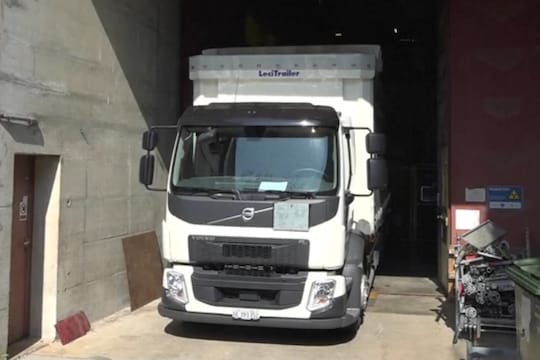
This image shows a truck transporting antiprotons in a first-ever test drive to study antimatter at the European Organisation for Nuclear Research, CERN, in Meyrin, near Geneva, Switzerland.
CERN spokeswoman Sophie Tesauri described the trial as successful. While the total number of antiprotons that survived the journey was unclear, around 91 out of 100 remained intact after the truck’s trip.
The challenge: Handling antimatter, including antiprotons, is fraught with difficulties. Currently understood by scientists, each type of particle has an antiparticle, mirroring the particle but carrying an opposite charge.
Contact between these opposites results in their “annihilation,” releasing substantial energy, contingent on the masses involved. Any unforeseen bumps during the test drive that the specialized box couldn’t stabilize could compromise the entire operation.
Tuesday’s trial is a promising step toward fulfilling aspirations to eventually deliver CERN’s antiprotons to researchers at Heinrich Heine University in Düsseldorf, Germany, approximately eight hours away under normal driving conditions.
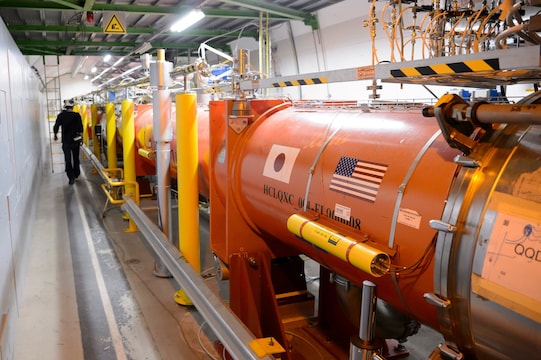
A technician works in the LHC (Large Hadron Collider) tunnel of the European Organisation for Nuclear Research, CERN.
The antiprotons were housed in a 1,000-kilogram (2,200 pounds) container referred to as a “transportable antiproton trap.” This compact design allowed it to fit through standard laboratory doors and be loaded onto the truck. It utilized superconducting magnets cooled to -269 degrees Celsius (-452 Fahrenheit) to keep the antiprotons suspended in a vacuum — preventing contact with the walls, which are composed of … matter.
Experts say the mass involved in Tuesday’s test was slightly less than that of roughly 100 hydrogen atoms, making the worst-case scenario merely the loss of the antiprotons. Even a brief interaction with matter would produce an imperceptible release of energy, detectable only by an oscilloscope, which captures electrical signals.
According to Tesauri, the trap is designed to contain the antiprotons under various conditions, including if the truck halts, accelerates, or has to brake abruptly — all factors considered. However, challenges remain: the trap can only maintain the antiprotons for about four hours, while the journey to Düsseldorf is double that duration.
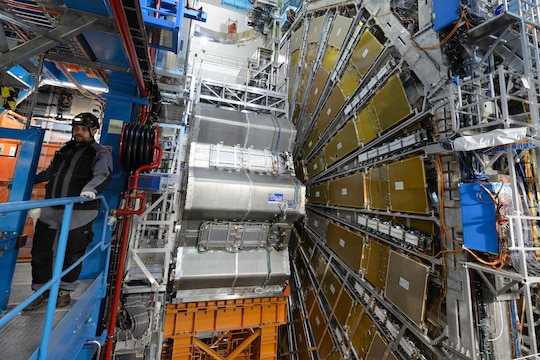
A technician works in the LHC (Large Hadron Collider) tunnel of the European Organisation for Nuclear Research, CERN.
Notably, the Geneva-based center is renowned for its Large Hadron Collider, a sophisticated assembly of magnets that accelerate particles along a 27-kilometer (17-mile) underground tunnel, colliding them at velocities nearing the speed of light. Researchers analyze the outcomes of these collisions.
However, this extensive scientific complex is involved in more than just atom collisions; notably, the World Wide Web was developed here by Tim Berners-Lee of Britain in 1989.
Heinrich Heine University is considered more suitable for conducting in-depth studies on antiprotons, since CERN’s plethora of activities generates considerable magnetic interference, which can affect antimatter research.
Yet, in order to transport these antiprotons safely, they must avoid all contact with any substances on their way.
The Antiproton Decelerator at the center, where a proton beam is directed into a metal block, creates collisions that produce secondary particles, including numerous antiprotons. This facility is renowned for generating low-energy antiprotons for antimatter research.
CERN’s “Antimatter Factory,” according to lab officials, is unique in the world for its capabilities to store and analyze antiprotons.
The center has been conducting antimatter experiments for years, achieving advances in measurement, storage, and interaction techniques. Two years ago, a similar transport of about 70 protons — rather than antiprotons — was executed across CERN’s campus.
This recent operation followed a comparable protocol, but according to Christian Smorra, the leader of the team responsible for the storage and transport apparatus, antiprotons necessitate an even better vacuum chamber.