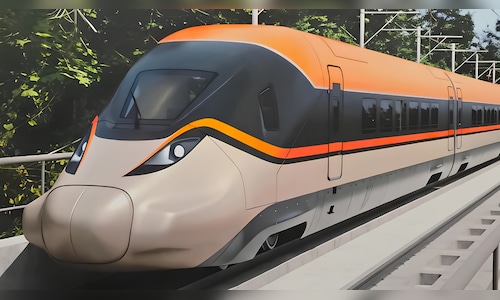
The bullet train initiative in India has received a symbolic public representation at the Ministry of Railways in New Delhi, with a showcase image displayed at Gate Number 4 of Rail Bhavan.
Railway officials have emphasized that the image is merely representational and does not reflect the finalized design. They indicated that this display may be changed if necessary.
The visual representation showcases an orange-and-silver train design akin to the Vande Bharat trains.
Key Details About the Project
The Mumbai-Ahmedabad High-Speed Rail project spans a 508-km corridor, developed with both technical and financial support from Japan.
This route will traverse through Gujarat, Maharashtra, and the Union Territory of Dadra and Nagar Haveli.
Twelve stations are planned, including those at Mumbai, Thane, Virar, Boisar, Vapi, Bilimora, Surat, Bharuch, Vadodara, Anand, Ahmedabad, and Sabarmati.
The bullet train aims to achieve speeds of up to 320 kmph, reducing the travel duration between Mumbai and Ahmedabad to approximately two hours, down from the current 6-8 hours.
The project was officially inaugurated in 2017 by Prime Minister Narendra Modi and former Japanese Prime Minister Shinzo Abe in Ahmedabad.
Initially expected to be completed in 2023, the timeline has been extended due to COVID-19-related delays and various challenges. The full route is now anticipated to be operational by 2027-28, with a target launch date of August 15, 2027.
The Ministry of Railways has also expressed optimism that the first operational section, between Surat and Bilimora, could begin service this year.
Advancement in Tunnel Construction
The initial representative image of the train was revealed shortly after the National High-Speed Rail Corporation Limited (NHSRCL) announced advancements in tunnel construction for the project in Mumbai.
NHSRCL reported that the first Tunnel Boring Machine (TBM) cutterhead was lowered at Vikhroli, located in Mumbai’s eastern suburbs.
This 13.6-metre diameter cutterhead weighs 350 tonnes and represents the concluding phase of assembling the TBM’s primary shield for the high-speed rail corridor.
According to NHSRCL, two TBMs, each exceeding 3,000 tonnes, are being set up to construct a 16-km section of the 21-km Mumbai tunnel.
The tunnel features a 7-km undersea segment beneath Thane Creek, which will mark India’s first undersea rail tunnel.
“The TBMs deployed are the largest ever utilized for rail tunnel construction in the country,” NHSRCL stated in a release referenced by PTI.
A nearly 6-km segment from Vikhroli to Bandra Kurla Complex (BKC) will be excavated using the TBMs, passing under densely populated areas and the Mithi river before arriving at the under-construction BKC station.
Progress on Stations
Earlier this year, Railways Minister Ashwini Vaishnaw informed Parliament that foundation work is complete at eight stations — Vapi, Bilimora, Surat, Bharuch, Anand, Vadodara, Ahmedabad, and Sabarmati.
He noted that 17 river bridges have been finished, with advanced work ongoing on the Narmada, Mahi, Tapti, and Sabarmati bridges in Gujarat. Construction is also in progress on four bridges in Maharashtra.
Depot development at Thane, Surat, and Sabarmati is proceeding well, and civil work at the Bandra Kurla Complex station is advancing.
The minister mentioned that excavation work at BKC has reached approximately 91% completion, while the basement slab work at Level 4 has been entirely finalized.
“Initiation of work on the under-sea tunnel (approximately 21 km) has begun, with 4.8 km of tunnel completed between Ghansoli and Shilphata in Maharashtra,” Vaishnaw stated.
Boosting India’s Rail Sector
Officials indicated that the MAHSR project is set to enhance India’s expertise in areas like track construction, advanced signalling, rolling stock manufacturing, maintenance, and project management for future high-speed rail routes.
Under the Make in India and Aatmanirbhar Bharat initiatives, the Integral Coach Factory is collaborating with Bharat Earth Movers Limited to design and produce high-speed train sets with a design speed of 280 kmph.
Land acquisition for the project has been conducted under existing regulations, with compensation and rehabilitation measures coordinated with state governments.
Officials stated that the corridor is designed for high-frequency operations with a substantial passenger capacity.