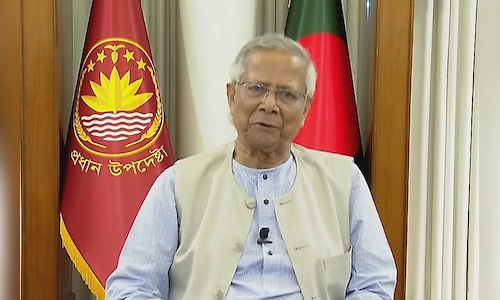
US Representatives Gregory W Meeks, Bill Huizenga, and Sydney Kamlager-Dove have addressed Interim Chief Adviser Muhammad Yunus, cautioning that the suspension of political parties and the revival of the International Crimes Tribunal, which they labeled as flawed, might erode public confidence during this crucial political period.
The lawmakers acknowledged Yunus’s efforts in guiding Bangladesh
through a challenging time, stating, “We appreciate your readiness to step forward in this national crisis to lead an interim government ahead of the February elections.” Nonetheless, they emphasized that an inclusive political process is vital for ensuring the elections are conducted fairly and freely.
The letter raised alarms that the prohibition of political organizations could disenfranchise significant segments of the electorate and undermine democratic legitimacy. The lawmakers called on the interim government to collaborate with all political factions, asserting that successful democratic transitions hinge on allowing citizens to peacefully express their preferences through the ballot box.
They also cautioned that achieving this objective would be challenging if the interim administration proceeded with the suspension of parties or the reactivation of the International Crimes Tribunal. Such measures, they argued, could further diminish the already fragile public trust in state institutions.
In a broader context, the lawmakers referenced Bangladesh’s recent electoral history, noting that the US Department of State and various international observers had determined that the 2018 and 2024 general elections were neither free nor fair.
The letter highlighted a report from the UN Office of the High Commissioner for Human Rights from February, which estimated that approximately 1,400 individuals lost their lives due to actions by security forces during protests in July and August 2024.
On the issue of accountability, the lawmakers remarked, “True accountability for these acts should reflect the values of Bangladesh’s democracy, rather than perpetuate a cycle of retaliation.”
They stressed that the right to freedom of association and individual accountability, rather than collective criminal responsibility, are key human rights, noting that suspending an entire political party contradicts these tenets.
The concerns arise amid recent political shifts, including the banning of the Awami League on May 10, 2025, following the interim government’s prohibition of its activities under the Anti-Terrorism Act. Just two days later, the Election Commission suspended the party’s registration.
Calling for a reevaluation of such actions, the lawmakers asserted that the people of Bangladesh “deserve the opportunity to choose an elected government in a free and fair election that allows participation from all political parties.” They characterized Bangladesh as a ‘critical partner’ of the United States and reiterated Washington’s commitment to collaborate with Dhaka.