This surge aligns with an AI-driven stock market boom in the US. Notably, five of the ‘Magnificent Seven’ tech giants—Nvidia, Microsoft, Meta, Alphabet, and Amazon—poured over $400 billion into developing AI infrastructure, resulting in a 27.5% increase in the stocks of these companies last year.
| Company | Mkt Cap Added In 2025 | Promoter Stake |
| Nvidia | $1.25 trillion | ~3.5% ($150 bn) |
| Microsoft | $446 billion | ~1.13% ($40 bn) |
| Meta | $190 billion | ~13-14% ($215-230 bn) |
| Alphabet | $1.45 trillion | Brin & Page: 87.4% of all Class-B shares ($500 bn+ combined) |
| Amazon | $140 billion | ~8-9% (~$230 bn) |
| $3.47 trillion (Combined) |
The AI-driven boom has given rise to a new breed of AI billionaires. Per Crunchbase, AI startups garnered $100 billion in venture capital in 2025, creating at least 50 new billionaires. Edwin Chen, founder of Surge AI, emerged as the latest ‘AI billionaire’, with a net worth of $18 billion.
Among the top 10 wealthiest individuals in the Forbes Billionaires List, at least four lead ‘Big Tech’ companies. Mark Zuckerberg of Meta was the second richest person in 2025, boasting a net worth of $216 billion. However, the most significant beneficiaries of the AI surge were Alphabet’s founders—Larry Page and Sergey Brin, whose wealth increased by at least $100 billion as Alphabet (Google) hit a $3 trillion valuation last year.
While the total wealth of the 10 richest billionaires reached $2.4 trillion last year, Oxfam pointed out that this amount surpassed the combined fortunes of the poorest half of humanity, roughly 4 billion people. “Corporate empires are generating trillions in wealth for their owners. Extreme wealth accumulation is particularly prominent in the tech industry, which exploits vast natural resources,” stated Oxfam’s report released ahead of the World Economic Forum in Davos.
The report warned that this growing wealth gap could lead to political inequality globally, asserting that more unequal nations are likelier to see democratic decline than their more equitable counterparts. In 2025, Gen Z sparked protests against rising economic disparity and political unrest, exposing vulnerabilities in the political economies of countries like Iran, Nepal, Bangladesh, and Indonesia.
Yet the threat of political inequality is expected to intensify over time. Oxfam reports that billionaires are over 4,000 times more likely to hold political office than average citizens. According to the report, US President Donald Trump’s economic policies resulted in the most significant growth in the fortunes of American billionaires last year, with Trump’s wealth reportedly tripling to $7.3 billion by September 2025, as per a Nasdaq report.
“Data from 136 countries confirms that as economic resources become more unevenly distributed, political power does too. This leads to policy outcomes that align more with the interests of wealthier groups than with those of the lower-income populace,” the report stressed.
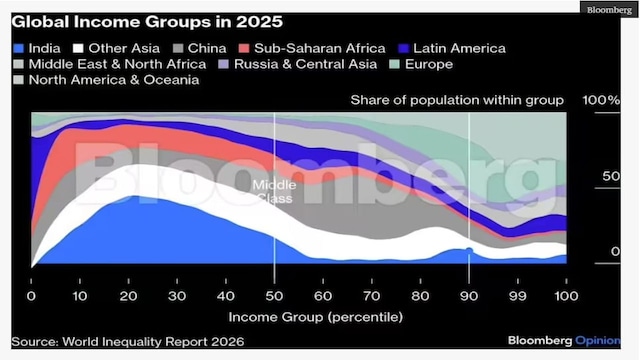
As the rift between the affluent and the impoverished widens, the middle class is diminishing worldwide. According to the 2026 World Inequality Report, global middle-class incomes have seen sluggish growth over the past four decades.
While the lower half has seen relatively solid growth since 1980, the middle 40% have stagnated, with some demographics growing at an annual rate of less than 1%. The report emphasizes, however, that the top 1% has made the most substantial gains during this period.
The decline of the middle class has been most pronounced in India. The report indicates that in 1980, a more considerable segment of the Indian population was situated within the middle 40%, whereas today, nearly all are classified in the bottom 50%.
(Edited by : Priyanka Deshpande)