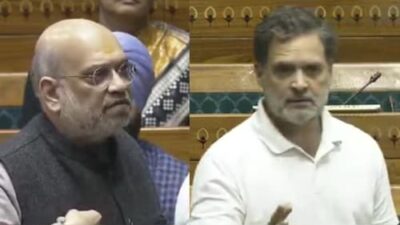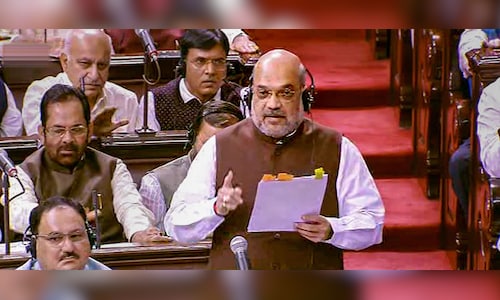
On Wednesday, December 10, Union Home Minister Amit Shah stated that the Special Intensive Revision (SIR) process aims to clean and refine the voters’ list, noting that similar efforts took place during the Congress administration.
In response to comments during the electoral reforms debate, Shah remarked, “The first SIR was initiated in 1952 when Jawaharlal Nehru was Prime Minister,” emphasizing that no party opposed SIR from 1952 to 2004 as it serves as a “method to create a transparent electoral roll.”
Shah explained that SIR is utilized to remove names from the electoral roll of deceased individuals and foreign nationals, questioning whether illegal immigrants should have the right to vote in Indian elections.
He criticized the Congress party, saying, “(The) Opposition is anxious because the citizens of the country do not vote for them, and SIR will eliminate the names of illegal immigrants who support them.”
Shah asserts Parliament cannot discuss SIR
Shah began his remarks by asserting that Parliament cannot debate the SIR issue, as it falls under the jurisdiction of the Election Commission, which operates independently.
“For two days, we conveyed to the Opposition that this matter should be discussed later, after two sessions. But they persisted. We eventually agreed… Why did we say no? There were two reasons for our refusal. First, they requested a discussion on SIR. I am unequivocally clear that SIR cannot be discussed in this House; it is the Election Commission’s responsibility,” he stated.
“India’s EC and CEC do not function under the government. If a discussion occurs and questions arise, who will respond? When they expressed readiness to discuss electoral reforms, we immediately agreed…” he added.
Shah highlights SIRs during Congress rule
The Home Minister referenced SIR activities during Congress rule, noting that no party opposed the initiative, as it is vital for “clean and transparent elections.”
“Our electoral history began in 1952, with the first major revision of the SIR undertaken in that year. Who was the Prime Minister then? Jawaharlal Nehru, from the Congress party. The second revision occurred in 1957, again under Nehru’s leadership,” Shah said.
“The third revision took place in 1961, still under Jawaharlal Nehru and the Congress party. In 1965-66, yet another significant revision happened within just two years, with Lal Bahadur Shastri as Prime Minister, also from the Congress party. Revisions were made during Indira Gandhi’s term in 1983-84. From 1987-89, revisions transpired under Rajiv Gandhi. In 1992-93 and 1995, revisions took place during Narasimha Rao’s tenure,” Shah added.
He mentioned that the revision process started in 2002-03, under Atal Bihari Vajpayee, and was completed in 2004 when Dr. Manmohan Singh was Prime Minister, also from Congress.
“The next comprehensive review is set for 2025, under our government. No party objected to a thorough investigation of SIR until 2004, because this process is crucial for maintaining clean and transparent elections,” Shah concluded.
ALSO READ | Rahul Gandhi to visit Germany from Dec 15-20, meet German ministers